


Want leaders to listen to you when talking about Localization? Start with risk
Many of us who work in this lovely Globalization industry have spent years explaining why quality matters, why context is important, why local review is not a luxury, and why launching in many languages is not just about pushing content through a workflow and hoping everything will magically land well in every market.
I think that works well in certain environments and companies where, for different reasons, the rush to launch products and do so with a high level of quality is not questioned. Of course, the problem is that fewer and fewer companies work this way. Nowadays, it is more common to find companies where launching early is more important than quality. And also, what is quality?
In our industry, we have been talking about quality for decades, and there is still no real consensus. Of course, poor quality is easy to spot: a clear grammar mistake, a confusing expression, truncated text, etc. But then we have the whole grey area: text that sounds strange, that does not sound engaging, situations that, at the end of the day, fall into the category of subjective linguistic quality.
If we, the people working in this space, sometimes struggle to agree on what good localization quality means, imagine a product owner or an executive leader who is involved in 1000 different things and needs to make many micro-decisions every day.
Every now and then, depending on the experience and knowledge of some of my stakeholders, I find myself pulled into conversations that will probably sound familiar to many of you:
Why does Localization need this much time? Why do we need more resources? Can we do it faster? And now, with AI, shouldn't this be cheaper, quicker, and easier?
It is not strange that these questions bother us. It is not strange that our first reaction is to explain the localization process, and that we start talking about quality, content readiness, linguistic QA, and many other things. And there we have the first problem. We can be perceived as having a defensive mindset. All of that is true, of course, but it may still sound too operational for an executive who is mainly trying to understand the business value.
I mean, I think these are not unfair questions. They are business questions. And because they are business questions, I think we need to answer them with a business conversation, not only with a localization explanation.
So I think the approach needs to be different. We should not start by defending every step of the process. We should start by explaining what those steps are meant to protect.
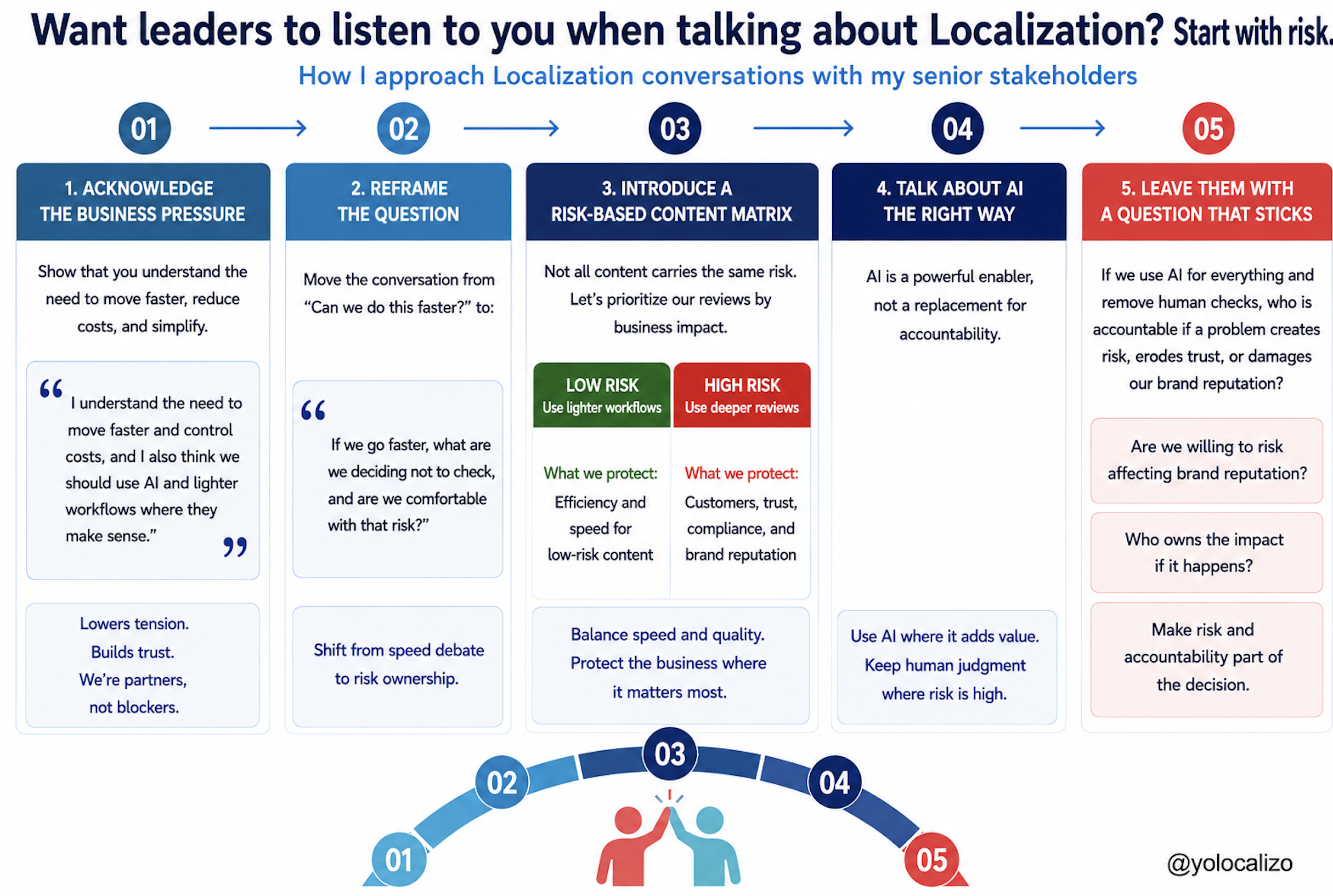
The strategy I use is the following
Click HERE to download the image
1.- First, acknowledge the business pressure. I would not start the conversation by saying that Localization needs more time or that the team is already overloaded, even if both things are true. I would start by showing that I understand the pressure to move faster, reduce costs, and simplify the way of working. Something like: “I understand the need to move faster and control cost, and I also think we should use AI and lighter workflows where they make sense.”
This helps to lower the tension because the executive can see that we are not coming from a defensive position. We are not saying “no” to speed, efficiency, or AI. We are saying we need to understand where speed is safe and where it may create a business risk that will surface later, likely when it is more expensive and more painful to fix.
2. Then, I would reframe the question. When the pushback is “why does Localization need this much time?”, I would avoid answering only with “because we need enough time for translation, review, and linguistic QA takes time….” That answer is technically correct, but it doesn't move the conversation forward enough. A stronger answer is: “I would try to move the conversation away from 'can Localization do this faster?' and into something more useful: 'Ok, if we go faster, what are we deciding not to check, and are we comfortable with that risk?”
That is the key shift. The conversation is no longer about whether Localization is slow or fast. The conversation becomes about risk ownership. If we reduce time, what are we actually removing? Are we removing in-context review? Are we removing final QA? Are we removing human review of AI output? There is a risk that what we are actually removing is the opportunity to catch an issue before it reaches customers.
3.- Introduce a localization content matrix strategy. This strategy involves categorizing content by business risk: high-risk content (such as legal terms, privacy notices, and payment flows) receives a more thorough review, while low-risk content (such as help articles or marketing updates) can proceed with lighter or AI-driven workflows. By defining what counts as high- or low-risk up front, we can balance speed and quality without treating all content the same.
By using this risk-based content matrix, we not only help reduce time but also build our credibility. It demonstrates to executives that we apply thoughtful prioritization: not every piece of content requires the same rigorous review. This strategic separation ensures efficiency where possible and extra attention where business risk is significant.
We can even go further and use what Chris Voss mentions in his book Never Split the Difference as an accusation audit, where we ourselves say the parts of our ideas or proposals that our interlocutor may push back on more easily. In this context, it would be around the idea that treating all content to be localized across different markets with the same level and quality expectations would be unrealistic and, to be honest, not very strategic.
Some content can move fast. Some content can use AI more aggressively. Some content can go through a lighter review with very limited risk. But there are other areas where the cost of getting it wrong is much higher: payment flows, privacy messages, legal terms, promotions, product claims, cancellation flows, safety information, and so on. We need to be careful when taking shortcuts with this type of content, and we can explain why.
We can explain that we should be careful with this type of content because it is not the same as generic text. If we get a payment message, a promotion, a privacy text, or a cancellation flow wrong, the issue can easily move from “the wording is not great” to “customers are confused,” “support tickets are increasing,” or “Legal needs to get involved.”
So the message to the executive should be clear: “We can move faster where the risk is low, and we should absolutely use AI and automation where they help us scale safely. But for high-risk content, we need human judgment and market validation because the business impact of a mistake is higher.”
Special bonus! How to handle the conversation if it starts moving toward using AI for localization
At this point, with the use of AI and the pressure to adopt it increasing enormously, it is very likely that the topic of using AI as the solution to all “our problems” will come up in the conversation. And well, the truth is that this is not a conversation we should avoid.
So let’s see in the next few paragraphs how we can approach it.
The best angle we can take is to bring AI into the conversation in a calm, non-threatening way, not as a defensive topic. We can explain that AI can help, for sure. We can explain that we agree that it can improve speed, reduce manual work, and make some workflows much more efficient. But AI does not remove accountability. If anything, AI makes the risk conversation more important because it allows us to move faster than our ability to validate what we are publishing.
So I would not respond to the AI's pushback with “AI is not good enough.” That sounds defensive, and it is not the right framing. I would say: “AI can help us reduce effort in low-risk areas, but for high-risk content we still need human review because someone needs to validate that the message is accurate, clear, locally appropriate, and safe for customers.”
And then we can also use the opportunity to leave a question that makes people reflect. For example, if we start using AI for everything, if the pressure to use AI keeps increasing, how are we going to manage accountability if, by accelerating processes or removing human checks, we introduce a problem for our stakeholders that ends up creating a risk, a drop in trust toward our product or our company? Are we willing to risk affecting brand reputation? Who is accountable for that situation if it finally happens?
In conclusion
When an executive pushes back on localization time, resources, or AI, I would not approach the conversation by defending every step of the process. I would approach it with a clear sequence: acknowledge the business pressure, reframe the question from speed to risk, separate low-risk content from high-risk content, explain what disappears when the timeline is reduced, show where AI can help and where human judgment is still needed, connect resources to coverage, present options, and make a clear recommendation.
For me, that is the shift. The conversation is not “Localization needs more time.” The conversation is: “Here is what this time protects, here is what we lose if we remove it, here is where AI can help, here is where we still need human judgment, and here is the level of international risk the business would be accepting.”
That is a much stronger executive conversation, and maybe, just maybe, it helps Localization move from being seen as a delivery function to a strategic partner in international growth.
@yolocalizo

Many companies claim to be customer-centric, but too often that promise stops at English. Surveys and focus groups are run in the US or UK and treated as if they represent the entire customer base, leaving most global customers unheard. In this post, I share a practical framework 5 audit questions to help leaders test if their strategy is truly customer-centric or just a slogan.