


Can a localization professional make everyone happy?
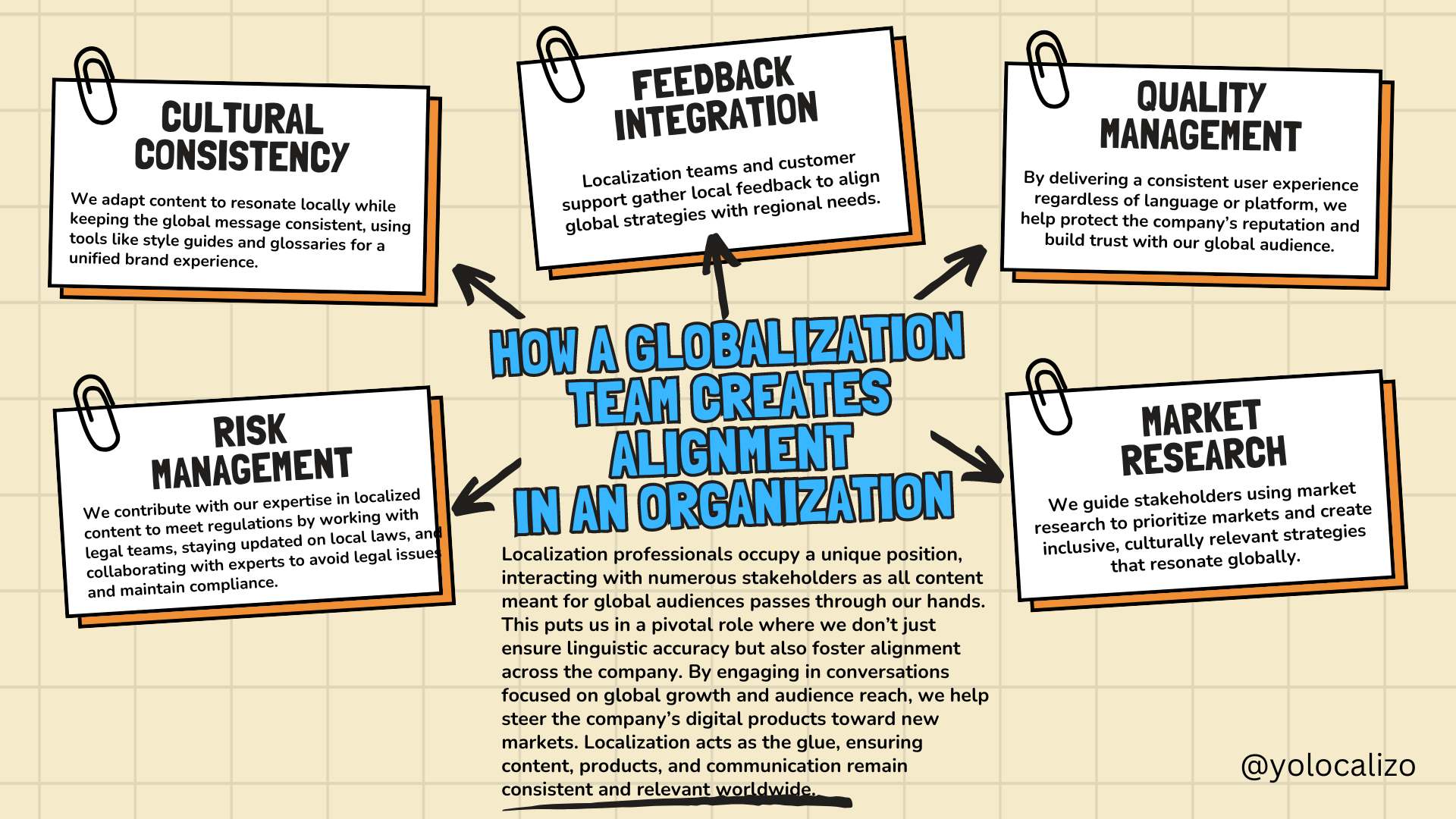
We often describe the role of Localization Managers, Localization professionals, in general, as if it were simpler than it really is. I always thought that we undersell/underestimate ourselves! People say Localization Managers coordinate translation, manage vendors, support stakeholders, ensure quality, and deliver global content on time. Well, that’s not wrong, but there’s more that goes into the role, I would say, and after working in Localization for a while, you realize that managing expectations is a big part of the job. The strategic part of the work of stakeholder management is at least as important as the operational one. Because each stakeholder group comes to Localization with a different expectation. Business teams usually think about speed, impact, and budget. Content owners want to make sure the primary message is not lost. Linguists need enough context to make good decisions. Product and engineering teams want to avoid surprises close to launch. Regional teams care about whether the content feels right in their market. And finance and procurement review costs, savings, vendors, and whether the model makes sense.
I’m not sure if Localization Managers can actually keep everyone happy. Maybe a better question is how we can keep everyone coordinated enough to make better decisions. And this is what I will be covering in this post.
And, to make this post more practical, I want to look at the main groups that usually sit around Localization and what each of them needs from the process. Often, they are looking at the same work from very different angles, and we need to understand their needs to keep them “happy” or aligned, whatever we prefer to refer to them :)
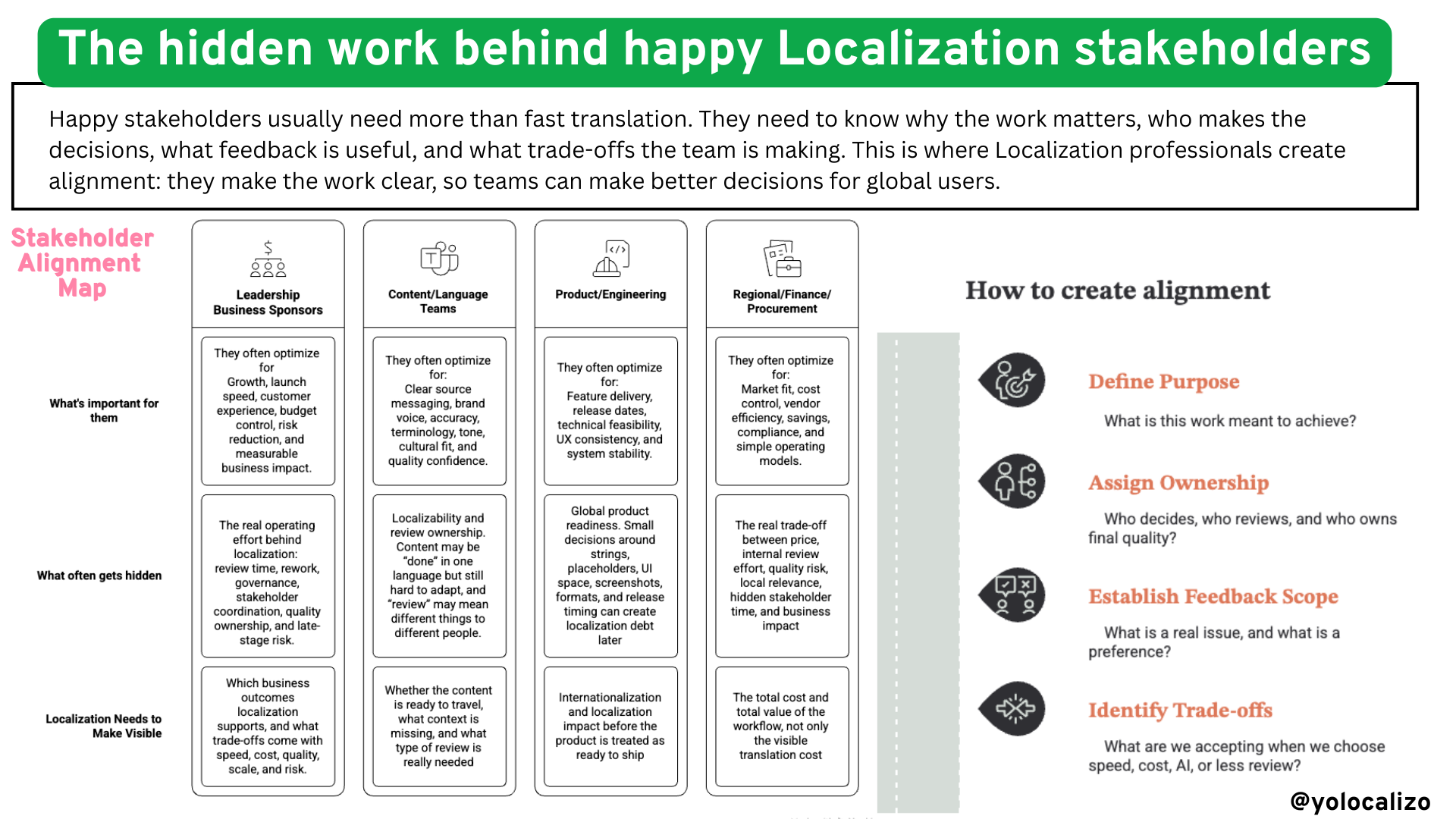
Click HERE to download the infographic
Business sponsors and the leadership team want to see the impact
Business sponsors usually do not need to know every detail of the localization process. Things like translation memories, linguistic QA, vendor workflows, terminology management, and review cycles matter to us. But sponsors often want to know something else: what is localization helping the business achieve?
This is why we need to be careful about how we explain our work. Saying we translated 80,000 words into 12 languages is accurate, but it might not be enough. Explaining that this work helped 12 markets launch with a coherent product message tells a more meaningful story.
AI often comes up here, too. Can AI make localization cheaper or faster? Maybe. Maybe not, it depends on many moving different pieces, but be ready to have an answer in case you get that question (or a similar one!), which nowadays you’ll probably get
Content owners need to prepare content for global use
Content owners shape localization before a translator, or LSP, even sees the content. Often, localization is brought in when the content is already considered “done.” But being done in one language does not always mean it is ready for an international audience.
A sentence might sound great in English but still be hard to adapt naturally. I often talked about this in my blog posts, and I cannot emphasize how important the idea of localizability is. A campaign message could rely on a cultural reference that does not work elsewhere. A UI string may be short in English but too long in other languages. A help article might seem clear to the writer but confusing to a translator who cannot see the product flow.
When the localized version does not work, people often call it a translation problem. Sometimes it is. But often, the problem started earlier. That is why I like to ask if the content is ready to travel: is the message clear, is the terminology stable, is the mood intentional, and is the product context available?
Product and engineering teams need localization to be involved earlier
Many localization issues are not really about language. They are about product readiness: hardcoded strings, text split into pieces, unclear placeholders, no room for text expansion, missing screenshots, or release calendars that put localization at the very end. This is all related to internationalization best practices.
This is why Localization Managers need stronger relationships with product and engineering teams before problems happen. If localization joins too late, the conversation is usually just “how fast can you translate this?” But if localization joins earlier, the discussion can be much more helpful.
Will this flow work in other languages? Will this design handle lengthier text? Will translators understand the string? Are we giving localization enough time before launch? Developers do not need to be localization experts, but they do need to know which product decisions will create extra localization work later.
Regional teams, finance, and procurement need to see clear trade-offs
Regional teams know their market, their customers, and local expectations. They can often tell when a global message sounds strange, too literal, too formal, or just not relevant. That feedback is valuable, but it needs structure. Market insight and personal preference are not the same.
Finance and procurement focus on budget, vendor rates, contracts, tools, savings, and operating models. For this group, this will be important because localization is part of the business. At the same time, we need to be careful not to focus only on costs.
The cheapest word rate is not always the cheapest workflow. A cheaper vendor may require more internal review. A reduced budget may increase risk for high-impact content. A tool may look expensive, but it reduces manual work elsewhere, and moreover, focuses all conversations on price and cost, which sends the wrong message to the business that we are a cost center instead of a revenue enabler, so be careful with that!
So, how do we create alignment?
For me, the first step is to make the purpose clear. Before discussing tools, timelines, vendors, AI, review rounds, or the number of languages, we should first ask what the localization effort is meant to achieve.
The second step is to define ownership. Who owns the source content? Who owns the terminology? Who owns market review? Who owns final quality? Who decides when reviewers disagree? Without this clarity, localization can turn into a slow loop of opinions.
The third step is to separate preferences from real issues. Some comments affect accuracy, legal meaning, brand trust, product understanding, or cultural fit. Other comments are just personal preference. Both matter, but they should not be treated the same way. Subjective feedback is a problem in our industry!
The fourth step is to make trade-offs clear. If we choose to deliver something super fast, what risks are we accepting? If we reduce the review, which content types are safe for that? If we use AI, who checks the output, and what criteria do they use?
Final thoughts
I like happy teams. I like making people happy! But I do not think happiness should be the main goal, because localization always entails balancing speed and quality, cost and risk, global consistency and local relevance, and automation and human decision.
I still like the idea of happy teams, of course. But in practice, I think the work becomes more sustainable when people understand what is needed, who owns what, and what trade-offs we are accepting.
Many companies claim to be customer-centric, but too often that promise stops at English. Surveys and focus groups are run in the US or UK and treated as if they represent the entire customer base, leaving most global customers unheard. In this post, I share a practical framework 5 audit questions to help leaders test if their strategy is truly customer-centric or just a slogan.