


A practical way to build your next Localization strategy
If you work in a corporate organization, there is a good chance that June is not only the month when you realize that half of the year is already gone, which honestly always surprises me.
But anyway, June is also a very important month in many companies because, for some organizations, it is the moment when teams start preparing the strategy for the next fiscal year.
Not every company follows the calendar year from January to December. Some companies start their fiscal year in July, which means June becomes a key planning month. It is the moment when teams look back at what worked, what did not work, what needs more budget, what needs less budget, what needs to be stopped, and what needs to be explained better to leadership.
And if you work in Localization, you probably know what happens next.
Suddenly, many questions start appearing. Do we need more budget? Can we reduce costs? Should we use more AI? Are our workflows still working? Which markets should we prioritize? Are we measuring the right things? And of course, the famous question how are we saving money?
Ouch.
I know strategy season can be exciting, but it can also be overwhelming because it is very easy to jump directly into solutions. Let’s implement a new tool, let’s change the vendor model, let’s use AI for that content, let’s create a dashboard.
And yes, many of those things can be useful. I am not against tools, dashboards, workflows, or AI. But lately, I have the feeling that in Localization we also like to overcomplicate things a little bit.
For these reasons, I want to go back to the basics and explain how I approach this time of the year, when many of us are asked to dust off our crystal ball and create a strategy for the next cycle.
So, let me walk you through the next paragraphs and share what I think are the 5 pillars of a solid Localization strategy.
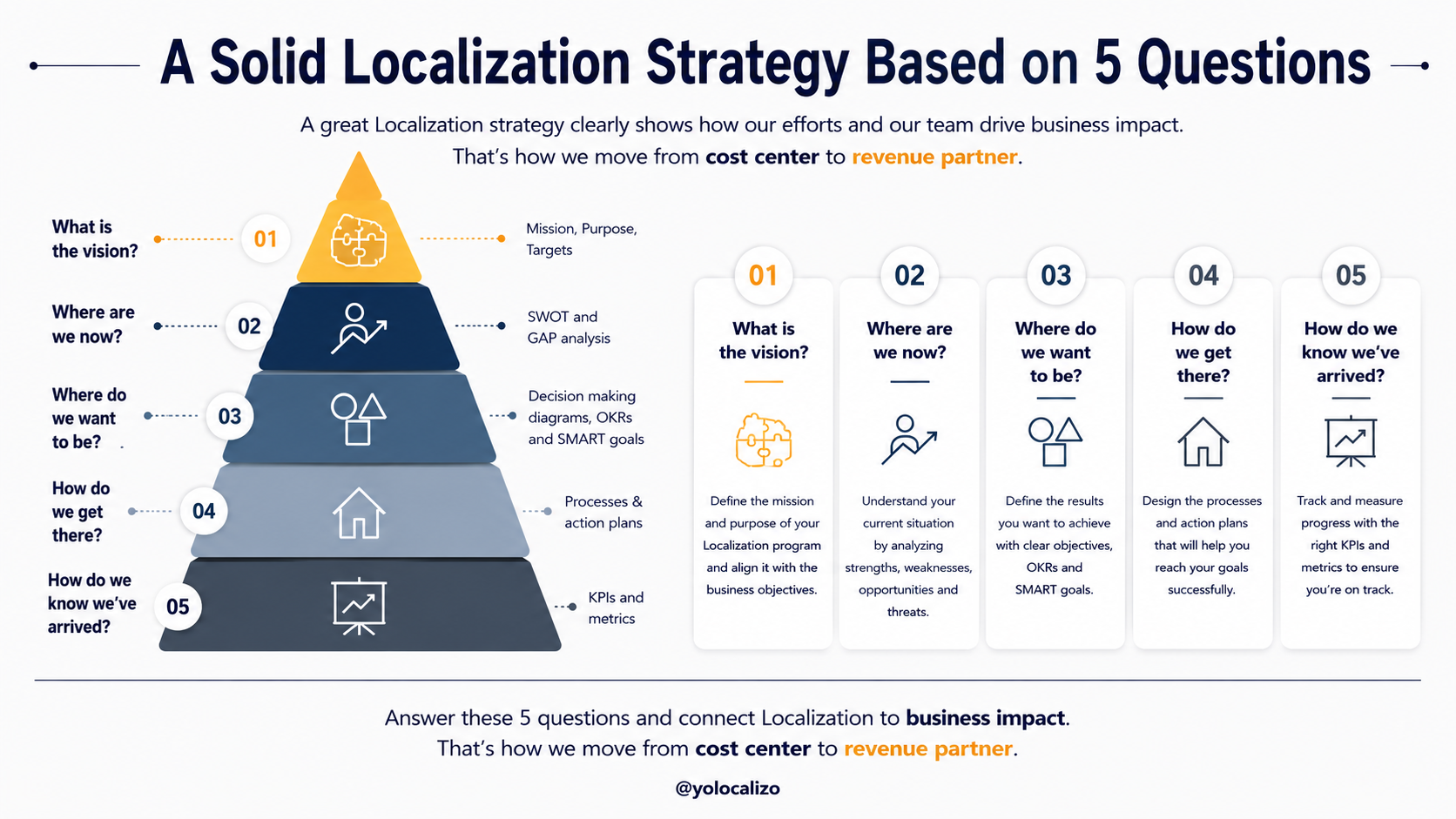
The pillars of a solid Localization strategy are 5.
Click HERE to download the infographic
What is the vision?
The first one is about vision.
In this pillar, we must pause to reflect on the mission of our Localization team and our Localization program. And I do not mean the kind of mission sentence that looks beautiful in a slide but that nobody remembers three weeks later. I mean the real purpose.
What is Localization expected to do for the business? Is it helping the company grow internationally? Is it improving customer experience in key markets? Is it helping regional teams sell better? Is it reducing legal or compliance risk?
All those answers can be valid, but they are not the same answer. Vision gives direction, helps us decide what matters most, and shows us what we should not prioritize.
Where are we now?
Once we know the vision for our Localization program, the next natural step is to understand where we are now. This involves reflecting on our current setup: where the process works well, where it gets stuck, which teams are frustrated, and where we are using manual effort to compensate for a process that is not really working.
This last one is important because in Localization, many things work because people make them work. Someone follows up with the stakeholder, someone fixes the file, someone asks for context again, someone reminds the reviewer, and someone explains for the fifth time why sending screenshots is useful.
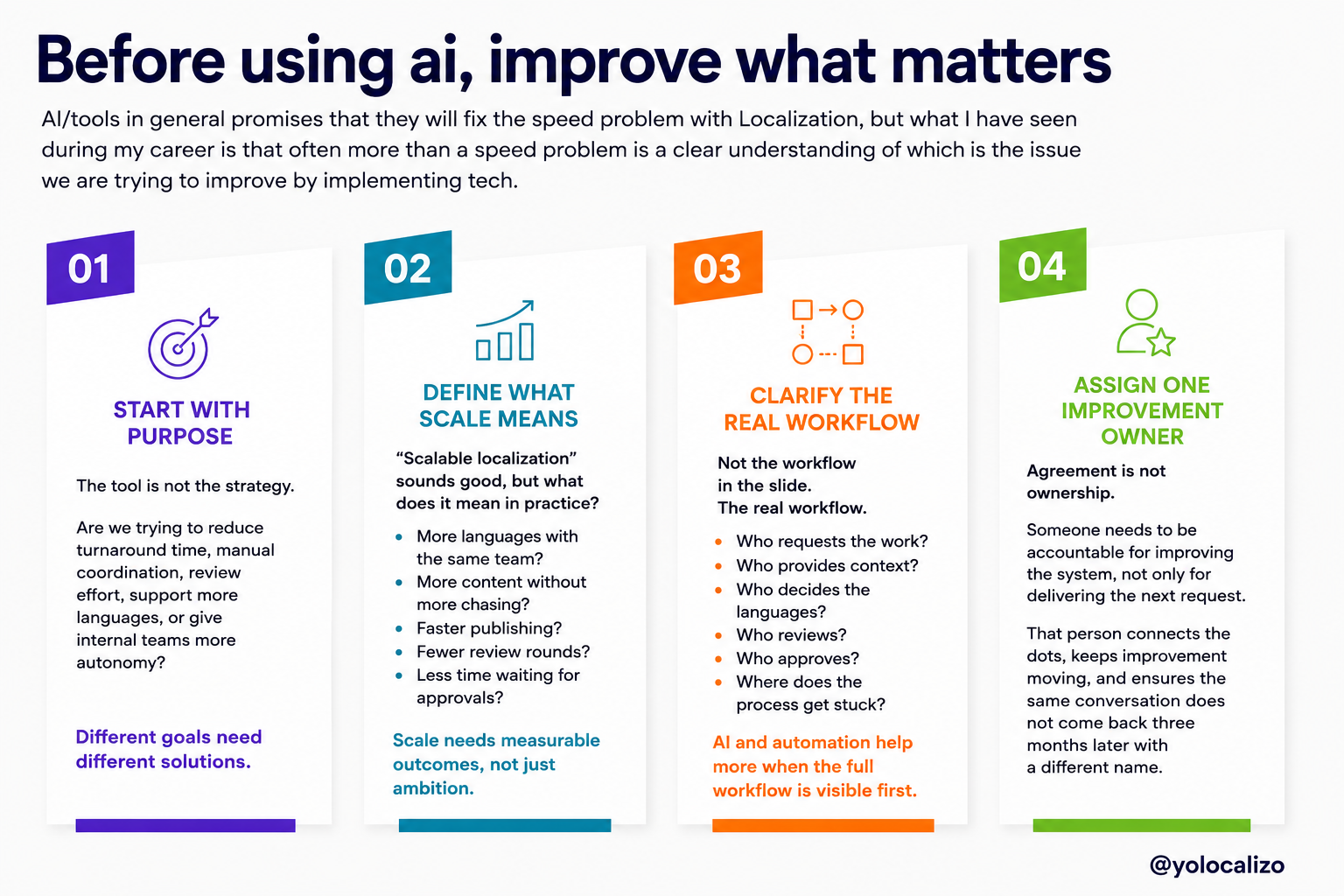
For example, stakeholders may say Localization is slow, but when we look more closely, translation is not the real bottleneck. Maybe the source content arrives late, the request is not clear, or approvals take too long. In that case, making translation faster will help a little, but it will not solve the real problem.
Where do we want to be?
Here, we analyze the results we want to achieve, the problem we are attempting to solve, and the opportunity we are seeking to capitalize on. In short, when we run our Localization program next year… what do we want to happen?
The key to this pillar is to be very clear about the definition of success, because we will not reach our destination if the destination is unclear.
For example, “we want to improve Localization quality” sounds nice, but what does that mean? Does it mean fewer linguistic errors, better brand tone, less reviewer feedback, better customer satisfaction, fewer support tickets, or more consistency across languages?
The same happens with AI. “We want to use more AI.” Ok, but why? To reduce cost? To reduce turnaround time? To support more content? To help reviewers?
AI is not a strategy by itself. It can be part of the strategy, of course, but only if we know what problem we are trying to solve.
How do we get there?
In this section of our Localization strategy fundamentals, we must think about how we will get there.
This is the action part, and usually this is where Localization people feel comfortable because now we can talk about processes, tools, vendors, guidelines, terminology, training, automation, dashboards, quality checks, review models, and governance.
Finally, something we can organize!
But we need to be careful because being busy is not the same as being strategic. It is very easy to create a long list of actions: implement this tool, change this vendor, run this AI pilot, create this dashboard.
All of that may be useful, but the question is: useful for what?
The “how” needs to connect directly with the goal. Different goals require different actions.
How do we know we are making progress?
This pillar is all about KPIs and metrics. In other words, the key is to track and measure.
If we do not measure progress, how do we know if we are moving in the right direction?
In Localization, I am not sure we ever fully arrive. Markets change, products change, companies reorganize, budgets change, business priorities change, AI changes, stakeholders change, and even content changes.
So maybe the better question is: how do we know we are making progress?
Word count, turnaround time, and cost per word are easy to measure, and those metrics are useful. I am not against them, but they do not tell the full story. They tell us about activity and efficiency.
Final thoughts
Sometimes going back to basics is good. It brings clarity because often, more and more and more and more is not always better.
More tools, more dashboards, more workflows, more AI, more reports, and more meetings can sometimes mean only one thing: more things to manage. A busy Localization program is not always a strategic Localization program.
So maybe, before making things more complex, we should go back to the fundamentals.
What is the vision? Where are we now? Where do we want to be? How do we get there? How do we know we are making progress?
Simple questions, but not always easy ones.
Have a great week ahead!
@yolocalizo
Choosing a TMS is not an IT vs Localization decision. Localization understands the business problem and the workflow; IT understands the technical ecosystem. The best result comes when both work together, with clear roles, shared criteria and a selection process that looks beyond the vendor demo.