Featured Posts



Many companies claim to be customer-centric, but too often that promise stops at English. Surveys and focus groups are run in the US or UK and treated as if they represent the entire customer base, leaving most global customers unheard. In this post, I share a practical framework 5 audit questions to help leaders test if their strategy is truly customer-centric or just a slogan.
Choosing a TMS is not an IT vs Localization decision. Localization understands the business problem and the workflow; IT understands the technical ecosystem. The best result comes when both work together, with clear roles, shared criteria and a selection process that looks beyond the vendor demo.
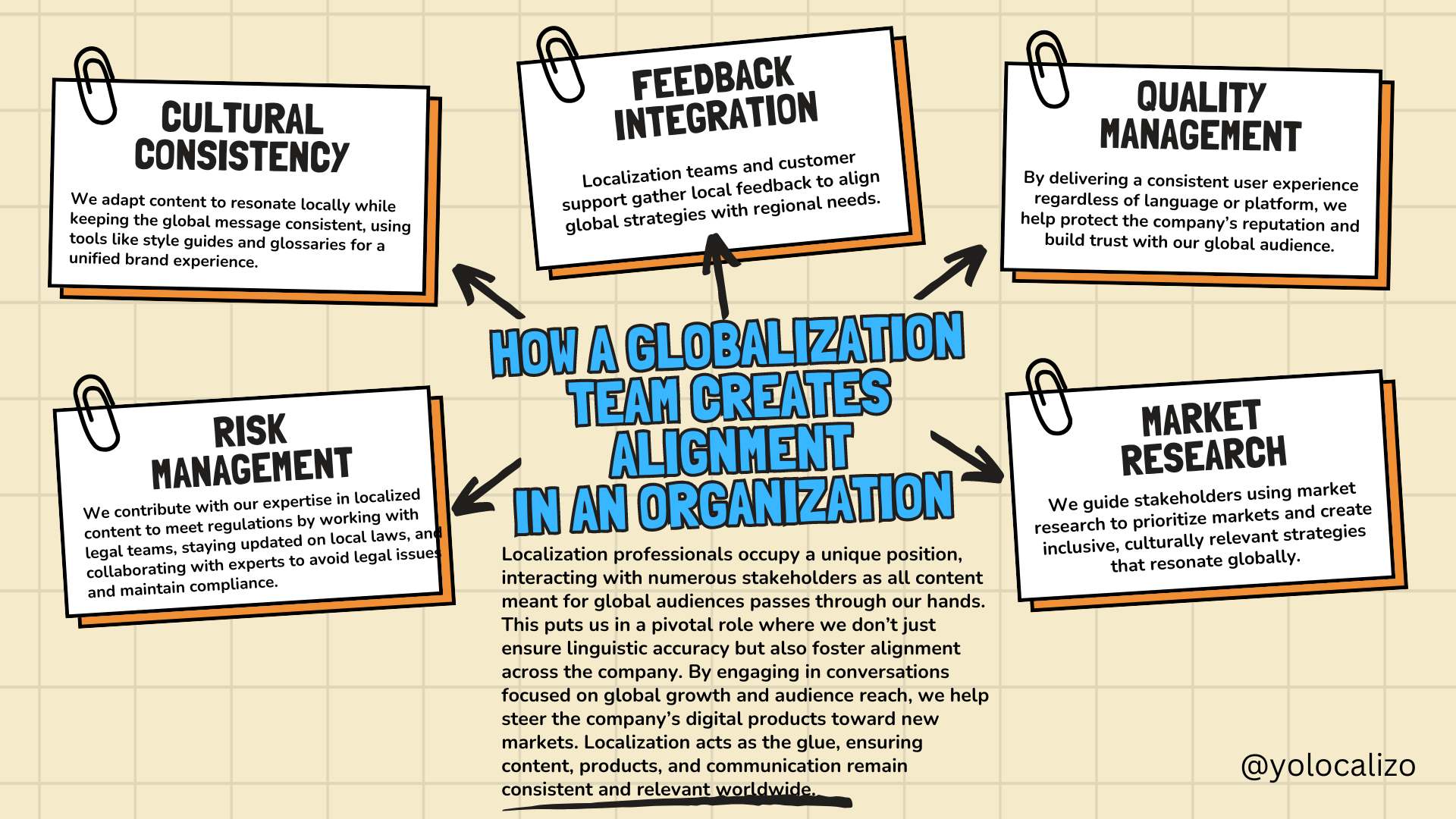
Words have the power to shape perceptions and influence actions, which is why reframing is such a powerful tool. In localization, we can reframe our role from simply translating to driving alignment across the company. By ensuring content is consistent, culturally relevant, and strategically aligned with business goals, localization professionals play a key role in helping businesses grow globally. This post explores how we create that alignment and why our work is much more than just translation.
AI is making it easier for teams to create multilingual content without going through Localization. That sounds very similar to a problem IT has been dealing with for years: shadow IT. In this post, I look at what Localization can learn from that experience and how we can keep visibility, quality and control without slowing the business down
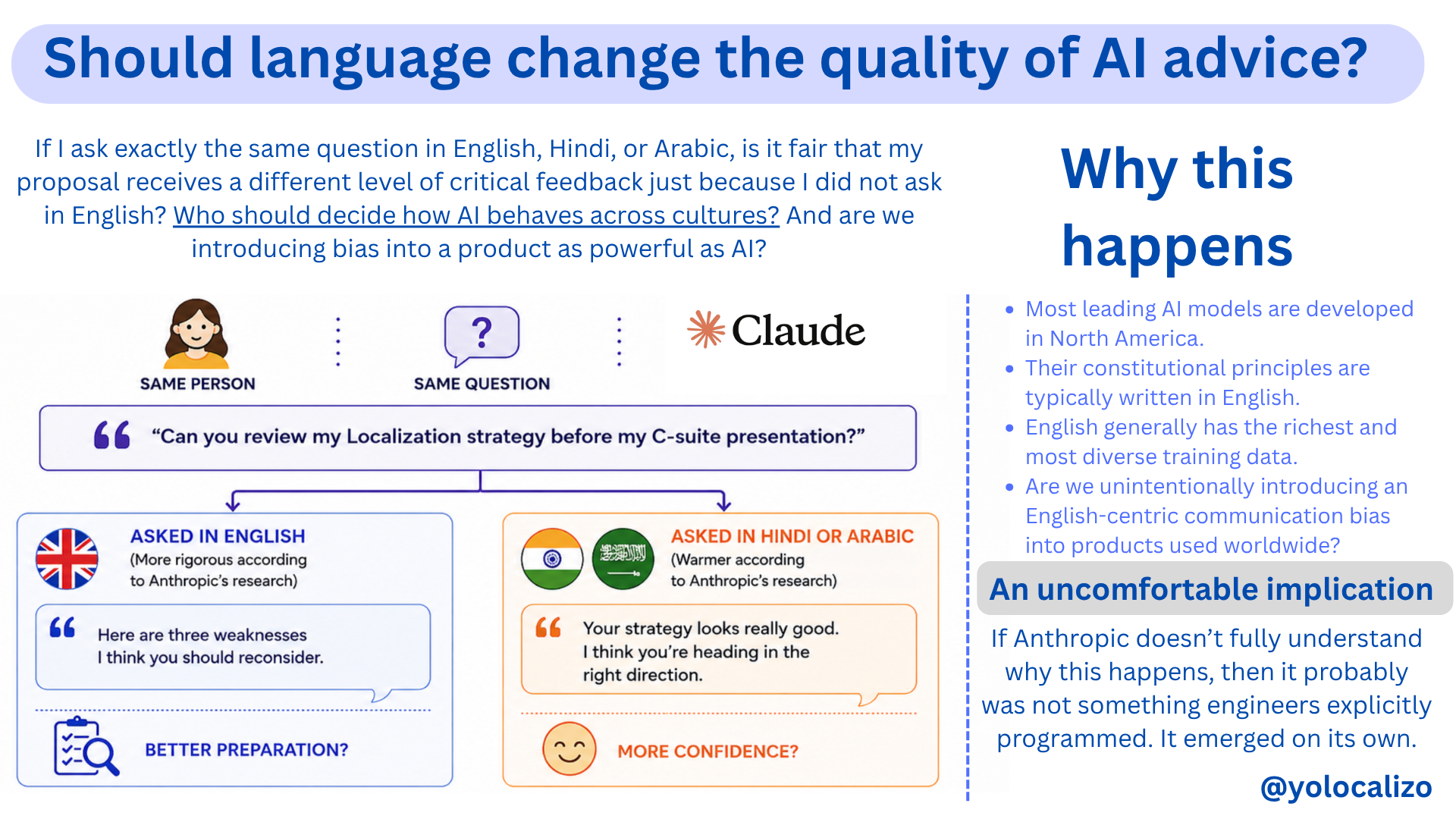
What if asking AI the same question in English, Hindi, or Arabic leads to different levels of critical feedback? Anthropic’s latest research raises fascinating questions about culture, AI behavior, and why Localization expertise may become increasingly relevant beyond translation.
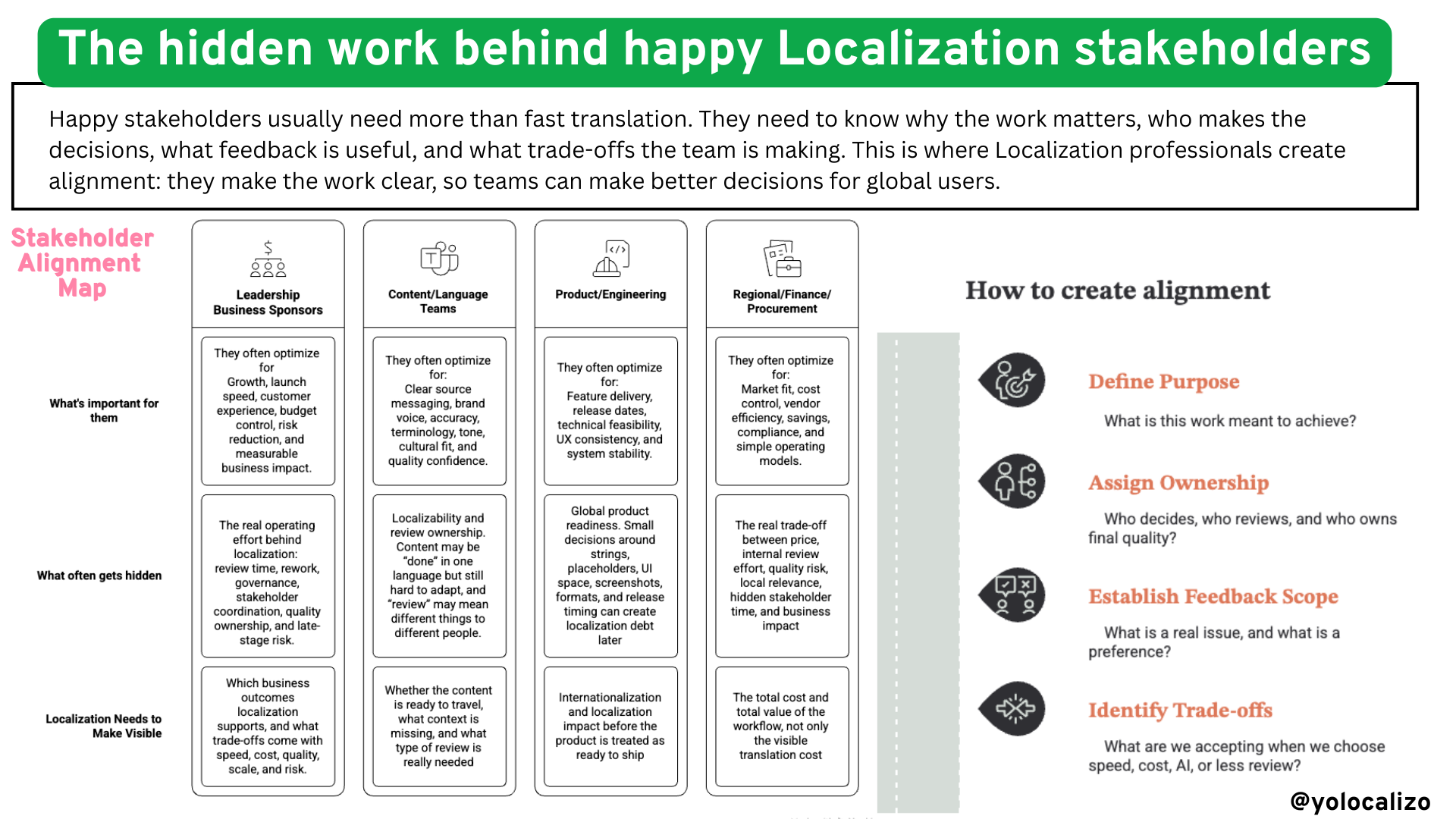
Localization Managers are often expected to keep many stakeholders happy: leadership, content teams, linguists, product teams, regional teams, finance, and procurement. But maybe happiness is not the real goal. In this post, I reflect on why stakeholder alignment matters more, and how Localization can make expectations, hidden work, ownership, and trade-offs more visible
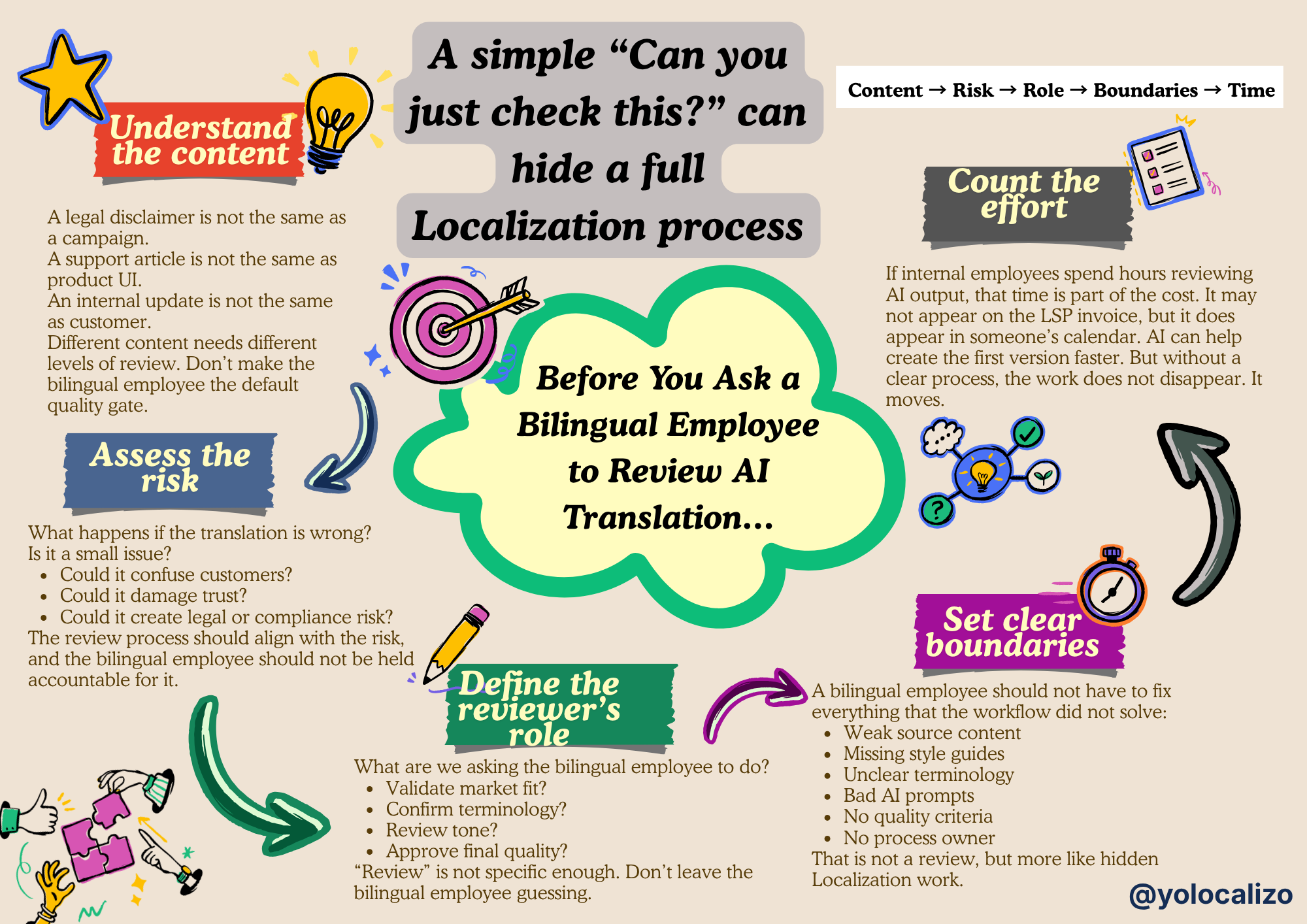
AI can help create the first translation faster, but the work does not always disappear. Sometimes it simply moves to someone else’s calendar. In this post, I reflect on the hidden cost of asking bilingual employees to review AI output without a clear process, role, or quality ownership
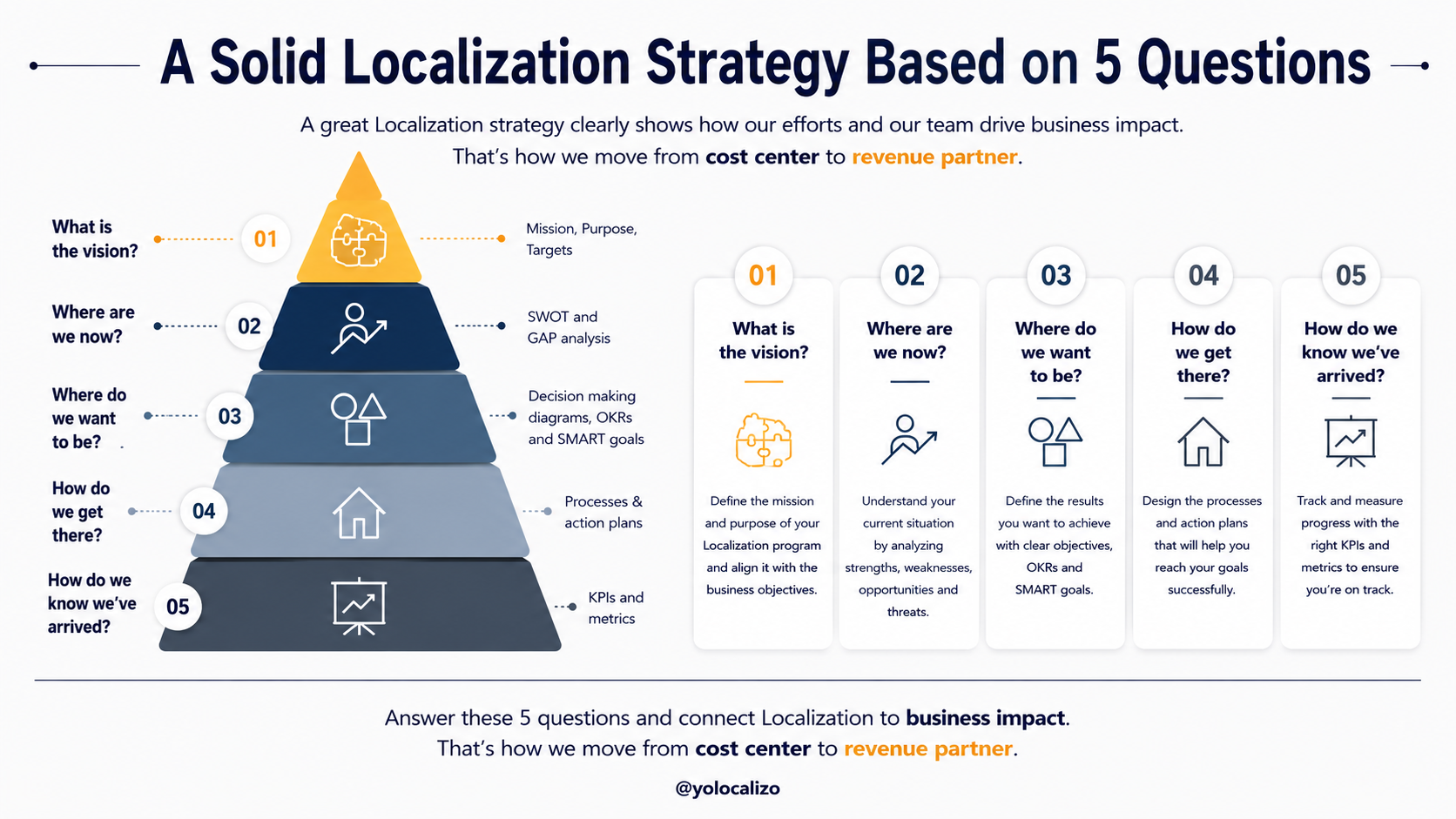
June is strategy season for many corporate teams. And for Localization, this usually means uncomfortable questions about budget, AI, workflows, markets, metrics, and business value. Before jumping into new tools or complex plans, maybe it is worth going back to the basics
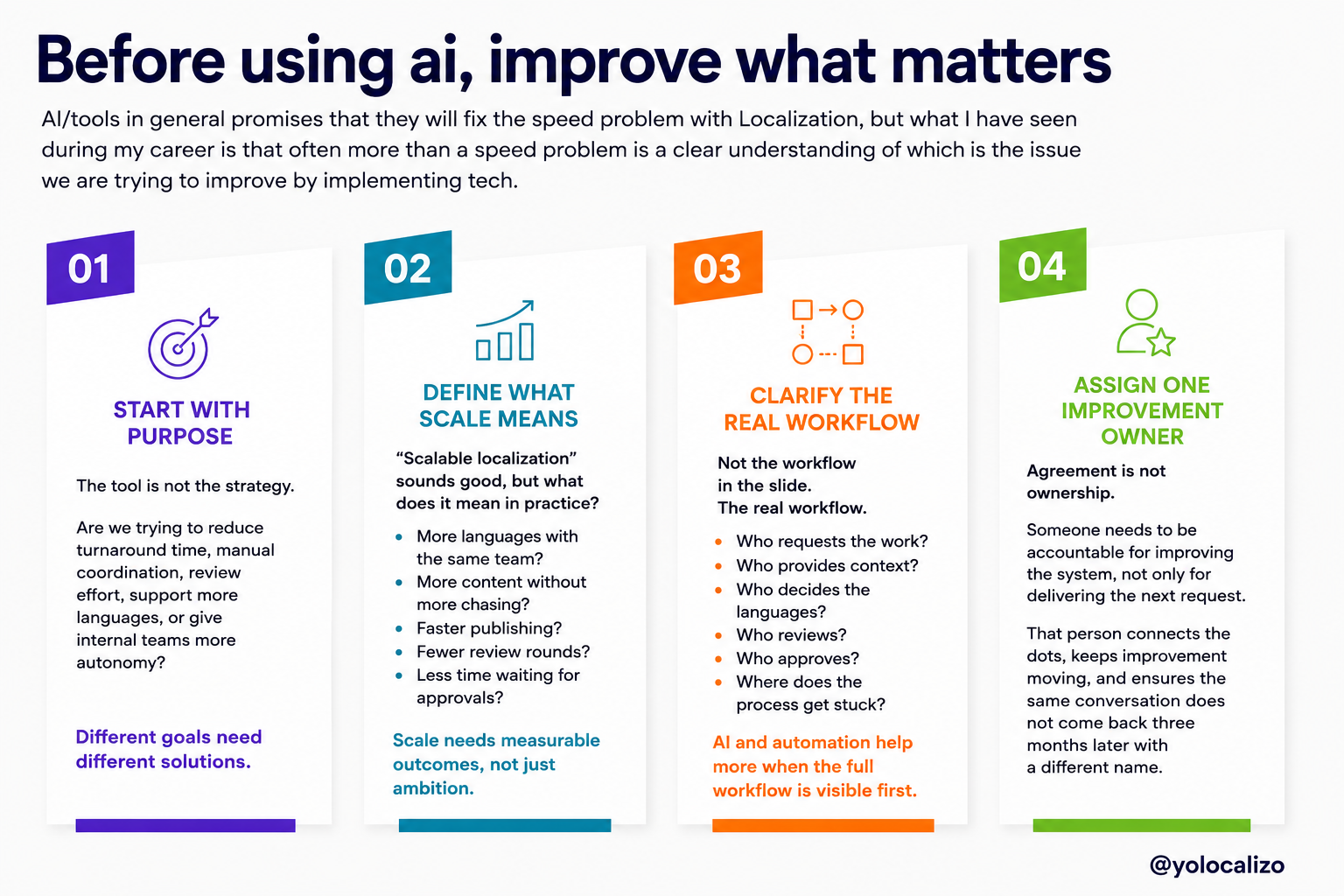
AI promises faster localization, and that message is attractive. But in many teams, the real issue is not speed. The work gets delivered. The harder question is how much hidden coordination, unclear ownership, and workflow complexity it takes to get there.

“Welcome to my blog. The space where I document my passion about Localization, Project Management and Leadership”
I was a team leader by chance, as I was a good Individual Contributor (IC) with knowledge of localization quality assurance and good communication skills. My transition was difficult and bumpy, as I was not ready and did not know the differences between being an IC and a Localization Team Manager. Despite the challenges, my capacity to adapt helped me succeed. To successfully transition from an IC role to a Localization Manager role, one must have the right mindset, be surrounded by skilled professionals, and have a supportive manager. I now understand the differences and want to share my learnings with others.
I was a team leader by chance, as I was a good Individual Contributor (IC) with knowledge of localization quality assurance and good communication skills. My transition was difficult and bumpy, as I was not ready and did not know the differences between being an IC and a Localization Team Manager. Despite the challenges, my capacity to adapt helped me succeed. To successfully transition from an IC role to a Localization Manager role, one must have the right mindset, be surrounded by skilled professionals, and have a supportive manager. I now understand the differences and want to share my learnings with others.
We’ve all heard the saying that “change is always good,” right? Wrong. We don't like change; we don't like to step out of our comfort, but still, change must happen. I've been studying "Change management and resistance to change" in the last weeks because change is the norm in our #localization industry. In this post, I summarized my learnings so far! I hope you find it useful ☺️
Labeling and calibrated questions are techniques used to advance negotiations in high-stress situations like kidnappings. The world of Localization, or leading teams, is also a world of negotiation, not on the level of what an FBI negotiator deals with where it's a life-or-death situation. Localization is important, but not to that extent 😊 however, there are things we can learn to help our efforts to negotiate more time for LQA, additional headcount for our Localization team, and to argue for reducing the price per word/budget etc., to conclude successfully.
And that's what my post is about this week.
A Personal Development Plan (PDP) is essentially a roadmap for our self-improvement journey. It's a way to identify our goals, strengths, areas of interest, areas for growth and then create a plan to enhance our skills and achieve those objectives.
We’ve all heard the saying that “change is always good,” right? Wrong. We don't like change; we don't like to step out of our comfort, but still, change must happen. I've been studying "Change management and resistance to change" in the last weeks because change is the norm in our #localization industry. In this post, I summarized my learnings so far! I hope you find it useful ☺️
Sometimes it seems that leadership skills are something innate, that one is either born with them or can never have them. Also, frequently in different articles and books, it is mentioned as being a manager or a leader. But is that really what is needed to implement an effective globalization strategy? Do we really need to choose between being a manager or a leader to implement localization processes that are solid and efficient? Some food for thought in this post after the summer holiday! 🙂
I was a team leader by chance, as I was a good Individual Contributor (IC) with knowledge of localization quality assurance and good communication skills. My transition was difficult and bumpy, as I was not ready and did not know the differences between being an IC and a Localization Team Manager. Despite the challenges, my capacity to adapt helped me succeed. To successfully transition from an IC role to a Localization Manager role, one must have the right mindset, be surrounded by skilled professionals, and have a supportive manager. I now understand the differences and want to share my learnings with others.
Few things are more frustrating than working on something and not seeing progress. It is something we face sooner or later when we want to improve in some area of our life, but we feel we are stuck.
In this post, I write about the plateau of latent potential, a phenomenon that occurs when our progress is slower than we would like it to be.
Reflection as a leadership skill as part of the Localization community provides us with several benefits: it allows us to learn faster and get up to speed in new situations more quickly. It helps us not make the same mistake twice. And it's super practical to question our assumptions and make better future decisions.
“ If I’m an OK leader, and I want to become a great leader, what do I do? Is leadership an illusion? Can we really motivate individuals trough leadership? How do you influence change? It’s all about leadership, and the great Peter Drucker knew years before us. I love his books, specially The Effective Executive. What a master piece!!”


A multi-market expansion strategy for any product is most effective if the various Globalization (i.e.Localization, Internationalization) activities are understood as a cycle that runs parallel to the multiple phases of software development; This cycle repeats during the various product upgrades. It is not an activity that is executed as if it were a process once the home market version (usually in English) is finalized. It is not a transaction that simply sends files to a professional localizer shortly before the global release. No; Globalization is not a process. Globalization is a cycle that runs multiple times. It is a cycle that runs in parallel with the product research, design, and development phases.