



Start with purpose because the tool is not the strategy
A lot of AI conversations in localization start with the same promise: with AI, we will have faster translation, faster review, and overall faster delivery. Yay!
And I understand why that message gets attention.
Speed is straightforward to explain, easy to promote internally, and simple to measure. If a task takes five days instead of ten, the improvement is clear.
However, I have two concerns with this argument. Speed matters, but I am not convinced it is always the core issue we need to address.
My first concern is that the Localization problem is not that we don’t deliver on time. What I have seen in my career is not that we are slow, so telling that AI will make everything faster makes me wonder if we are already starting off on the wrong foot. The second one is that localization is not just the translation step. Before a file is translated, a lot has already happened. Someone requested the work; the source content had to be ready; the languages had to be confirmed; the priority had to be clear; and the right context had to be shared. Then, after translation, there is still review, approval, and publishing.
And when something goes wrong, someone needs to explain what happened. And in many orgs, that “someone” is not always clearly defined.
So yes, AI may speed up one part of the workflow. And these days, when we talk about using technology to speed up localization, we are often really talking about AI.
But that does not tell the whole story.
If the rest of the process is unclear, making one step faster will not fix the system. The bottleneck will move somewhere else.
This is why starting with the question, “How can we make localization faster with AI?” can be too narrow.
A better question is:
What part of the localization system actually needs to improve?
The workflow is often heavier than we admit
I think many localization teams know this feeling.
Externally, localization may appear to be a straightforward delivery function: content is received, translated, and delivered by the deadline.
However, the underlying process is typically much more complex.
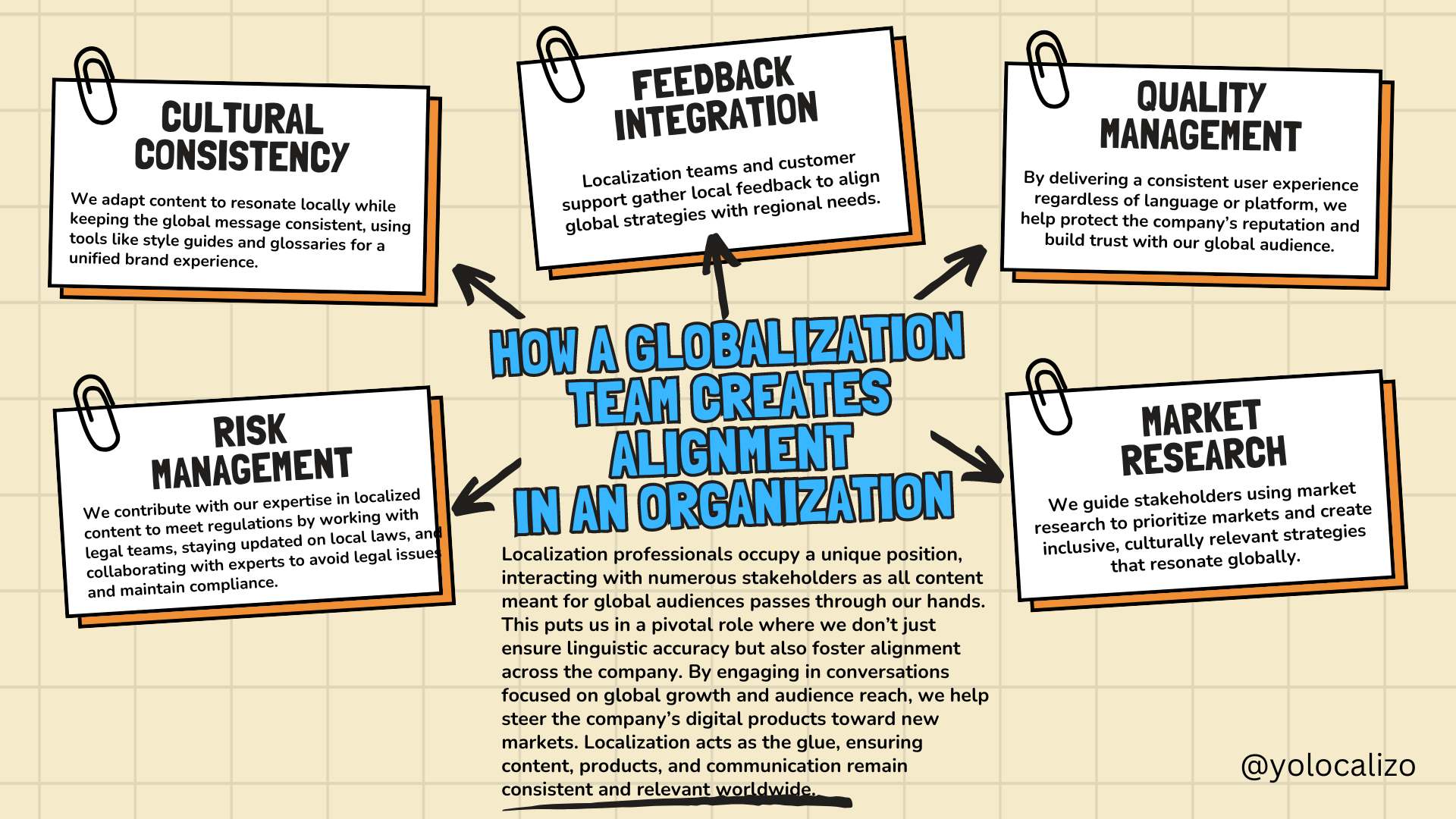
Localization is not only moving files from one language to another. The team is also trying to understand what matters most for each request. And for each stakeholder.
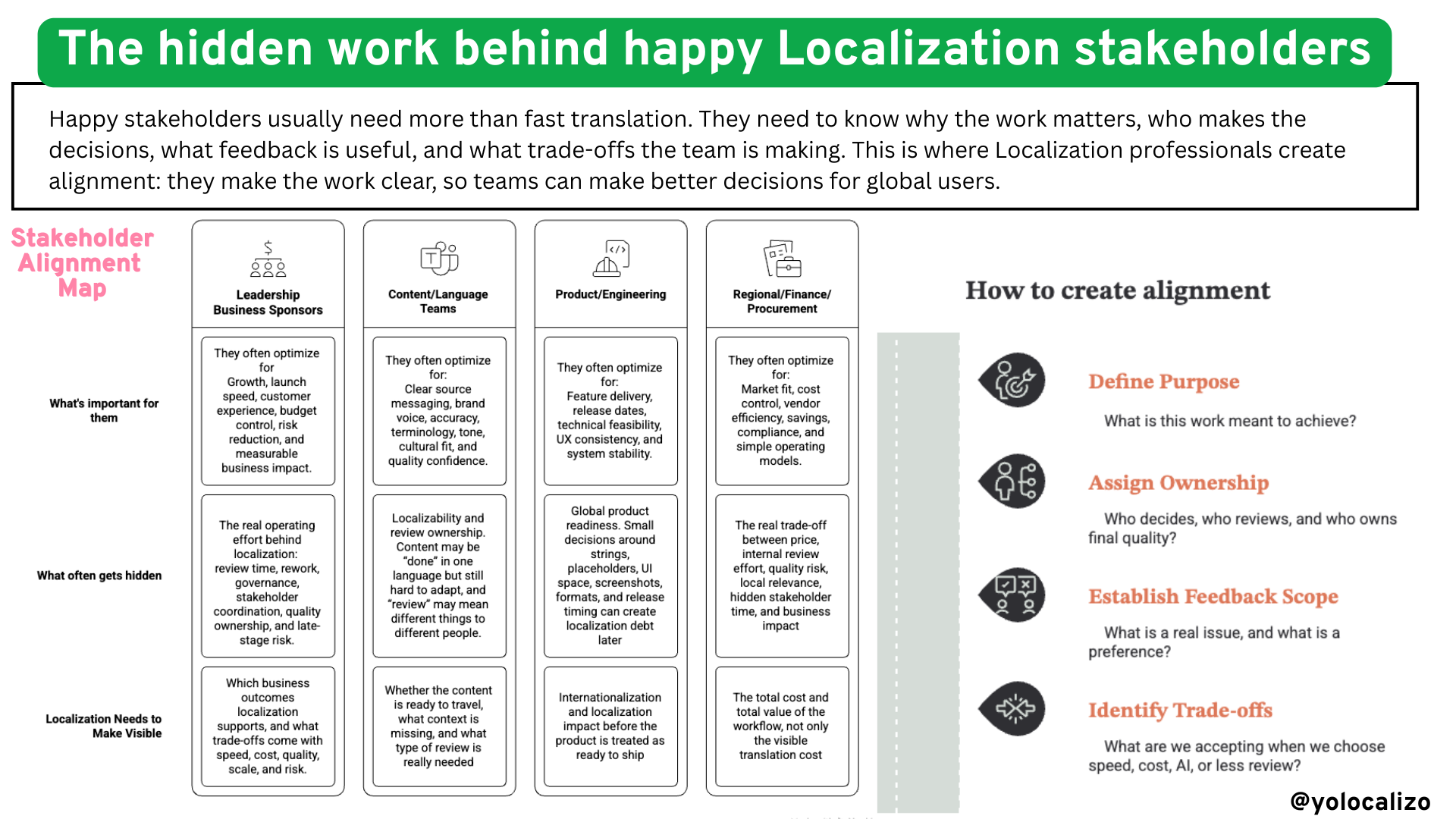
Sometimes different teams care about different things, but nobody has said which priority should lead the workflow.
So localization becomes the place where all those expectations meet. When the workflow lacks clarity, the localization team typically absorbs this complexity. But very often, the issue is bigger than speed. In that kind of situation, the problem is not the tool. The purpose is often unclear.
How to approach it
Click HERE to download the infographic
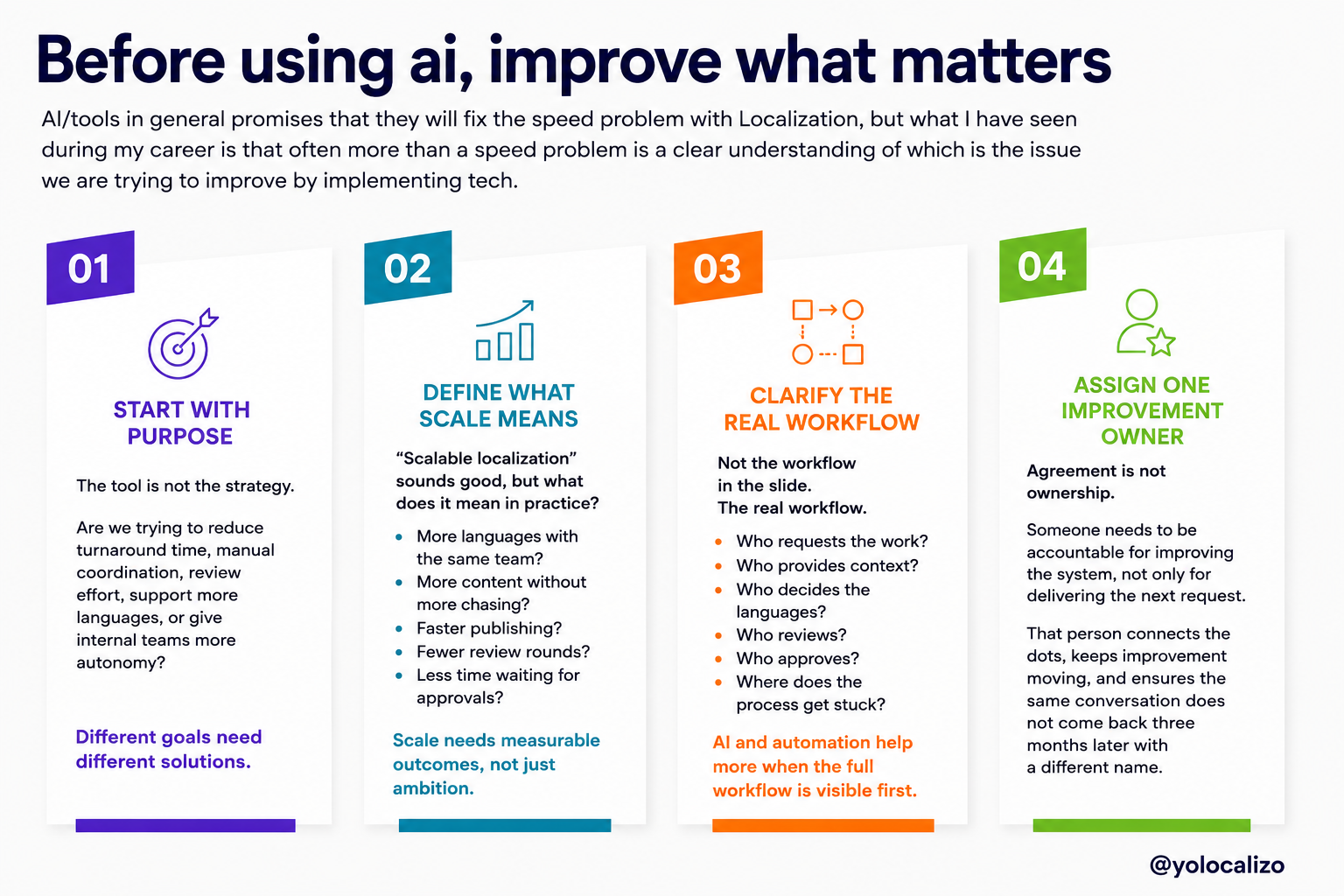
1. Start with purpose because the tool is not the strategy.
Before deciding where AI fits, I would ask what we are trying to improve.
Are we trying to reduce turnaround time? Are we trying to reduce manual coordination? Are we trying to support more languages without increasing the team at the same pace? Are we trying to give internal teams more autonomy? Are we trying to reduce review effort? Are we trying to improve quality for high-risk content?
These are distinct objectives and should not automatically result in the same solution.
This is where many modernization efforts become complicated. The conversation often begins with the tool, but the tool is not the strategy.
2. Define measurable outcomes that are directly linked to scalability.
“Scale” is one of those words we use a lot, and it always sounds good. We say we need to scale localization, build a scalable workflow, or create scalable quality. Yes, of course. But then you ask what that actually means, and the conversation becomes more interesting.
Are we talking about more languages with the same team? More content without more chasing? Faster publishing? Fewer review rounds? Less time waiting for approvals?
Because each answer points to a different problem. That is why I think scale needs to be connected to something real. Not just ambition, but outcomes the team can actually see in the workflow. And no, those metrics may not sound as exciting as “AI-powered localization”. But they tell us something much more useful: whether the workflow is becoming easier to operate, or whether we are just doing more with the same hidden effort behind every delivery.
3. Clarify the end-to-end workflow, owners, and internal customers
This sounds basic, but it is often where the biggest surprises appear. Not the workflow we show in a slide. The real workflow. Who requests the work? Who prepares the source content? Who decides the languages? Who provides context? Who reviews? Who approves? I have seen many situations where the translation step was not the real issue. The problem was everything around it. The source was not really ready. Reviewers were not aligned. The requester did not know what information to provide. The vendor lacked sufficient context. And sometimes the final approver arrived late and changed the direction. In that kind of situation, making translation faster helps, but only up to a point. The full workflow needs to be visible first. Only then can you decide where AI, automation, process changes, or better governance can actually help.
4. Assign one accountable improvement owner
This may sound like a small operational detail, but I think it matters more than we sometimes admit. I have seen this happen many times. Everyone agrees the workflow needs to improve. Everyone sees that there are too many manual steps, that the review takes too long, or that AI could probably help in some areas. But then the urgent work comes back.
And because no one clearly owns the improvement, the conversation slowly disappears. That is the problem. Agreement is not ownership. Someone needs to be accountable for improving the system, not only for delivering the next request. That person does not need to make every decision alone. Localization touches too many teams for that. But someone needs to connect the dots, keep the improvement moving, and make sure the same conversation does not come back three months later with a different name.
Final thoughts
AI is changing localization. No doubt about that. But I think one of the most useful things AI is doing is forcing us to look at our workflows with fresh eyes. If the process is clear, AI can help streamline parts of it and make them easier to manage. If the process is unclear, AI may only add more output, more review, more exceptions, and more questions about who owns what.
So before asking how AI can speed up localization, I would ask something more basic:
What are we actually trying to improve?
Because sometimes the real opportunity is not to make localization faster. Sometimes the real opportunity is to build a workflow that finally makes sense for the scale the business needs today.
@yolocalizo
A multi-market expansion strategy for any product is most effective if the various Globalization (i.e.Localization, Internationalization) activities are understood as a cycle that runs parallel to the multiple phases of software development; This cycle repeats during the various product upgrades. It is not an activity that is executed as if it were a process once the home market version (usually in English) is finalized. It is not a transaction that simply sends files to a professional localizer shortly before the global release. No; Globalization is not a process. Globalization is a cycle that runs multiple times. It is a cycle that runs in parallel with the product research, design, and development phases.