


When you don’t want to wnswer “What’s the ROI of Localization?”
There are moments that, as a localization team lead, I will never forget, even if years have passed. I still remember the feeling. It was the typical weekly status update meeting, where department heads gave updates on how things were going. I remember that when it was my turn, and I mentioned our progress and the work we were doing, I was asked (by a product owner, in a very normal tone) what the ROI of localization was. Nothing dramatic happened. He was not rude. It was just one of those questions that landed on the table, and suddenly I felt frustrated, like here we go again with the ROI topic, ouch! But I nodded, said something polite, and said I would come back with an answer
Then I did what I used to do in those moments. I went back to my laptop, opened spreadsheets, went to Statista to get market data, and went to App Annie (now data.ai) to look at conversion trends, revenue, retention, and anything that could help me build a convincing case. I spent a lot of time doing that earlier in my career. And yes, even when I found useful numbers, something about the exercise never felt right. Not because I had a problem with metrics. Quite the opposite. I find them interesting and useful, and over time, I even learned to enjoy working with them. I learned to build nice dashboards and all that. But the more I worked on those answers, the more I felt I was trying to prove something that did not reflect real life.
Because behind that question, there was another idea hiding … that localization was somehow working on its own, and that if a market was doing well, I should be able to isolate exactly how much of that success belonged to us.
After hearing that question so many times, one day I handled it differently. I did not leave the meeting thinking I needed to go and work on the numbers again. I answered right there. Politely, but clearly.
I said I was happy to talk about impact. I said I was happy to talk about contribution, market readiness, player experience, and the role localization plays in helping a game connect with players in different markets. But I also said I did not think the question was fair in the way it was framed. And then I said something I wish I had said much earlier in my career:
Why is nobody asking the UX team what the ROI of a good user interface is? Why is nobody asking the art designer what the ROI of good art in a game is?
There was a dramatic silence, and, to be honest, I felt uncomfortable after saying it. Not because I was trying to be rude. It was more than that, once I say it out loud, it becomes very hard to ignore. If we think about it, products do not succeed because of one function alone. Usually, many things are working well at the same time.
Let me explain this better with an example from my work in the video game industry these days.
Take a mobile game. If it performs well in a market, what exactly made that happen? Was it only localization? Of course not. It may be that the gameplay was strong, the onboarding was clear, the difficulty curve felt right, the live events kept players engaged, the art style resonated, and the marketing found the right campaign. In many games, even the music, the sound effects, and the overall emotional tone are part of what makes the experience work. Localization is part of that whole. It helps all those elements feel natural, clear, and relevant for players in that market.
So how much of that success can we honestly attribute to localization alone?
The truth is, nobody can answer that in a clean way.
For a long time, I thought that was my problem to solve. Now I think the question was wrong to begin with.
That is the trap. Once you accept the question, you are already in the wrong conversation. You start looking for clean proof that localization created revenue, when deep down you know that is not how products win. Products do well because design, functionality, marketing, timing, and localization come together.
That moment changed a lot for me. From then on, I stopped trying to prove that localization alone had made a market successful. It felt much more realistic to talk about what we had added, where we had helped, and why that mattered. That was the real challenge I was dealing with all that time …. I was trying to answer a question that was too narrow from the beginning. I was looking for a clean answer to something that, in real life, is messy. A product is not the result of one team working in isolation, and localization is no different.
Once I started talking about contributions instead, the conversation improved.
So what do I do now when the ROI question comes up?
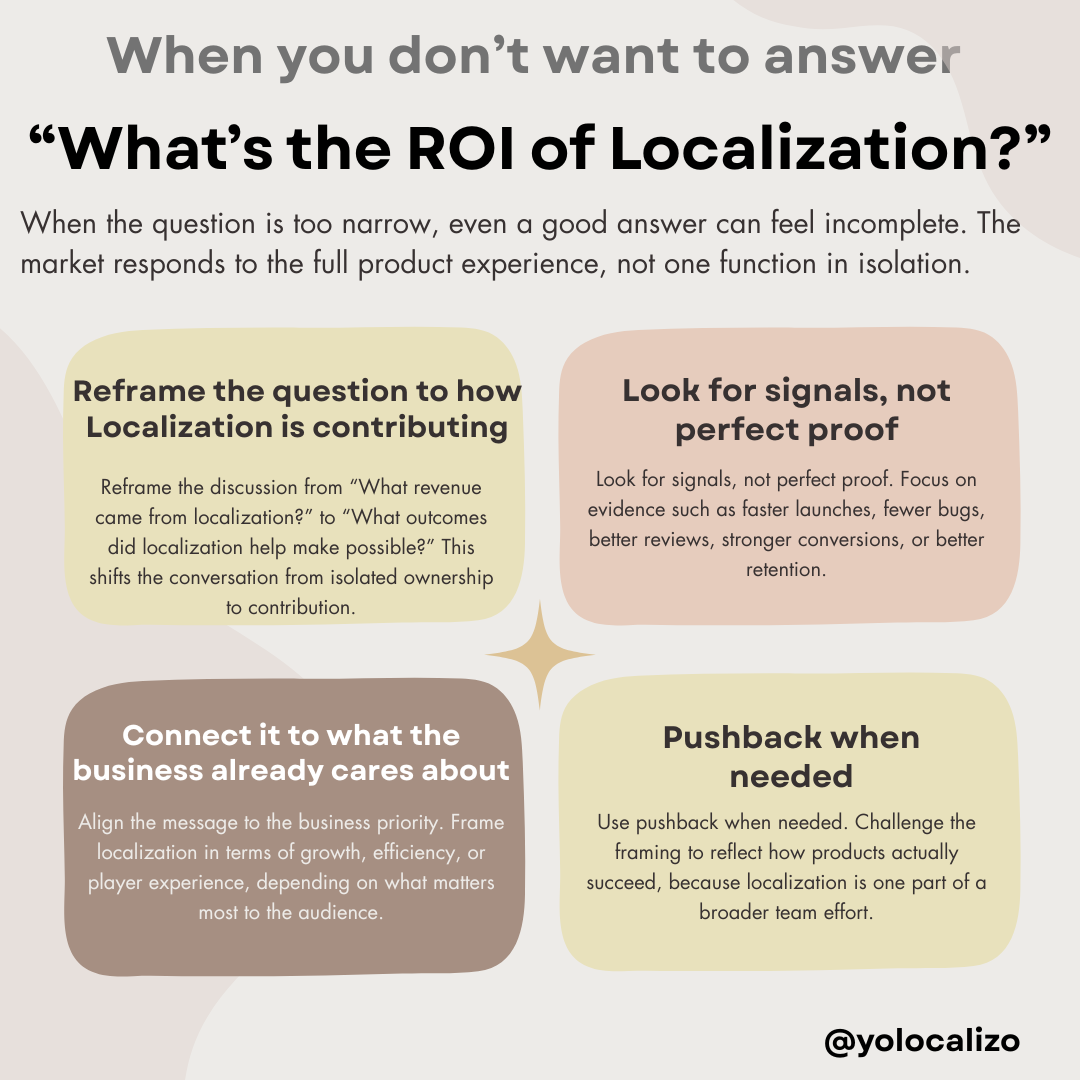
I usually work through it in four steps:
Click HERE to download the graphic
1. I reframe the question to how we are contributing
I try to move the conversation away from “What revenue came from localization?” and toward something more useful: “What outcomes did localization help make possible?” That small change already improves the conversation, because now we are talking about contribution, not pretending a team worked in isolation.
2. I look for signals, not perfect proof
Most of the time, there is no clean number that tells the whole story. So instead of chasing that, I look for signs that localization made a difference. That could be faster launches, fewer LQA bugs, fewer player support tickets, better app store reviews, stronger conversion in localized versions, or better retention in certain markets. Not perfect data, but still useful evidence.
3. I connect it to what the business already cares about
This part matters a lot. If the company is focused on growth, I talk about market readiness and expansion. If the focus is efficiency, I talk about rework, delays, and operational friction. If the focus is on player experience, I talk about trust, clarity, and usability in local markets. Same work, different angle depending on the business priority. All this is about something I often talk about in my blog here …. The idea about learning to speak the language of the business and adapting the conversation to what matters most in each moment, depending on who you are talking to.
4. I push back when I need to
Not to avoid accountability, but to ensure we discuss the work in a way that reflects reality. Products do not succeed because of a single team alone, and localization is part of that picture. Sometimes the most useful thing you can do is challenge the framing before you even try to answer it.
Final thoughts
I still believe localization leaders need to be commercially aware. We need evidence, we need to understand metrics, and we need to explain impact in language the business understands. But I also think we should stop accepting unfair framing so quickly. When the question is wrong, even a good answer can feel off. The market responds to the full product experience. My job was never to claim all the credit. It was to explain what localization added to that experience and why that mattered.
@yolocalizo

Many companies claim to be customer-centric, but too often that promise stops at English. Surveys and focus groups are run in the US or UK and treated as if they represent the entire customer base, leaving most global customers unheard. In this post, I share a practical framework 5 audit questions to help leaders test if their strategy is truly customer-centric or just a slogan.