


The Arrival Fallacy: I’ll Be Happy When People Understand Localization
During the past Christmas holidays, while I was on vacation, I had some time to catch up a bit on the books I had on my Evernote “to read” list. Christmas is a very good time for that. The cold weather around those dates, together with that cozy atmosphere that invites you to stay at home, is the perfect mix to grab a blanket, sit on my IKEA Poäng armchair, and enjoy a slow reading session about a topic that is not related to Localization, because that is what vacations are for!
The book I picked was The Myths of Happiness, a book that had been on my radar for quite some time and that, for one reason or another, I had not started yet. As the name suggests, the book examines different lies and false expectations about happiness across various areas of life: connection, work, money, and so on.
One of the parts of the book that I liked the most is when it looks at the happiness myth behind the pattern of “I’ll be happy when…”. That is a pattern I have unconsciously fallen into many times throughout my life: I’ll be happy when I have a house with two more rooms, I’ll be happy when I have a brand-new car, I’ll be happy when I get the promotion…
In the book, Sonja, the author, explains quite well why that mindset is the wrong one and supports her argument with extensive research. She calls it the arrival fallacy and explains why it does not really work at a psychological level. It is the belief that once we reach a certain point, everything will finally feel complete, stable, and solved.




While I was reading it, I immediately thought about localization.
Maybe because, if I am honest, I have had my own version of that belief for years. At different moments in my career, I thought that one day, localization would finally be fully understood inside the company. I thought there would be a point where people would clearly see what we do, why it matters, and the value we bring. I also thought that once we had the right processes, the right metrics, or the right level of maturity, we would stop needing to explain ourselves so much and could simply focus on the work. It was my own version of I’ll be happy when my stakeholder understand why Localization is important ….
But the more years I spend in this field, the more I think that moment does not really exist.
I do not mean that in a negative way. I mean it in a realistic way. The good thing is that I realized this some time ago, and I was able to change my mindset. I understood that I would probably always need to explain the value of what we do as localization professionals.
I also understood some time ago that the “arrival” of Localization, that moment when people would finally get it, might never actually come.
Why this clicked for me, and what may help if you feel the same
The thing is that organizations do not stand still. People come and go, new leaders join, teams get reorganized, priorities shift, and new technologies change expectations. AI has only made this (even) more visible, because it creates new possibilities but also new confusion about what localization is, what it is not, and what part of the work will still matter in the future.
Understanding that this is just how companies operate gave me a sense of relief. I accepted that, in many ways, it is what it is. The world changes, and organizations change with it.
Every time the context changes, the explanation has to change too. So in that sense, localization never fully arrives. I think many of us in localization carry this quiet belief that one day people will fully understand what we do, often without even realizing it.
We tell ourselves things like: once we have better metrics, people will understand our value. Once leadership sees the impact, we will stop needing to justify the work. Once we are involved earlier, product design will make much more sense for global markets.
I had that way of thinking too, and while reading the book I recognized that same “I’ll be happy when…” pattern in the way I thought about localization. But experience has taught me something else. In localization, understanding is rarely permanent. A team may spend years building credibility with stakeholders. It improves workflows, reduces turnaround times, aligns better with product or marketing, creates visibility, and starts getting invited earlier into important conversations. For a while, it feels like progress has become stable. Then a reorg happens. A new executive joins. The company changes direction. Suddenly, the same questions come back again:
What does localization actually do?
Why does this matter?
Where is the value?
Can AI do this faster?
Do we still need this team in the same way?
When that happens, it can feel frustrating. After all the work done, it is natural to ask why the same conversation is happening again. But maybe that frustration comes from expecting a final point of arrival. And maybe that is the fallacy.
What helps me move forward
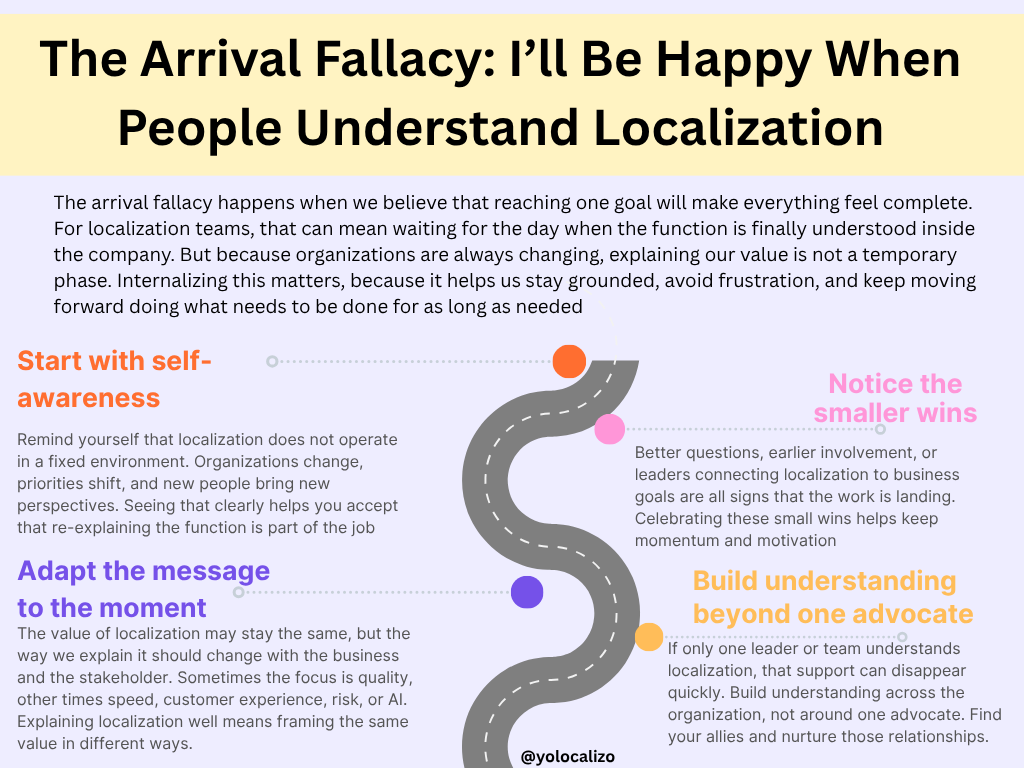
Click HERE to download the infographic
If we accept that localization never fully arrives, then the next question is how to keep moving forward without getting tired of repeating ourselves.
A few things help me.
1. Start with self-awareness
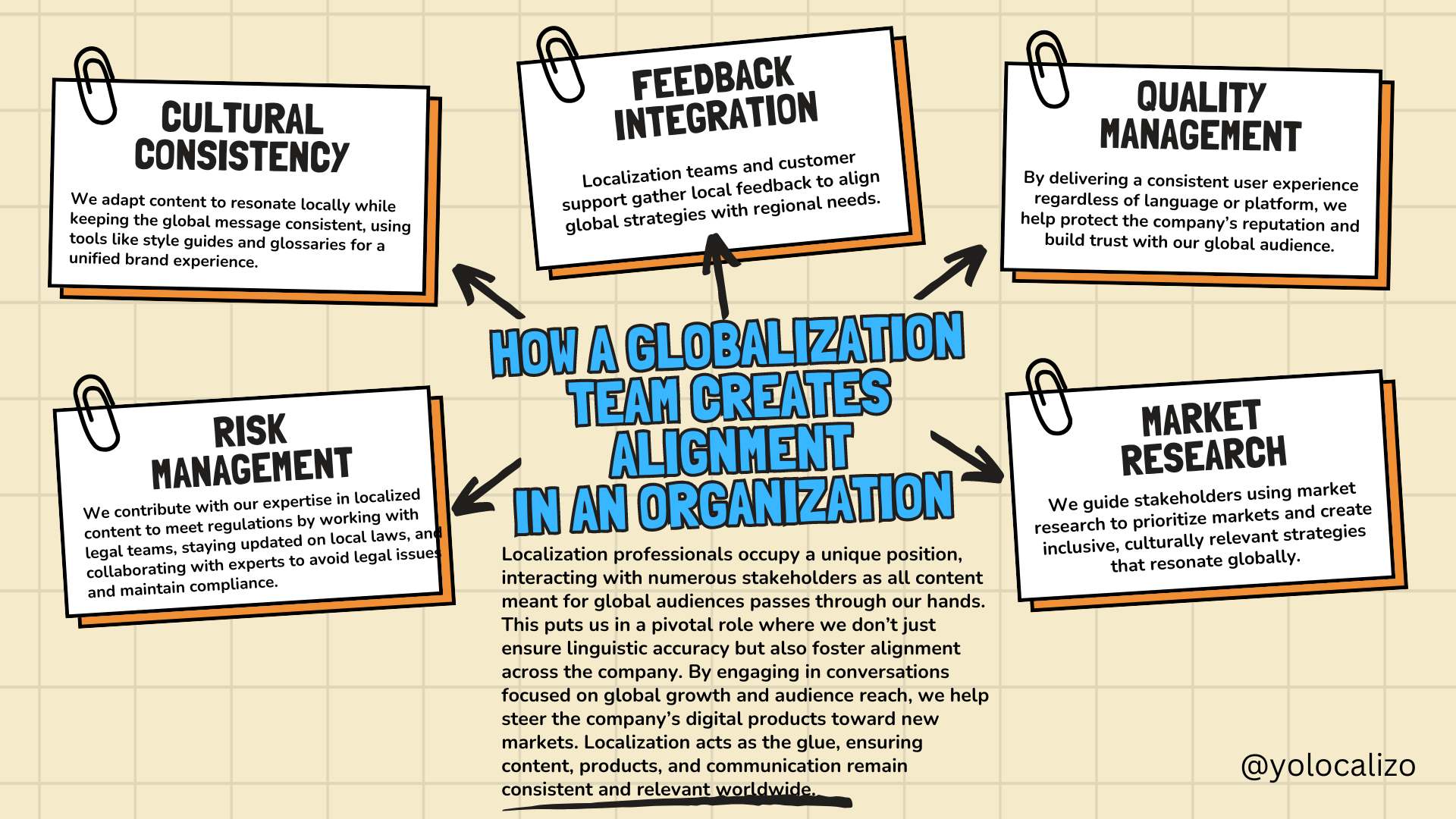
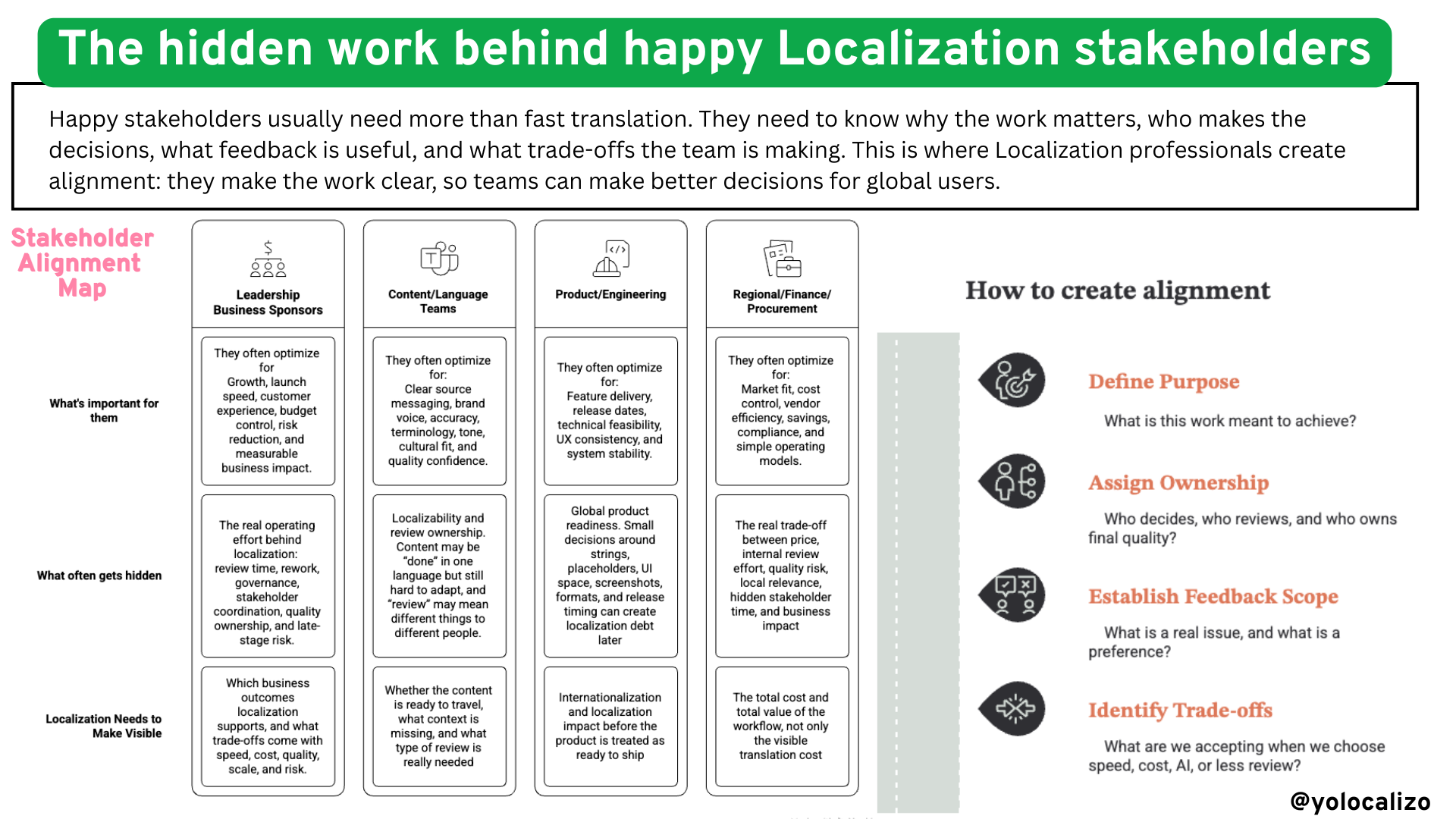
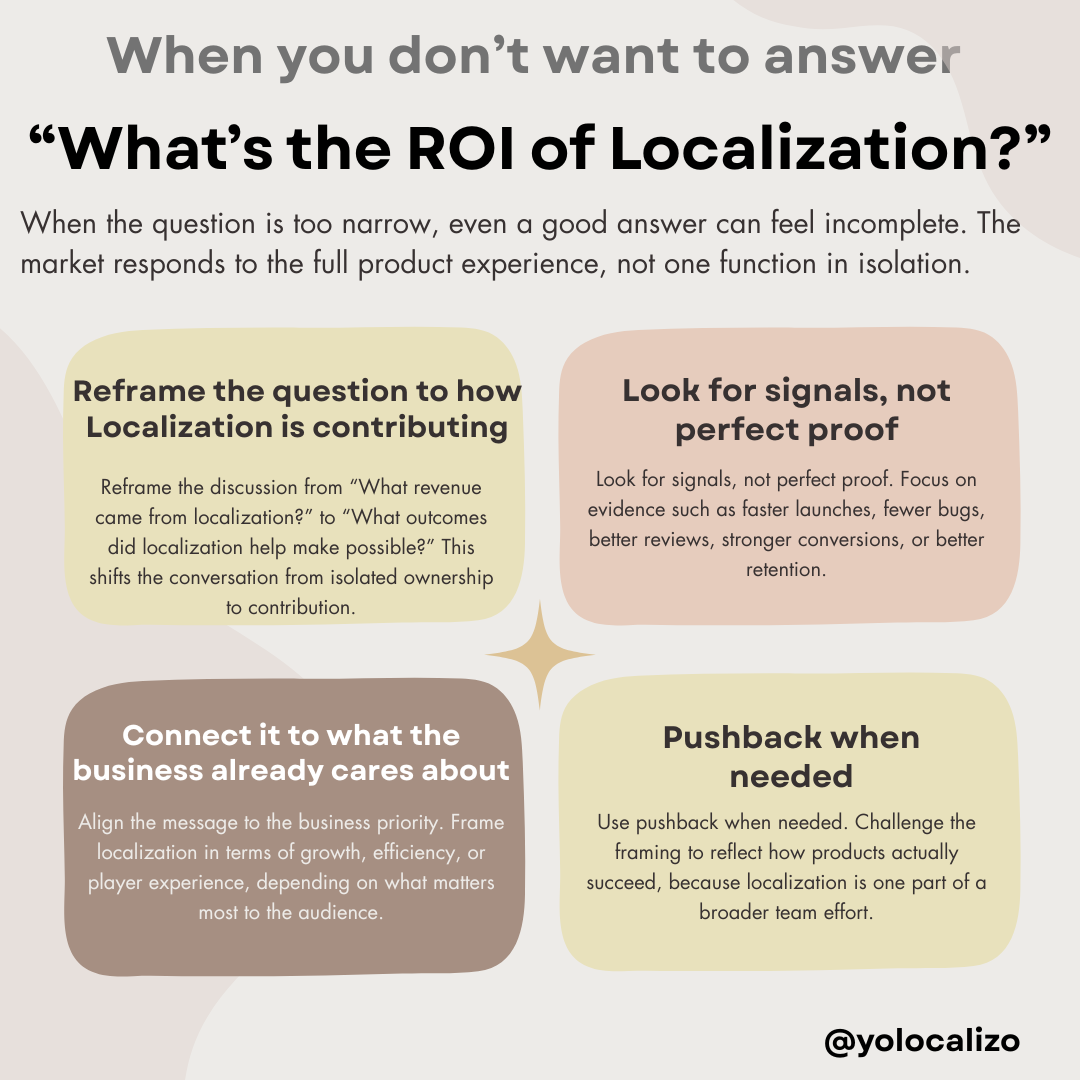
First, I try to remind myself that localization works inside systems that are always moving. That is part of the challenge. The function may remain important, but the business lens around it keeps changing. A product leader may see localization as launch readiness. A marketing leader may see it as campaign adaptation. A finance leader may see it as cost. An engineering leader may see it as automation. A regional leader may see it as market enablement. All of those perspectives are valid, but none of them tells the full story. Realizing this helped me a lot, because it made me understand that having to explain localization again is not strange. It is part of working in an organization that keeps changing.
2. Notice the smaller wins
I stopped expecting recognition to last forever. In organizations, the context changes, new people come in, and sooner or later localization needs to explain its value again A stakeholder asking better questions, a product team involving localization earlier, or a leader connecting localization to business goals without needing too much explanation are signs that the work is landing. Celebrate these small wins matter to keep the momentum and stay motivated!
3. Adapt the message to the moment
The value of localization may be stable, but the way we explain it should evolve with the business and with the stakeholder in front of us. Sometimes the conversation is about quality. Sometimes it is about speed, customer experience, scalability, risk, or AI. Explaining localization well also means knowing how to frame the same value differently depending on who you are talking to.
4. Build understanding beyond one advocate
When localization is understood by only one leader or one team, that support can disappear very quickly. A stronger position is to build understanding across different parts of the organization, so the value of localization does not depend on a single advocate. The more people who understand what the function brings, the more resilient that understanding becomes when the company changes. Find your allies and nurture that alliance
Final thought
Reading about the arrival fallacy gave me language for something I had felt for a long time in localization but had never named so clearly. Maybe one of the hard truths of this function is that we never fully arrive.
There is no final moment where localization is understood forever. There is no permanent state where nobody questions the role again. There is no point where the business stops changing and our value becomes self-evident for everyone, all the time.
And maybe that is okay. Maybe the job is not to arrive. Maybe the job is to keep building relevance, clarity, and trust in an environment that keeps changing.
@yolocalizo
Choosing a TMS is not an IT vs Localization decision. Localization understands the business problem and the workflow; IT understands the technical ecosystem. The best result comes when both work together, with clear roles, shared criteria and a selection process that looks beyond the vendor demo.