


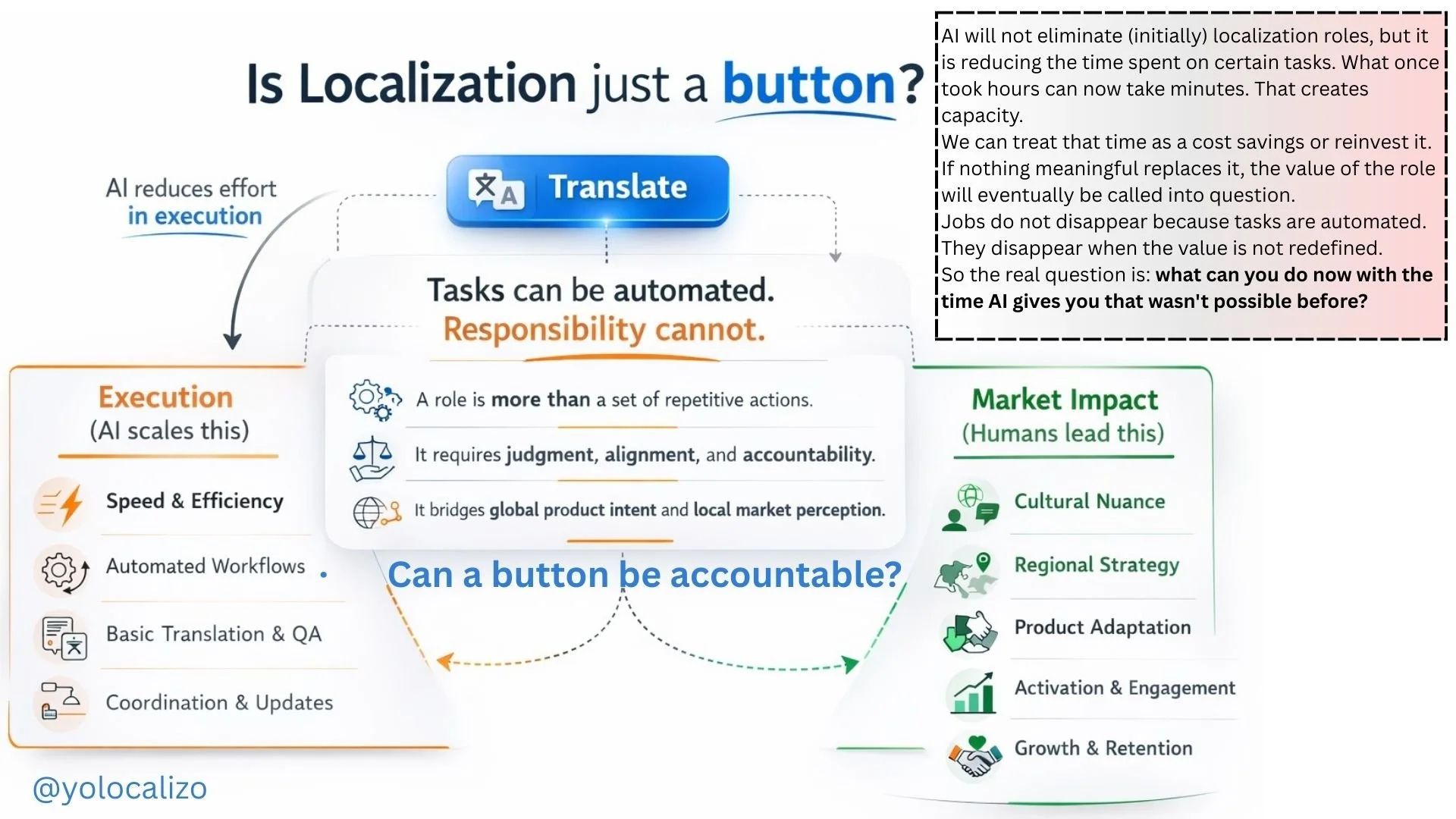
Is Localization just a button?
In the last couple of years, I have been part of many conversations where the same idea keeps coming back. Sometimes it is stated directly, sometimes more subtly, but the message is the same. Most TMS platforms now include a translate button. So the question appears quickly: why do we need a Localization team? If translation can be managed through the system, can’t our IT team handle it?
Many content platforms already integrate AI solutions. Drafts can be generated instantly. Workflows can be automated. If technology can manage the flow from source to target language, then what exactly is the role of the localization team?
I understand why this question appears reasonable. From a systems perspective, it looks efficient. Content goes in, translation comes out. The process is faster than before and often cheaper. Dashboards show throughput, turnaround time, and cost per word. For organizations under pressure to optimize budgets, it can feel like a logical simplification. If translation is automated, perhaps localization becomes a technical configuration challenge rather than a strategic function.
However, this line of thinking rests on an assumption that deserves closer examination. It assumes that localization is primarily the execution of translation tasks. If that were true, then automation would indeed make much of the function redundant. But that assumption does not reflect how localization actually creates value inside a company.
AI is very capable when it comes to task automation. It can pre-translate large volumes of content. It can apply terminology databases consistently. It can detect inconsistencies and formatting errors. It can accelerate review cycles. These improvements are real, and they change the operational landscape in meaningful ways. Anyone working in localization over the past few years has felt that shift.
What AI does not do, at least not in a reliable and context-aware way, is connect language decisions to business outcomes. It does not sit in product planning meetings and ask whether a feature concept resonates equally across regions. It does not challenge a marketing message because it may conflict with cultural expectations in a specific market. It does not look at retention data and wonder whether wording choices in onboarding flows could be influencing user behavior. Those activities require judgment, contextual awareness, and a cross-functional understanding of how language interacts with product strategy.
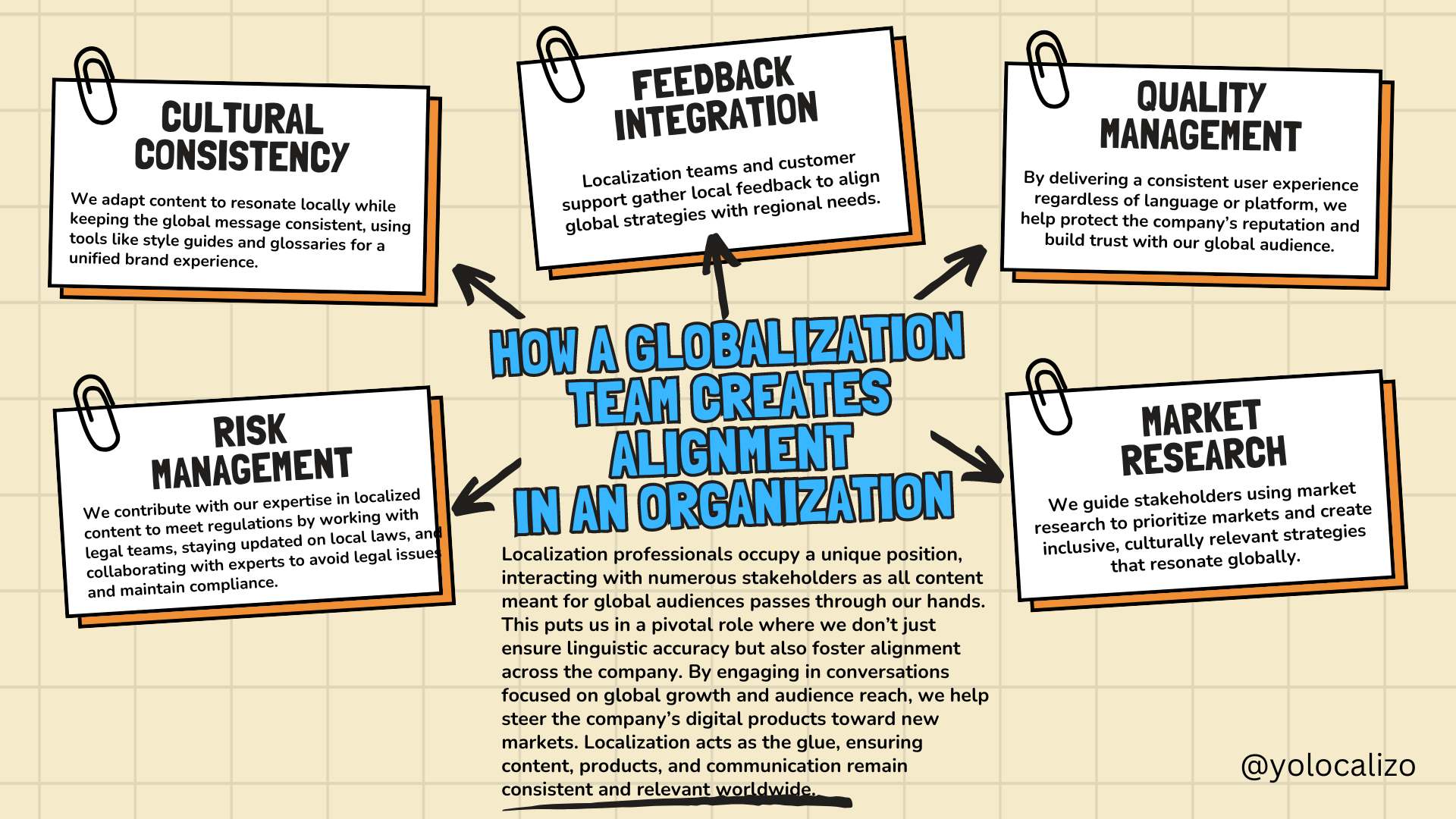
This is where the distinction between tasks and roles becomes important. A role is not simply a bundle of repetitive actions. A role carries responsibility, interpretation, and alignment. In localization, that often means acting as a bridge between global product intent and local market perception. The operational layer is visible and measurable, which makes it easy to focus on. The strategic layer is less visible, and this is what creates the confusion (unless the value of localization is clearly articulated regularly to the leadership team and company decision makers)
When organizations reduce localization to a button, they are effectively saying that the operational layer is the whole function. In that framing, it becomes natural to ask why IT cannot manage it. After all, IT teams are experts in system integration and workflow automation. If localization is treated as a pipeline problem, then it will be solved as a pipeline problem.
The risk is not that automation will improve efficiency. That part is positive. The risk is that by narrowing the definition of localization, companies also narrow the scope of impact they expect from it. Once localization is seen purely as a cost center that processes text, it becomes evaluated primarily on speed and savings. Meanwhile, the conversations that matter most to senior leadership are the ones about growth, market expansion, user engagement, and retention.
I do not believe AI will eliminate localization roles entirely. What I see happening is more granular. Certain tasks are shrinking in time and complexity. Coordination that once required multiple emails can now be automated. First-pass translations that once took days can now be generated instantly. Quality checks that relied heavily on manual review can be partially automated. These changes reduce workload in specific areas, but they do not remove the need for strategic oversight.
Click HERE to download the infographic
This is why I often talk about time reinvestment. When automation reduces the effort required for a task, the organization gains capacity. The important question is what we decide to do with that capacity.
One option is to treat it only as a cost-saving opportunity. But that can be risky in the long run. If time is saved and nothing meaningful replaces it, sooner or later someone will ask whether the role still requires 40 hours per week. Saving time without reinvesting it is not a sustainable strategy for a great career development plan.
The alternative is to reinvest that capacity into activities that were previously postponed due to lack of time. That is how roles evolve rather than disappear.
Jobs do not vanish simply because some tasks are automated; they disappear when organizations and/or individuals fail to redefine their value.
For localization professionals, this reinvestment could mean engaging earlier in the product lifecycle, before content is even created. It could mean conducting structured local market reviews of new features to identify cultural friction points. It could involve analyzing engagement metrics by region and collaborating with product managers to interpret the data. It could mean partnering with a local influencer to launch a regional marketing campaign. It could also mean building feedback loops with local stakeholders to inform future iterations.
None of these activities are handled by a translate button. They require people who understand both language and business context. They require professionals who can move between operational details and strategic conversations without losing credibility in either space.
Can a button be accountable?
There is also a broader organizational dimension to consider. As AI lowers the barrier to entry for basic translation, more teams will experiment with self-service approaches. Marketing teams might run quick translations for campaigns. Product teams might pre-translate UI text directly within their design tools. This decentralization is not inherently negative, but it increases the need for governance, standards, and alignment. Without a coherent localization strategy, different parts of the organization may create inconsistent experiences across markets.
In that environment, the role of localization evolves rather than disappears. It becomes less about managing every single string and more about defining frameworks, quality thresholds, and market priorities. It becomes about ensuring that speed does not undermine brand consistency or cultural relevance.
Final thoughts
The real question is not whether a translate button exists. It does, and it will keep improving. The real question is whether companies want to compete globally with a purely mechanical approach to language, or whether they understand that market relevance requires intentional adaptation.
In recent years, I have seen that organizations who treat localization as a strategic partner ask different questions. They look beyond cost per word. They analyze activation in new markets, compare retention across regions, and examine why a feature performs well in one country but struggles in another. In those discussions, localization is not a button. It becomes a way to evaluate product-market fit internationally.
AI is reshaping workflows, and ignoring that would make no sense. But accepting a narrow definition of localization would also be a mistake.
When some tasks disappear, the role’s value does not drop immediately. It gains room to evolve. The localization professionals who understand this will not spend their energy resisting AI. They will use automation deliberately to increase their impact and strengthen their contribution to global growth.
@yolocalizo

Many companies claim to be customer-centric, but too often that promise stops at English. Surveys and focus groups are run in the US or UK and treated as if they represent the entire customer base, leaving most global customers unheard. In this post, I share a practical framework 5 audit questions to help leaders test if their strategy is truly customer-centric or just a slogan.