


A translated product is not yet a global one
The other day, I was sitting in a presentation, coffee in hand, when someone said something I hear quite often:
“We’re translating our digital product to enter new markets.”
And honestly? That’s a good thing. It really is. Translation is a solid starting point. It means international growth is being discussed. It means someone has already moved past “maybe someday” and into “we’re doing this.” But as I listened, I also had that familiar feeling. The one where you know something important is about to be skipped.Because very often, this is where the conversation ends.
Outside the circles of localization and globalization, translation is still seen as the step to go global. As if adapting the language automatically creates a global product. As if users in new markets will suddenly feel at home just because the words are no longer in English.
Ouch. I know, an uncomfortable thought, but… it is what it is, because what is still widely misunderstood is that translation alone does not create an international customer experience. It solves a visibility problem. Not an experience one.
Many companies genuinely believe that creating a global product and a global customer experience means translating the interface, maybe localizing a few pages, and then shipping. And to be fair, the industry has reinforced this idea for years.
Click HERE to download the infographic
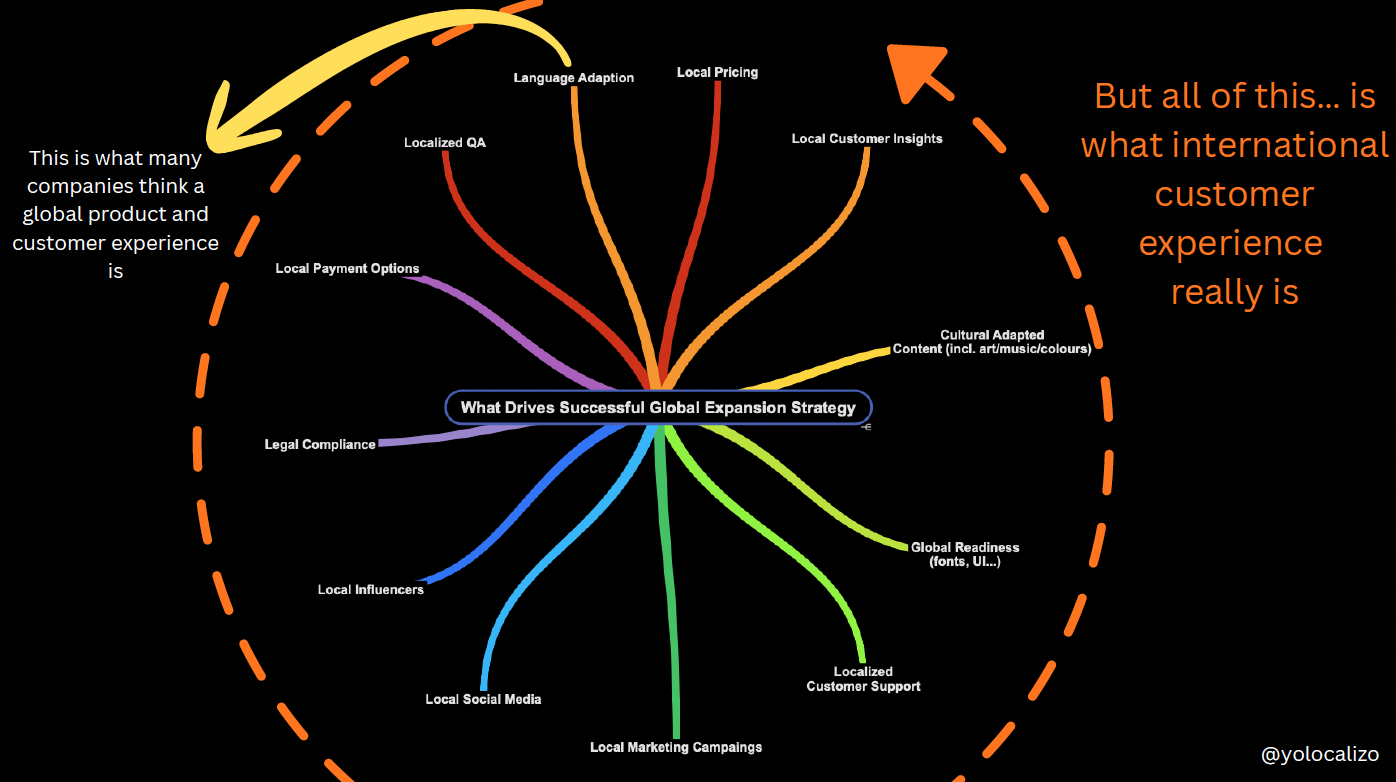
That’s what the small part of the graphic represents. The variable of Language adaption
But all of this, the full circle, with all those variables … this is what international customer experience really is.
When users interact with our product in another market, they don’t think in terms of “localization.” They don’t separate language from pricing, or content from payments. They just experience the product. And that experience either feels natural… or it doesn’t.
They notice if the price feels off.
They notice if the payment methods don’t match local habits.
They notice if support answers feel distant or scripted.
They notice when the product technically supports their language or barely survives it.
This is why international expansion is not a translation project. It’s an experience strategy. And yes, a business one.
Over the years, whenever someone asks me where to start with international expansion, I always say the same thing: stop thinking in terms of tasks, and start thinking in terms of experience variables (all the ones I included in the circle!)
Let me explain what I mean in that circle, so we can better understand the real meaning of going global
Language adaptation
This is the obvious one. Translating the product and content so people can understand it
Local pricing
Prices don’t travel well. What feels reasonable in one country can feel premium, cheap, or simply suspicious in another. And no, this is rarely solved by currency conversion alone; you need to adapt the price per market, hello McDonald's index?
Local customer insights
Users don’t behave the same way everywhere. They have different expectations, ask different questions, and value different things. If you skip this, you end up optimizing for a user that doesn’t really exist.
Cultural adaptation (content, visuals, tone)
This one is subtle and powerful. Images, colors, humor, tone of voice …. they all carry meaning. Sometimes the problem is not that something is wrong, but that it feels… off. And that’s often enough to break trust.
Global readiness (fonts, UI, layouts)
This is the unglamorous part. Does your product actually support other languages? Longer text? Different character sets? Different reading patterns? If not, no amount of translation will save the experience.
Localized customer support
This is where theory meets reality. When something goes wrong, users expect help in their language and with an understanding of local context.
Local marketing campaigns
Reusing the same campaign everywhere is tempting. It’s efficient. It’s scalable. And it often doesn’t work. Different markets respond to different messages, channels, and timing.
Local social media
Being present is not the same as being relevant. Some platforms matter in some markets and are almost invisible in others. Engagement styles also vary a lot.
Local influencers
Trust is local. The voices that influence buying decisions in one country may mean absolutely nothing in another. Reach without credibility is a poor strategy
Legal compliance
This one is not optional. Different markets have different rules, especially regarding data, privacy, and consumer rights. Ignore this, and expansion stops fast.
Local payment options
You can have the best product in the world. If people can’t pay the way they expect, they won’t buy. Simple as that.
Localized QA
This is about checking the experience, not just the words. Does everything work once it’s live? Does it look right? Does it behave as expected in that market?
When you put all of this together, something interesting happens. You start to see why localization teams often struggle to show their real value. Their work touches many of these areas, but they are still too often brought in at the very end, when most decisions are already locked.
And at that point, even the best localization work can only fix so much.
Final thoughts
So yes …. start with translation. But don’t stop there.
Speaking more languages helps, of course.
But that’s not what makes a product truly work internationally.
International customer experience is built through many small, connected decisions.
And the earlier you start treating it that way, the better your chances of building a product that truly feels global…. not just translated.
@yolocalizo
Choosing a TMS is not an IT vs Localization decision. Localization understands the business problem and the workflow; IT understands the technical ecosystem. The best result comes when both work together, with clear roles, shared criteria and a selection process that looks beyond the vendor demo.