




Localization metrics are easy to define, hard to track
The other day, I was on a Google Meet call with a colleague from the industry. It was one of those informal conversations where I started talking about tools, workflows, and how teams are adapting to the current Localization world we are living in, with AI and automation.
And at some point, the topic of localization metrics came up. How weird, right? 🙂
If you spend enough time discussing any localization topic, the metrics topic will eventually come up.
Which metrics do you track?
How do you measure localization success?
What numbers do you show leadership?
And other variations of those ones… I have been part of many conversations like this over the years. The first part of the discussion is usually straightforward. Most teams already have a mental list of the metrics they would like to track. Especially the ones localization professionals feel more comfortable with, such as turnaround time, cost per word, or quality scores.
Then there is another category of metrics. The ones that localization teams usually mention but rarely track themselves. Metrics closer to business impact, such as growth by market, users per region, or engagement differences across languages.
If you put a group of people in a workshop room for a couple of hours, most of them will agree on what those metrics should be.
Defining them is not the hard part.
But during that call, the conversation took a slightly different direction.
Instead of debating which metrics matter, we started talking about something that is not often part of the conversation, something that usually is not discussed that much, which is…
How difficult it actually is to get them!
Defining localization metrics is relatively easy. In many cases, a team can write a reasonable list during a workshop, like the ones I mentioned above, or during a strategy session. The conceptual part of what to track and why rarely takes long. The real difficulty appears later: HOW you actually obtain those metrics.
Getting and tracking those metrics consistently inside a company is a very different problem.
I would even go so far as to say that defining the metrics is the easy part.
Getting the data and tracking it regularly… well, that is a completely different level of complexity.
And there are several reasons, but I will focus on the three I encountered most often during my career.
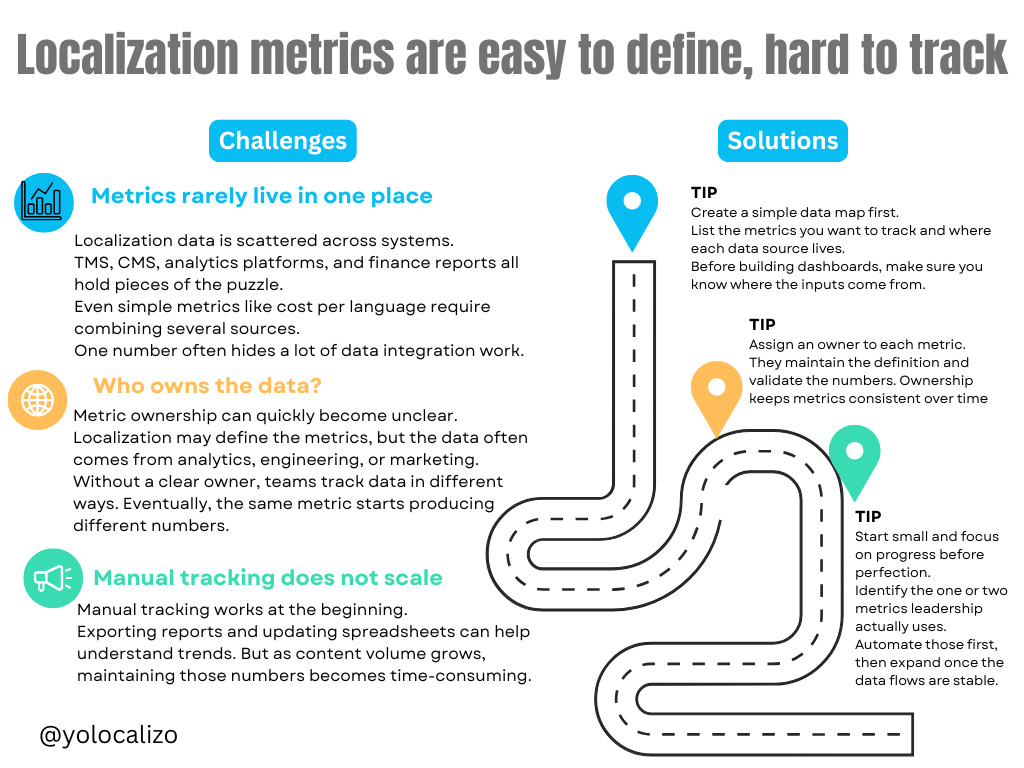
Metrics that matter rarely live in one place
Localization data rarely lives in a single place. Some information sits inside the TMS. Other pieces come from content management systems, product analytics platforms, or internal product team dashboards.
And that is where the first practical question appears.
Where do you actually get the data from?
I’ve worked in different companies, and I have never seen metrics generated from a single system. The numbers emerge from a combination of tools that were never originally designed to work together (thankfully, there are APIs nowadays and capable developer allies who can help with this).
At first glance, it sounds simple. Someone might ask, “How much does it cost to localize Candy Crush :) into German, Spanish, and Japanese?” Modern TMS platforms already organize much of the content and language data, so in theory, the information should be available. The complexity appears when you look at the cost side. Some translation costs may come directly from the TMS, while others may come from vendor invoices that, for various reasons, are not tracked in the TMS (e.g., an LQA vendor). Additional services such as copyediting or culturalization may also be tracked outside the system. On top of that, finance teams often group localization spend by vendor or department rather than by product.
What initially appears to be a straightforward number quickly becomes a complex task: aligning and integrating disparate financial and operational data.
TIP
A suggestion here is to create a simple data map. Instead of jumping immediately into dashboards, list the metrics you want to track and identify where each piece of data currently lives. Often, the challenge is not defining the metric but simply understanding which systems contain the inputs required to calculate it.
Click HERE to download the graphic
Who owns the data?
Ownership is another area where complexity appears quickly.
Metrics need someone responsible for maintaining them. Someone has to confirm that the data remains accurate, that definitions do not drift over time, and that the numbers are interpreted correctly when they appear in reports.
In practice, localization metrics often sit in an ambiguous space between teams. Localization may define them, but the underlying data may come from product analytics, engineering, or even marketing.
When ownership is not clearly defined, another problem appears: data normalization becomes difficult. Different teams may track similar information in slightly different ways, using different definitions, formats, or timeframes. Without a clear owner responsible for aligning those inputs, the same metric can start producing different numbers depending on where the data comes from.
At that point, dashboards may still exist, but confidence in the numbers slowly declines. People start asking whether the metrics actually represent what is happening, or simply reflect how the data happened to be collected.
TIP
One practice that makes a big difference is assigning an explicit owner to each metric. Not necessarily the person who generates the data, but the person responsible for maintaining the definition and validating the numbers over time. Without that ownership, metrics tend to evolve differently across teams and slowly lose consistency.
Manual tracking does not scale
Another layer of complexity arises when teams begin to consider how these metrics will be maintained over time.
In the early stages, it is common to manually collect numbers. A localization manager exports reports from the TMS, gathers additional data from other systems, and updates a spreadsheet to track performance.
For a while, this can work. Especially if the goal is simply to understand trends. If you have never had a metrics dashboard before, even a simple spreadsheet can feel like a big step forward.
And to be fair, that first dashboard moment is always satisfying.
But after the initial excitement fades, reality sets in.
If the process depends on someone manually compiling data every week or every month, it quickly becomes fragile. I have seen this happen multiple times.
As content volumes grow and workflows become more distributed across systems, manual tracking becomes very time-consuming. At some point, it simply becomes unsustainable.
And that is when the conversation changes again.
The question is no longer which metrics to track, but how to do it without spending hours every week.
Finding a way to automatically collect and update the data so the numbers remain reliable without constant manual effort becomes essential.
Tip
Start small and look for progress before perfection. It is important to resist the temptation to automate everything at once. In many cases, it works better to start by identifying the one or two metrics that leadership actually looks at regularly and focus automation efforts there first. Once those data flows are stable and reliable, expanding the system becomes much easier. Trying to automate every possible metric from the beginning often leads to overly complex solutions that are difficult to maintain (and along the way you would probably end up demoralized because it is more complex than it looks).
Final thoughts
Over time, I have realized that localization metrics are less about spending a lot of time about what to track but more on how to track it, the infrastructure of it. Defining them is easy; if you have never done this before, you might find this phase complex, but believe me, it’s way easier than tracking and reporting them at scale. Building the systems, ownership, and processes that sustain those metrics consistently within an organization is where the real effort lies. But once that structure is in place, metrics stop being numbers collected for reporting purposes and start helping teams understand how localization contributes to the broader goals of the company.
And that ability to explain how we add value to the company is critical. Not only now, with the pressure of AI, which is very real, but because it has always been a challenge. For many organizations, localization work often falls into the commodity category. A place where many of us do not feel comfortable. The key to opening that door is precisely having a localization metrics infrastructure in place, ideally automated, that helps us explain, whenever needed, the impact of the work we do.
@yolocalizo

A multi-market expansion strategy for any product is most effective if the various Globalization (i.e.Localization, Internationalization) activities are understood as a cycle that runs parallel to the multiple phases of software development; This cycle repeats during the various product upgrades. It is not an activity that is executed as if it were a process once the home market version (usually in English) is finalized. It is not a transaction that simply sends files to a professional localizer shortly before the global release. No; Globalization is not a process. Globalization is a cycle that runs multiple times. It is a cycle that runs in parallel with the product research, design, and development phases.