


Who pays the party? Why Localization budget ownership matters
I have worked in companies where the localization team owned the budget for localization activities. I have also worked in organizations where the budget was somewhere else. Sometimes in product, sometimes in marketing, sometimes with regional teams. When you are inside the company, this difference can look like a small detail. After all, everyone is working under the same roof, trying to deliver a product globally. So who really cares who pays for the party? Whether the bill sits with the localization team or with another department should not matter that much. As long as someone pays, the work moves forward, right? Well, but….
For a long time, I thought that assumption made sense. But after working in a few different organizations, … I’m not sure about that anymore :)
When the budget for localization activities lives outside the globalization or localization team, the work tends to become more difficult. Not necessarily the operational side of the work. Translation can still happen, workflows continue to run, and content still moves through the system as expected. The challenge appears somewhere else.
It becomes visible when localization teams try to influence decisions or participate earlier in product discussions. It is especially noticeable during the early phases of product ideation, when teams are shaping what a launch will look like and deciding which markets to prioritize. When the budget sits elsewhere, localization gradually stops being part of the company’s strategy. Instead, it becomes something other teams decide whether or not to fund. And that subtle difference changes the dynamics more than it may seem at first.
When the budget lives somewhere else
When another team owns the budget, localization quietly becomes one option among many competing priorities.
If the budget sits in marketing, localization competes with campaign spend, media investment, and creative production.
If it sits in product, localization competes with feature development, engineering work, and infrastructure improvements.
If it sits with regional teams, it competes with local sales initiatives, partnerships, or campaigns.
In each of these situations, localization becomes a trade-off. This usually does not happen because stakeholders do not appreciate localization. In most companies I have worked with, people understand that reaching global markets requires adapting content and experiences. But every team works under constraints. Budgets force people to make choices. When localization depends on someone else’s budget, the team often needs to prove its value again and again. That is where things become more complex.
Why this changes Localization influence
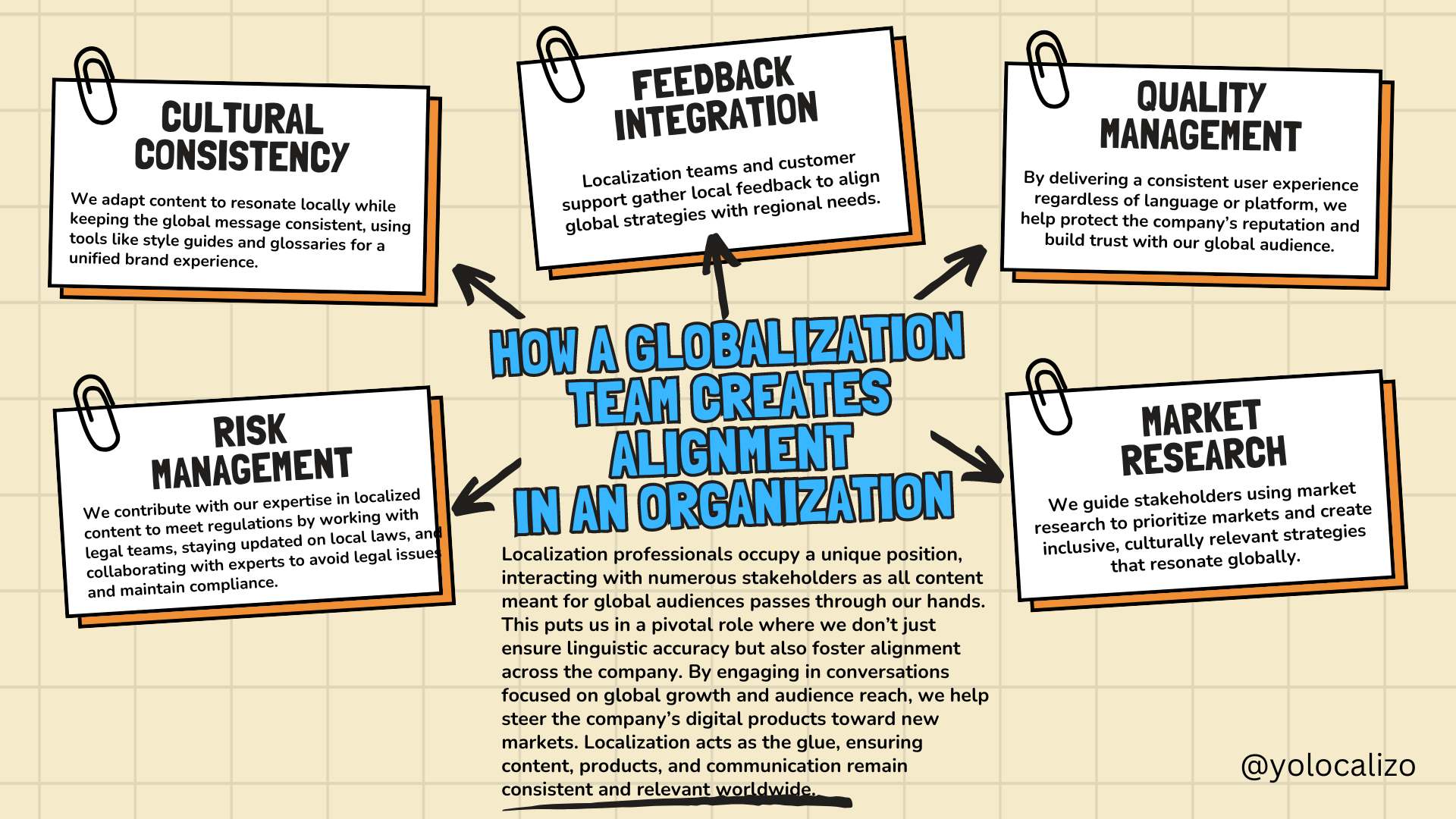
When localization does not control the budget, influence cannot come from a financial authority. Localization leaders cannot simply decide what gets localized or when. Those decisions depend on other teams deciding that localization deserves part of their budget. So influence has to come from somewhere else.
In my experience, it comes from being close to the conversations where business priorities are defined. I have seen situations where localization teams were responsible for global language operations, but were rarely present when launches or campaigns were being planned. Marketing teams defined campaign strategies, product teams decided which markets to enter next, and regional leaders set growth priorities.
Localization often entered the conversation later, once content already existed and timelines were already tight. At that point, the discussion usually becomes operational:
What needs to be translated?
How fast can it be delivered?
How much will it cost?
The work still happens, of course, but the role of localization begins to change. Instead of helping shape how a company approaches global markets, localization simply executes requests made elsewhere. And that is exactly the situation I try to avoid; you can find many articles on my blog site to help you avoid it… to be seen as a commodity instead of a strategic capability. If localization keeps appearing late in the process, it starts to look more like a service than a strategic function. And once that perception settles, influencing earlier decisions becomes much harder. That is why the question of where the budget lives is not just an accounting detail because it shapes how localization interacts with the rest of the organization.
When a Localization budget starts to make sense
In many organizations, localization does not start with its own budget. The function often grows inside marketing, product, or regional teams. But as localization becomes more involved in strategic discussions, the question of budget ownership sometimes appears naturally. Having a dedicated localization budget can make a difference. It allows teams to plan initiatives rather than react only to requests, invest in internationalization earlier, and test approaches across markets rather than wait for funding from other teams. But asking for a localization budget works best after the team has demonstrated its impact.
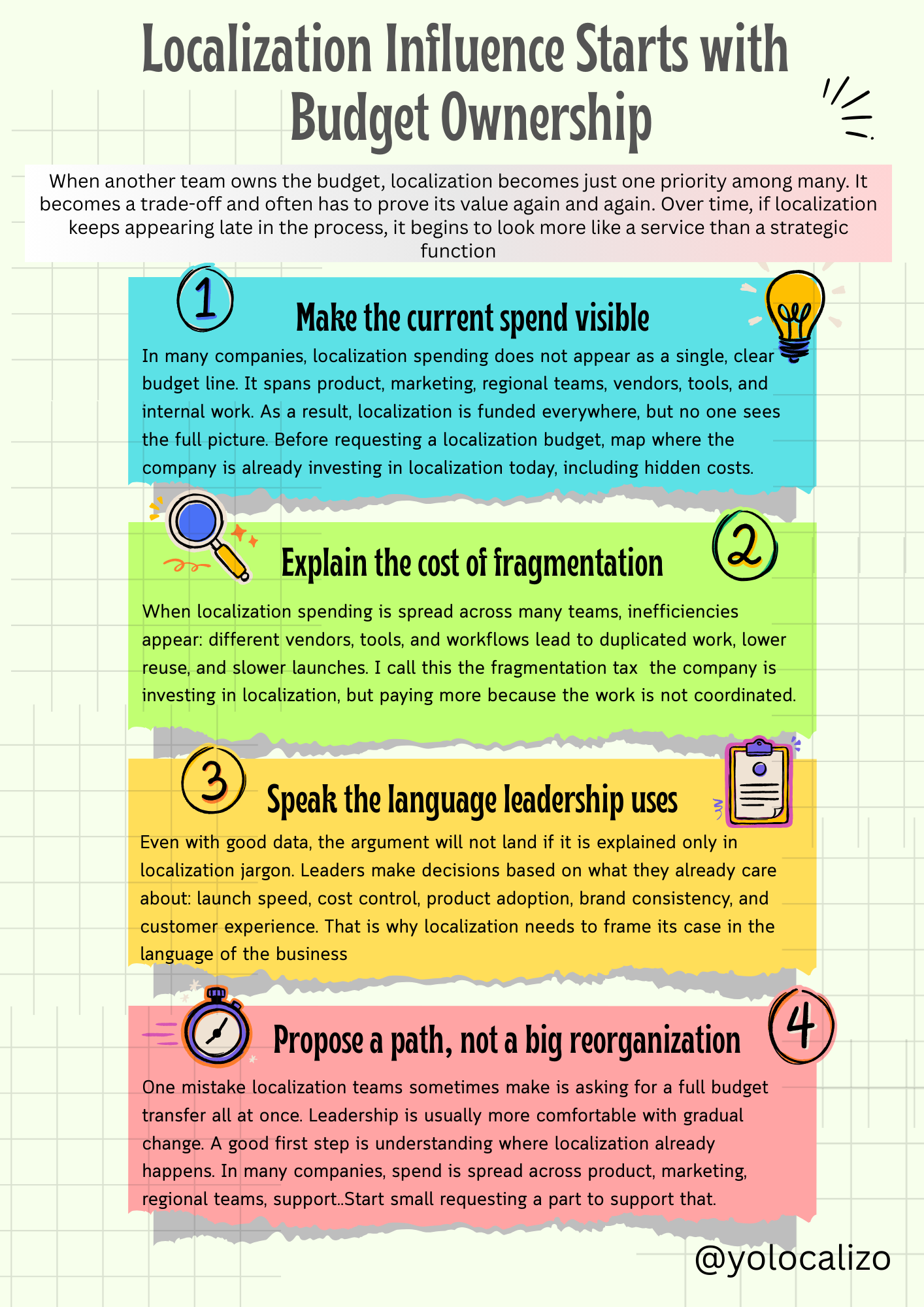
Below, I share 4 tactics with you
Click HERE to download the graphic
1. Make the current spend visible
In many companies, localization spending does not appear as a single budget line. It is spread across product teams, marketing campaigns, regional initiatives, vendor contracts, tools, engineering support, and sometimes even internal review time. The result is that localization spending exists everywhere, but nobody sees the full picture. Before asking for a localization budget, it helps to map where the company is already investing in localization today. Not only direct costs like vendors or tools, but also hidden ones: duplicated workflows, rush projects, in-country review time, and work that gets redone because planning happened too late.
This exercise changes the conversation. Instead of asking for control, localization starts by helping the company understand where money is already being spent.
2. Explain the cost of fragmentation
When localization spending is distributed across many teams, the system often becomes inefficient. Different teams may use different vendors, different workflows, or different tools. Terminology becomes inconsistent. Translation memory reuse drops. Work gets repeated. Launch timelines slow down because planning occurs across different teams.
This creates what I call a fragmentation tax. The company is still investing in localization, but it is paying extra because the work is not coordinated. When leaders see that the current model creates hidden costs, the conversation changes.
3. Speak the language leadership uses
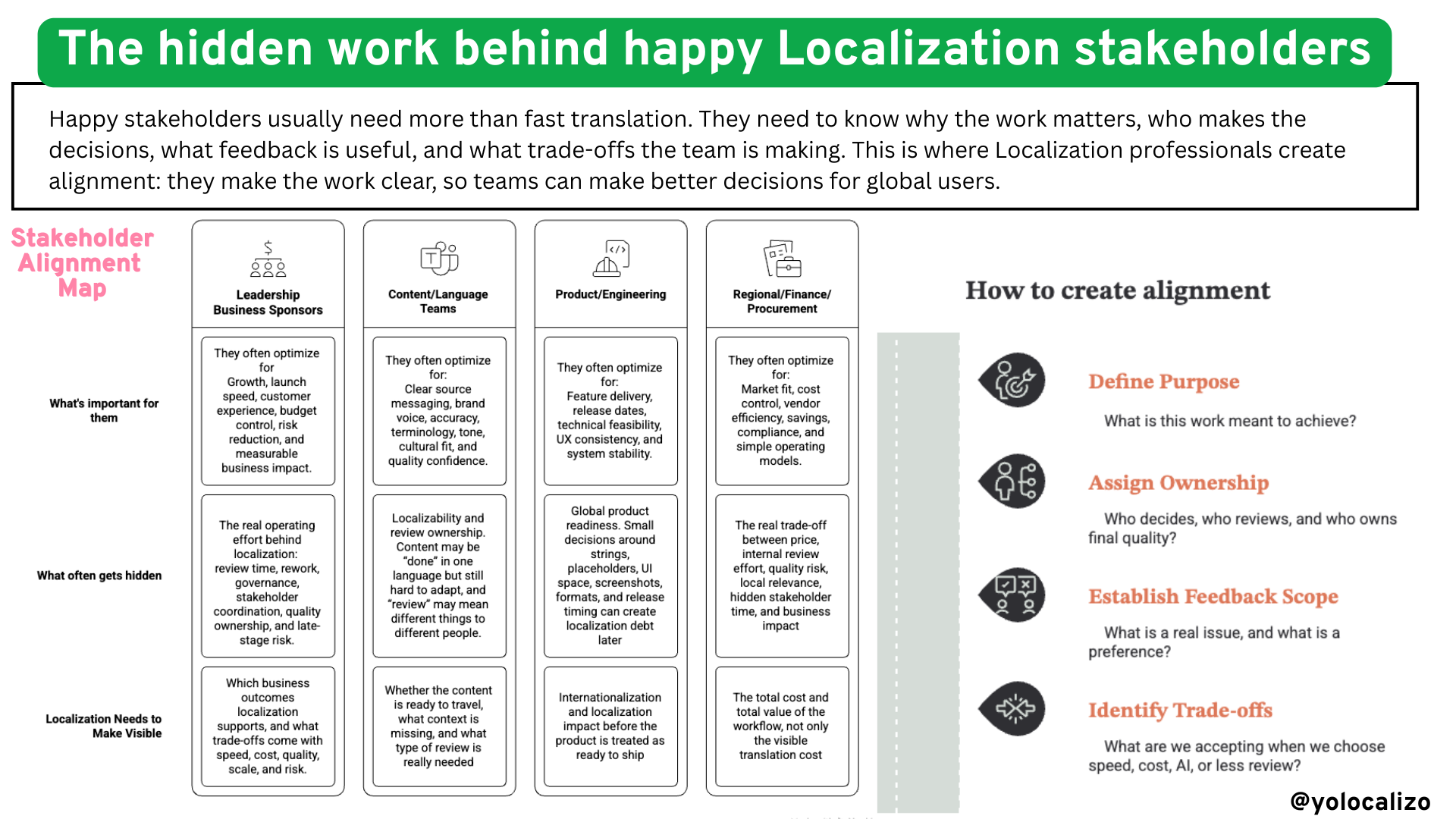
Even with good data, the argument will not land if it is explained only in localization terms.I talk about this often in my blog; you can find some articles here about that topic Leaders rarely make budget decisions because translation volume is high or terminology management is complex. They make decisions when they understand the impact on what they already care about: launch speed, cost control, product adoption, brand consistency, and customer experience.
This means localization needs to explain its case in the business's language. A CFO may care about spend visibility and cost efficiency. A product leader may care about release readiness and scalability. A marketing leader may care about campaign speed and performance in local markets. The message is the same, but the framing needs to adapt.
4. Propose a path, not a big reorganization
One mistake localization teams sometimes make is asking for a complete budget transfer all at once. In reality, leadership is much more comfortable with gradual change. A good first step is simply to understand where localization is already happening today. In many companies, the spend does not appear as one clear budget. It is spread across the organization. Product teams may fund localization for feature launches, marketing teams pay for campaign adaptation, regional teams handle local reviews, support teams translate help content, and somewhere in the background technical teams maintain the tools and systems that make all of this work.
When you start looking at it this way, something interesting becomes visible. The company is already investing in localization, just not in a coordinated way. And that realization changes the conversation. This phased approach works because it lowers the perceived risk. It also allows localization to prove the value of a more coordinated model before the organization commits to a larger structural change.
Final Thought
Budget ownership is rarely just a financial detail. It usually reflects how a company thinks about globalization. When localization owns the budget, it tends to be part of the strategy. When the budget sits elsewhere, localization often becomes something teams decide to fund or postpone. So maybe the real question is not who pays the party. It is whether localization is in the room when the party is being planned. And if it is not, the next question becomes simple: what can we do to get invited?
@yolocalizo
Choosing a TMS is not an IT vs Localization decision. Localization understands the business problem and the workflow; IT understands the technical ecosystem. The best result comes when both work together, with clear roles, shared criteria and a selection process that looks beyond the vendor demo.