



In the age of AI, Localization must operate at 2 layers to stay relevant
For many years, localization had a very clear definition of success. If the translation was accurate, the terminology consistent, and the release delivered on time, the job was considered done. I built teams around that model. I reported on quality metrics. I defended investment decisions using execution data. For a long time, it made sense. Without strong linguistic foundations, global products simply do not work. Users lose trust quickly when language feels broken or careless. For a while, the difference between how we measured success and how executives measured success was present but manageable. We focused on accuracy, consistency, and process optimization. Leadership focused on growth indicators. Both worlds operated in parallel, even if they were not fully aligned.
Then came the irruption of large language models and AI more broadly.
In the last couple of years, the pressure to implement AI has been very real. It came directly from executive leaders asking how fast we could deploy it, how much efficiency we could unlock, and what cost reductions were possible. The tone of the conversation changed quickly.
In that context, I’m realizing about something uncomfortable. Quality is no longer (enough) the central debate. It is increasingly assumed that execution can be automated at scale. The discussion is moving from “Can we maintain accuracy?” to “Why are we still investing so much manual effort here?”
At this moment, defending localization solely on linguistic excellence begins to feel insufficient. If execution is being perceived as solvable by AI (and for many stakholders it is), then our strategic value had to be defined elsewhere.
That is when I began to think more clearly about two different layers of localization.
So where do we actually add value today?
Let’s think about the following: if translation is increasingly assumed, what is localization really responsible for?
When I step back and look at the work we do , from the earliest stages of product conceptualization all the way to user support ,I don’t see just one type of contribution. I see two distinct layers.
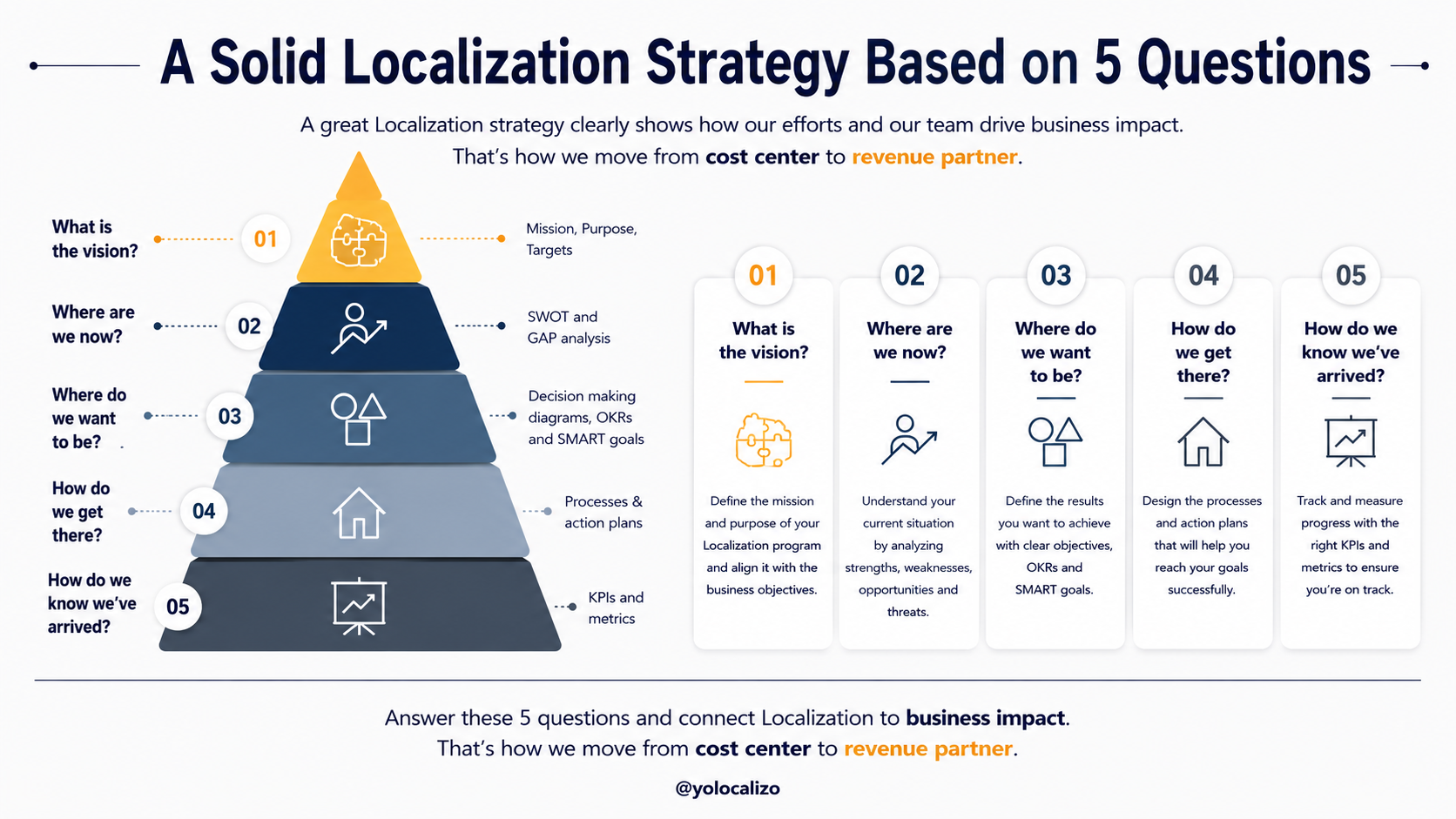
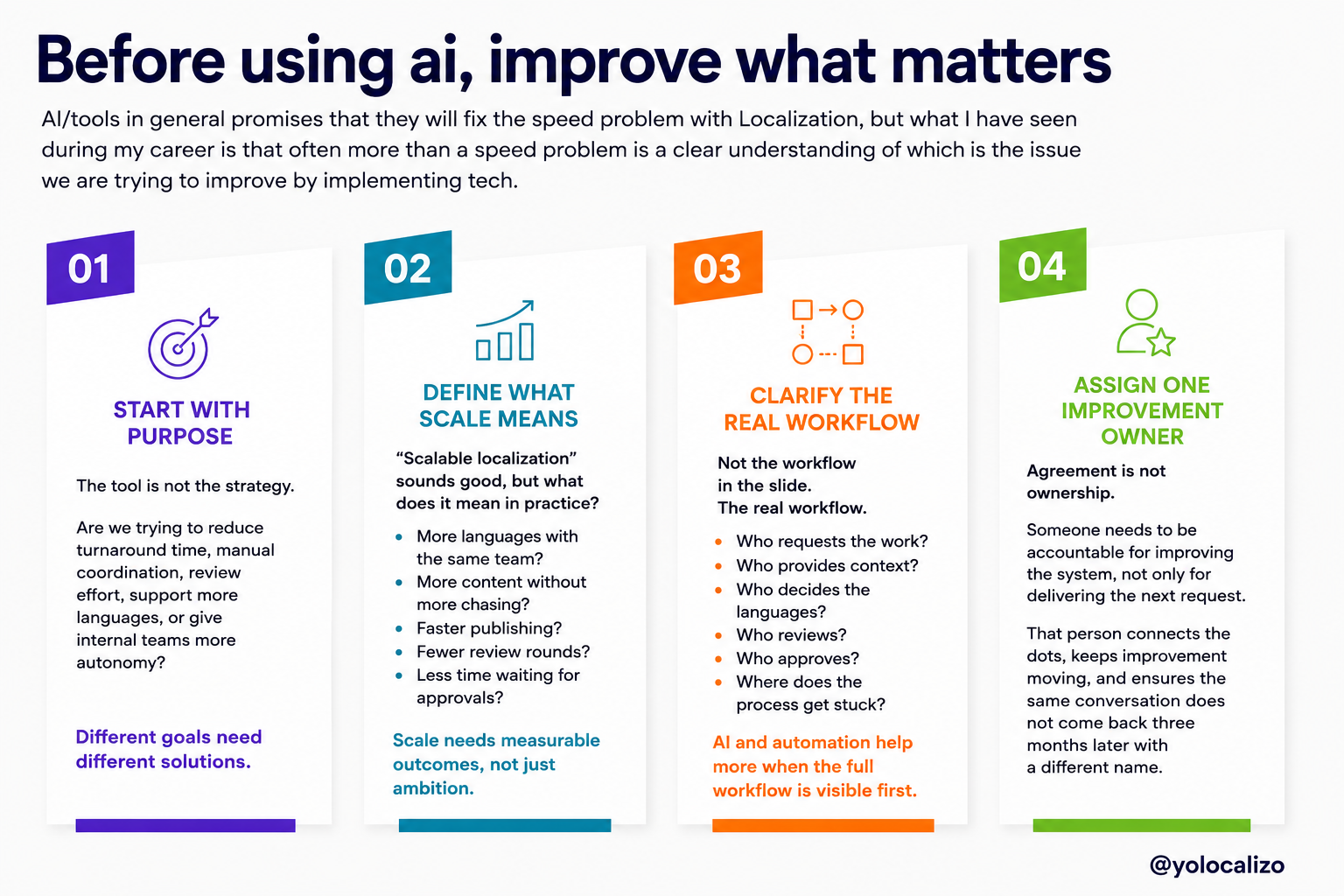
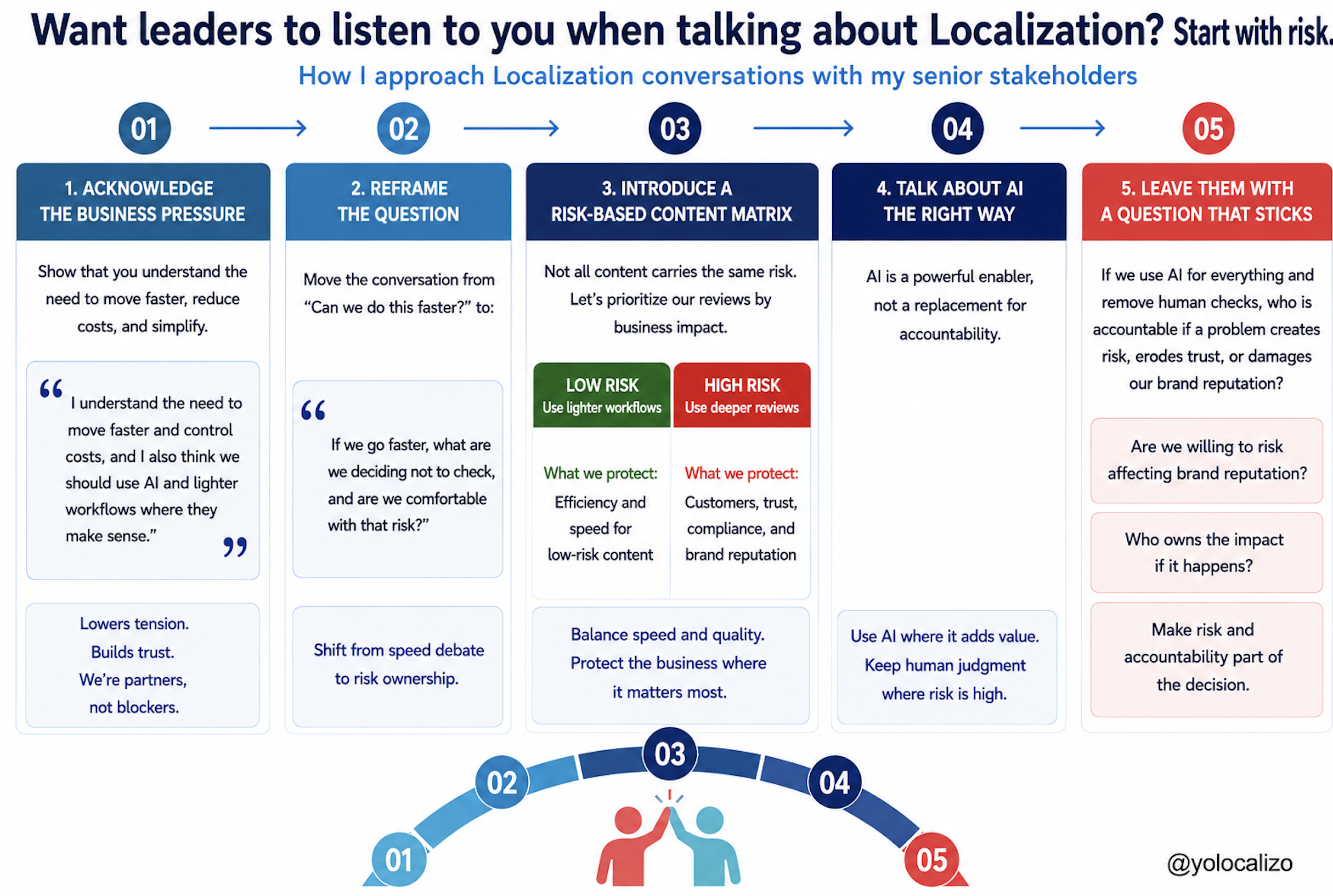
Click HERE to download the infographic
Layer 1 – Execution
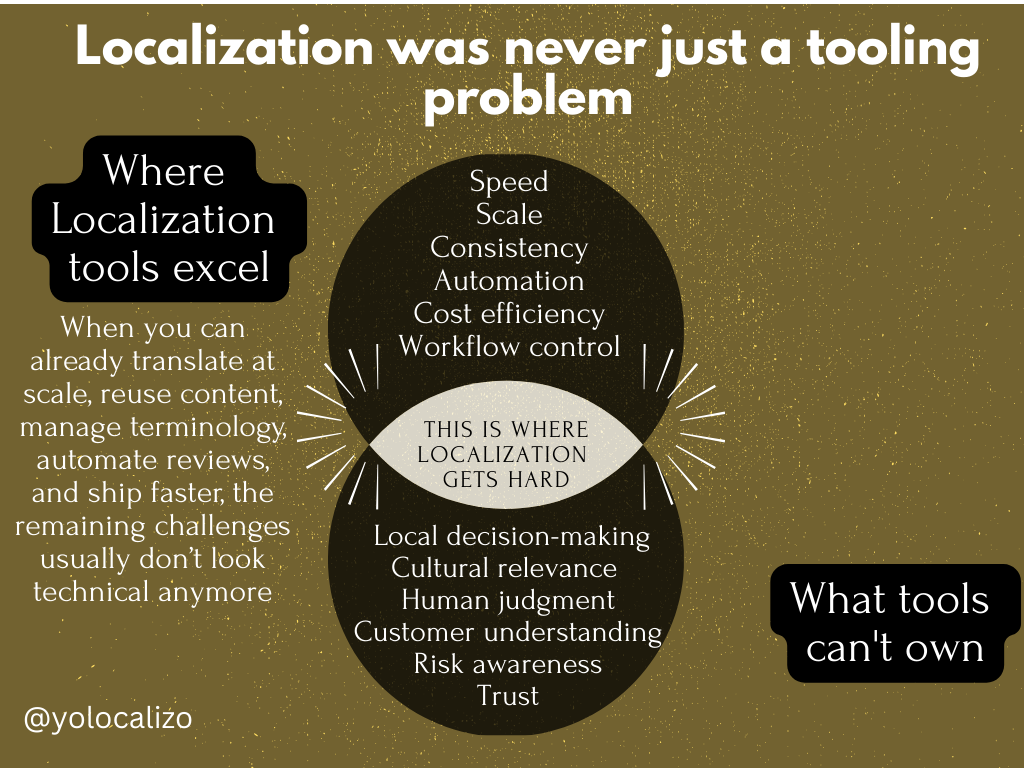
The first layer is execution. It includes translation quality, terminology management, QA processes, workflow efficiency, and delivery speed. It is structured, measurable, and operationally clear. It has been the backbone of our discipline for decades, and it remains essential. Without it, there is no credibility.
And we are good at it.
We know how to structure processes. We know how to measure quality. We know how to scale across languages without losing control. That operational discipline did not happen overnight. It is the result of decades of learning and standardization.
And we are good at it. Really good at it!. If execution were an Olympic sport, localization would at least make the finals
The problem is that AI would be in those finals too. AI is becoming very good at this layer as well.
In the last couple of years, the gap between human execution and AI-supported execution has been closing at a very fast pace.
AI is particularly strong in this layer. It accelerates translation, improves consistency, handles large volumes of content, and reduces manual workload. When our role is defined narrowly around producing and reviewing text, AI can appear as a direct substitute.
However, localization does not operate only in this execution layer.
Layer 2 – Cultural Resonance
There is another layer that is less discussed but much closer to business impact. I think of it as the cultural layer. It relates to how a product presents itself in each market, how it builds trust, and whether users feel that it was designed with them in mind. This includes decisions about what users encounter during onboarding, which creators or products are featured, how recommendations are structured, how examples are framed, and how tone aligns with local expectations. These elements shape whether the experience feels naturally embedded in the market or slightly foreign.
Consider a global digital product entering a new country. The interface may be perfectly translated and technically flawless. Every button works, and every sentence is correct. Yet the onboarding flow might highlight content that does not resonate locally, or the imagery might reflect assumptions that feel distant from everyday reality in that market. Nothing is wrong from a linguistic standpoint, but the emotional connection is weak.
Now imagine the same product where cultural signals are intentionally considered. Local creators appear early in the experience. Examples reflect familiar habits. The tone aligns with how people in that market typically build trust and make decisions. In that scenario, the product feels relevant rather than imported. That’s layer 2 embedded in Localization stratgy in action
The difference between these two approaches is not about grammatical accuracy or technical quality. Here’s what’s happening is how the experience is perceived. What truly matters at this level is the user’s perception of the product. And perception directly influences behavior, including engagement, activation, and retention. Those are the metrics that executive leaders actually pay attention to. Executive attention is directed toward growth metrics: retention curves, activation rates, lifetime value by market, and engagement after onboarding. These are the indicators that drive investment decisions.
This is where the AI conversation becomes more balanced. In the execution layer, AI clearly optimizes processes and reduces friction. In the cultural layer, its role is different. It can analyze behavioral data by market, identify patterns in user engagement, and support experimentation with different onboarding flows or content strategies. At the same time, it does not fully grasp the historical, social, and emotional context that shapes trust in a specific country. It cannot independently decide which cultural signals will resonate authentically.
That requires human judgment, informed by market proximity and product knowledge. This is where we add value across both layers. In Layer 1, execution, we have built strong operational discipline over decades. In Layer 2, the cultural dimension, we apply context and insight so the product resonates in each market. Together, that combination is difficult to automate. And the challenge to label Localization as a commodity increases
Final thoughts
If localization professionals define themselves exclusively through execution, AI will continue to look like competition. This does not mean abandoning Layer 1.
Execution excellence is the ticket to enter the game. Without it, nothing else works.
But staying only there is risky. The current uncertainty around AI is understandable. Many professionals built their careers around linguistic craftsmanship and process control. When automation accelerates, it can feel like a direct challenge to that identity.
AI is not eliminating localization, but it is also very true that it is removing the illusion that execution alone is enough.
For years, quality and control defined our professional value. Today, they are expected as a baseline. The pressure executives feel is centered on growth in each market, on whether users stay, and on whether products gain real traction locally.
If localization wants to remain strategically relevant, it cannot limit itself to protecting execution. It needs to help shape how the product is experienced in each market. That requires engaging with product and growth teams, discussing cultural signals openly, and being comfortable linking our contribution to retention and engagement data. This evolution demands maturity and confidence. Cultural impact is more complex to measure than translation accuracy, but it is much closer to how users actually experience a product.
So the real question becomes very simple.
In an AI-driven environment, do we want to be known primarily for translating faster, or for helping products genuinely belong in each market?
The answer to that question will define the next chapter of localization leadership.
@yolocalizo

Many companies claim to be customer-centric, but too often that promise stops at English. Surveys and focus groups are run in the US or UK and treated as if they represent the entire customer base, leaving most global customers unheard. In this post, I share a practical framework 5 audit questions to help leaders test if their strategy is truly customer-centric or just a slogan.