


Upskilling the Localization team for the next 5 years
Now that the year is coming to a close and the holidays are approaching, I’ve found myself doing what I often do around this time: taking a step back and reflecting on how things have gone, and trying to think about where they might be headed next.
That’s not easy at all. Things are moving incredibly fast. As a small anecdote, last Thursday I was preparing a presentation about LLMs, comparing how ChatGPT 5.1 works versus the latest versions of Claude and Gemini. Then on Friday morning, while having my usual coffee, my GPT asked me to restart… and suddenly I was on version 5.2. Crazy. This is moving very fast.
Still, I think we need to make the effort to look ahead and try to understand where things might be going, so we can position ourselves a bit better for whatever comes next. At the same time, I like to stay realistic. And with that dose of realism, I often think about an idea from Jeff Bezos, the founder of Amazon.
In his biography, Jeff mentions one of his key management principles: not only thinking about what will change in the next five years, but also about what will not change. I find that approach very powerful. Focusing on the things that will always remain useful. In Amazon’s case, Bezos realized that customers would always want fast delivery and competitive prices. That thinking led to Amazon Prime, which became one of the most effective revenue engines for the company.
So here I am, reflecting on the year that’s about to close, on how rapidly technology is advancing, and on the significant changes we’ve seen in the localization industry in such a short time. AI, new workflows, new expectations. I’ve realized that things that felt experimental not long ago are quickly becoming the new normal.
That’s the part that made me pause. Not because change is bad. Anyone who has worked in localization for a while knows that change is part of the job. New markets, new products, new tools, new constraints. We’ve always adapted. But the pace feels different now. Faster. More constant. Less forgiving. It’s no longer enough to “keep up” with tools and processes. The ground keeps shifting while we’re standing on it. The question I keep coming back to is how localization teams adapt to this new norm that is taking shape.
For me, the answer doesn’t start with technology. It starts with skills. And that’s what I want to talk about in this week’s post.
Tools will change. They always do. New platforms appear, others disappear. AI features get announced, renamed, and replaced. What stays with teams much longer are the skills they build, or fail to build. Skills shape how teams think, how they make decisions, and how they show up in conversations with the rest of the business.
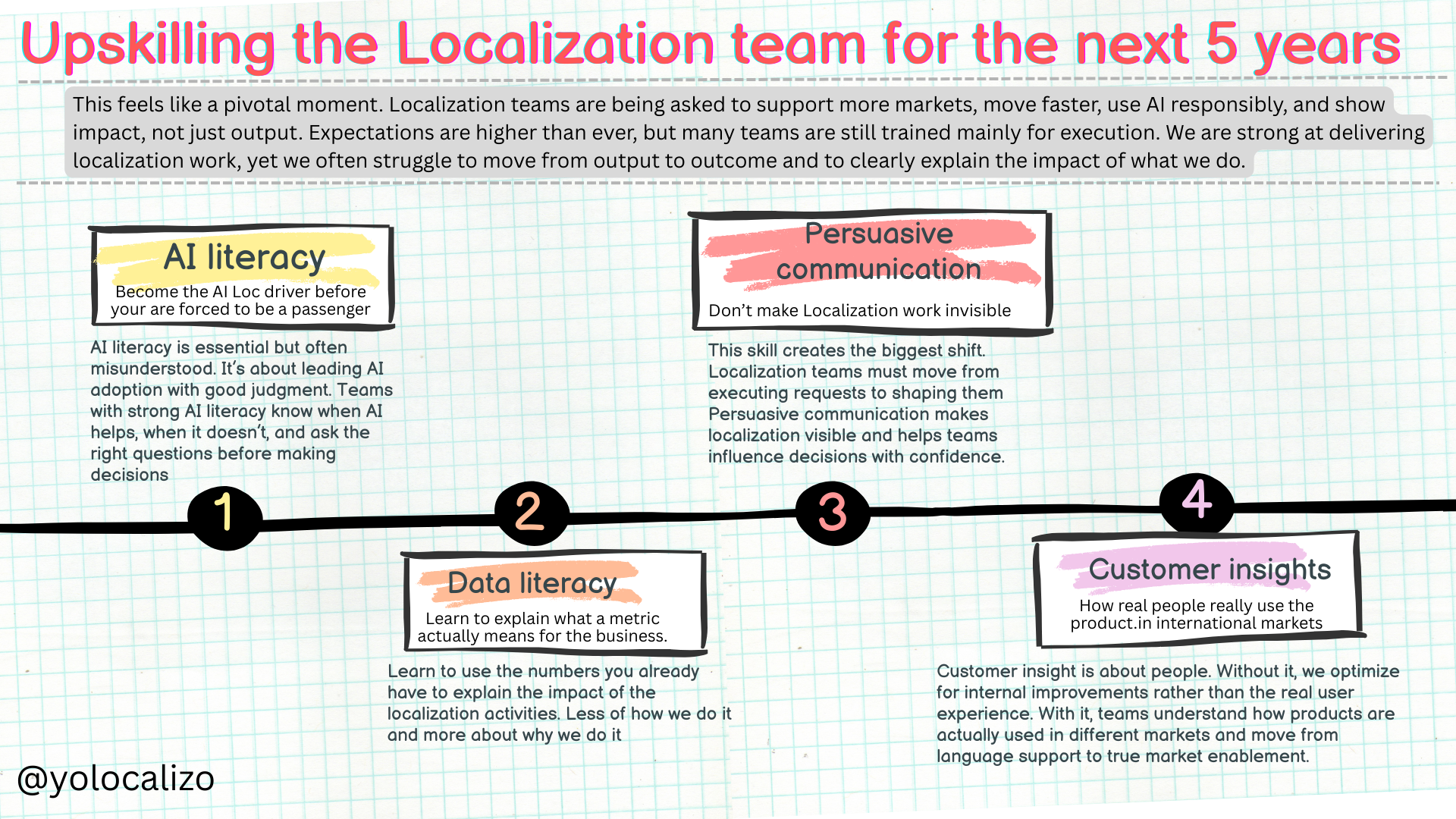
Currently, this feels like a pivotal moment for many of us. Localization teams are being asked to do more than ever before. Support more markets with the same or fewer resources. Move faster without sacrificing quality. Use AI responsibly, but also efficiently. Show impact, not just output. Speak the language of product, marketing, and leadership.
More is expected from us than ever. But the problem I see is that many teams are still trained mainly for execution. We are very good at the practical execution of localization tasks, but we struggle to move from output to outcome. We spend a lot of time explaining how we do things, and much less time explaining the impact of what we do.
That gap between expectations and skills is starting to hurt. I see it in frustrated teams, in tense conversations about AI, and in localization being pulled in late, or not at all, into important decisions.
After working closely with localization teams for years, I’m starting to have a fairly clear picture of where we are real superstars, and where things are harder for us. These are the skills I believe will matter most over the next five years.
Click HERE to download the infographic
AI literacy
AI literacy is the first one, and probably the most obvious. But it’s also the most misunderstood.
The goal here should be for localization teams to become drivers of AI adoption inside the company. Instead of waiting for a product owner, an executive, or even a finance partner to push AI into our localization processes, we should take the initiative. Take the bull by the horns. Think proactively about how AI can help localization teams, experiment with it, and give visibility into what works and what doesn’t.
We need to make an effort to become AI-proficient. And by that, I don’t mean becoming AI experts who understand how models are trained or spend all day writing prompts. What I mean is developing a solid understanding of what AI is good at, where it falls short, and when human judgment truly matters.
Our goal should be to develop the criteria to say “yes, this helps” and “no, this is risky” with confidence.
Teams that lack AI literacy often swing between two extremes. Either they trust AI too much and automate things they shouldn’t, or they reject it completely out of fear. Neither approach works in the long run.
Good AI literacy enables teams to ask more effective questions. What is the risk here? What does “good enough” mean in this context? What should be reviewed by a human, and why? Those questions are far more valuable than any specific tool.
A practical way to build this skill is through safe experimentation. Pick one real use case, test it as a team, and talk openly about the results. Not just whether the output was good, but what surprised you, what felt uncomfortable, and what you would or wouldn’t trust next time.
On the learning side, I usually recommend practical AI books and articles written for product, content, or business audiences, rather than engineers, as technical resources tend to delve much deeper than what most localization teams actually need.
Data literacy
Data literacy is another skill that may seem obvious, but is often overlooked in practice.
Localization teams usually have access to a lot of data: cost, quality, turnaround time, volume, language coverage, user feedback. The issue is rarely a lack of data, but rather a lack of confidence or sometimes even knowledge when it comes to using it. I’ve seen many smart localization professionals struggle when numbers become part of the conversation. Or rely on dashboards they don’t fully trust. Or struggle to explain what a metric actually means for the business. Data literacy doesn’t mean becoming a data scientist. It’s more about gradually changing the mindset and becoming comfortable enough with numbers to incorporate them into the conversation. Reading trends, questioning assumptions, and explaining what the data is saying in simple words.
Books like Storytelling with Data by Cole Nussbaumer Knaflic are a great starting point. It’s one of my favorite books because it focuses on clarity and communication, not formulas. It helps you think about how to present localization numbers in a way that actually supports decisions.
Beyond books, some of the most effective learning occurs internally. Spending time with finance, operations, or product analytics teams can be incredibly eye-opening. Asking how they read dashboards, which metrics they trust, and why. This also helps localization teams align better with how the business thinks.
Consulting and persuasive communication
This is the skill that, in my experience, creates the biggest shift.
Localization teams are often trained to take requests and deliver them. Someone requests something, and the team determines how to execute it. That model no longer works well.
The future requires localization teams to act more like internal consultants. That means shaping requests, not just accepting them. Asking why something is needed when we see a weird request. Explaining trade-offs. Recommending options, not just executing tasks.
Persuasive communication is a big part of this. It’s about presenting recommendations clearly, adapting the message to different audiences, and being confident enough to defend a point of view. Not aggressively, but thoughtfully.
Good localization work is often invisible. When things work, no one notices. When they don’t, everyone does. I’ve never been a big fan of the idea that localization should be invisible when done well. For me, that often means our work is taken for granted.
I believe the opposite: we should make our work visible and explain how what we do helps the company. What is visible is less likely to be ignored.
Looking outside localization helps a lot here. Books like The Pyramid Principle by Barbara Minto are still extremely relevant. They teach you how to structure your thinking and your message so others can follow it.
Practice matters even more than reading. Short internal presentations, clear written recommendations, and honest reflection after meetings all help build this skill over time.
This is also where Toastmasters has personally helped me. I’ve been part of this community since 2016, and I’ve found it incredibly useful. It’s a safe and practical environment for practicing public speaking, structuring messages, and receiving honest feedback. Not to become a conference speaker, but to become clearer and more persuasive in everyday work conversations. The impact of that confidence shows up very quickly at work.
Customer insight
Finally, customer insight.
Localization has never really been about words. It’s about people. Real users, in real markets, using products in ways that don’t always match internal assumptions.
Teams that lack customer insight often optimize for internal efficiency, not for real user experience. They make decisions based on what seems logical from headquarters, not on how products are actually used in different markets.
Customer insight means getting closer to reality. Understanding how people interact with products, where they struggle, and what feels natural or strange to them. It shifts localization from language support to true market enablement.
This skill is best learned close to real users. Joining user research sessions, listening to support or sales calls, reading market-specific feedback, and regularly communicating with regional teams all contribute. Even small exposure makes a difference.
Communities around UX research or product discovery can also be valuable, especially because localization is often missing from those conversations. Seeing how other teams approach user insight can broaden perspective.
In conclusion
None of these skills are built overnight. And they don’t require massive training programs or perfect roadmaps.
What they require is intention. Teams that intentionally invest time in AI literacy, data literacy, consulting and communication, and customer insight are much better prepared for the new normal that is already taking shape. They are calmer in the face of change. They make better decisions. And they are more trusted by the business.
When these skills are missing, the same patterns repeat. Decisions are made elsewhere. AI adoption becomes messy or shallow. Localization stays reactive. Impact is hard to prove.
I don’t think the real question is whether localization teams need to upskill. That part is clear.
The more interesting question, especially as we look ahead to the next year, is this:
Which of these skills are we still under-investing in today?
I’d love to hear how others are thinking about this.
@yolocalizo
Choosing a TMS is not an IT vs Localization decision. Localization understands the business problem and the workflow; IT understands the technical ecosystem. The best result comes when both work together, with clear roles, shared criteria and a selection process that looks beyond the vendor demo.