


Your bilingual employees are not your AI Localization quality strategy
The other day, I was chatting on WhatsApp with a friend who is living in Turkey. He is the kind of friend you do not need to talk to all the time to feel that the friendship, or the relationship, is still alive. It is as if we simply continue from where we left off. I do not really know why that happens. It does not happen to me with everyone, but with this friend, it does. It is a different dynamic, and I feel comfortable with it because we can talk about anything, asynchronously most of the time, and via FaceTime every now and then.
The last thread I had with him, which is the essence of this post and what made me think, was about his company, a Turkish video game company. By the way, the gaming market in Turkey is an incredible opportunity in case anyone is interested in looking there :) The company is growing above average, and, of course, AI came up in our message exchange.
He told me that his company had implemented certain AI workflows, including one responsible for translation. That is where they had asked him to take a look at the Spanish and see what “quality” it had. My friend is a game designer, so now he is wearing multiple hats: now I design, now I am a linguist, and now I am a quality guardian…
And that conversation left me thinking because his case is probably not an isolated one. I can imagine many companies doing something similar right now: using AI to generate the first translation and then asking an internal person, usually bilingual, to check whether the result is good enough.
At first, I understand why this sounds like a good idea: if you are under pressure to reduce costs, support more content, show progress with AI, and still maintain some human validation, this approach feels like a reasonable middle ground. AI creates the first version, an internal employee who speaks the language reviews it, the business gets faster content, and the budget looks better.
But, as it often happens in Localization, the answer is more complicated than that. I always become a bit suspicious when the word “just” appears in a workflow, because a simple request like “Hey, could you just check if this AI translation sounds good?” can mean many different things depending on the content, the risk, the reviewer, and the expectations behind the request.
Sometimes it really is a quick check, especially if the content is simple, low risk, and the AI output is good enough. But other times, “just reviewing” means fixing terminology, adjusting tone, or rewriting parts of the AI output because the translation is understandable but not really engaging.
Where the work really goes
I think this is one area where companies may underestimate the real cost of AI in Localization. The conversation usually starts with the visible cost: how much we paid before, how much AI can reduce the LSP invoice, or how much faster we can deliver. Those are valid questions, but if we only look at the invoice, we may miss the cost in someone else’s calendar.
Imagine a company uses AI to translate a campaign into several languages. AI creates the first draft, and native speakers, like my friend, review it. It looks efficient, but then one person rewrites the copy because the tone feels generic, another changes product terms, and another does not have time, so the review is delayed. Maybe translation cost went down, but if internal teams are spending hours correcting or approving AI output, I am not sure we are looking at the right number.
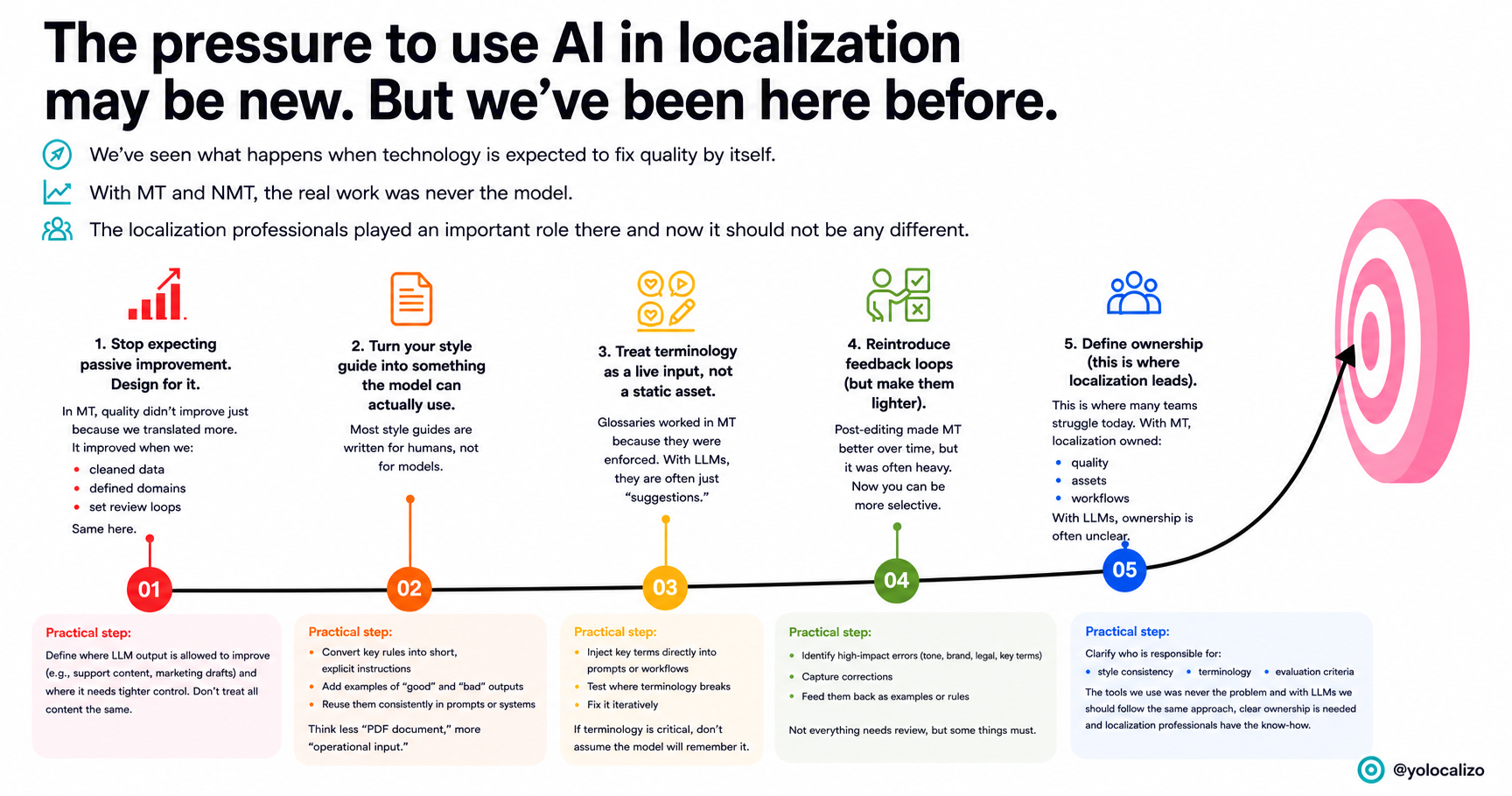
This problem is not completely new
For me, this is the part that feels risky. We may be asking bilingual employees to serve as the quality layer for a workflow that hasn't really been designed.
One risk is quality and consistency. Each reviewer may understand the task differently. Someone may rewrite everything because it does not sound natural, while another person may only fix obvious mistakes because they are busy. Someone else may focus on terminology or brand voice. None of that is wrong, but it becomes difficult to manage when nobody has defined what “review” means.
And this is exactly what a Localization project manager and a mature Localization process are supposed to prevent. A good process does not leave reviewers guessing. It defines the review purpose, expectations, terminology to follow, and the point at which feedback becomes preference rather than an issue.
For me, Localization quality also depends on the system around the reviewers. People may speak the language, but they still need context, instructions, terminology, and clear expectations to review in the same direction.
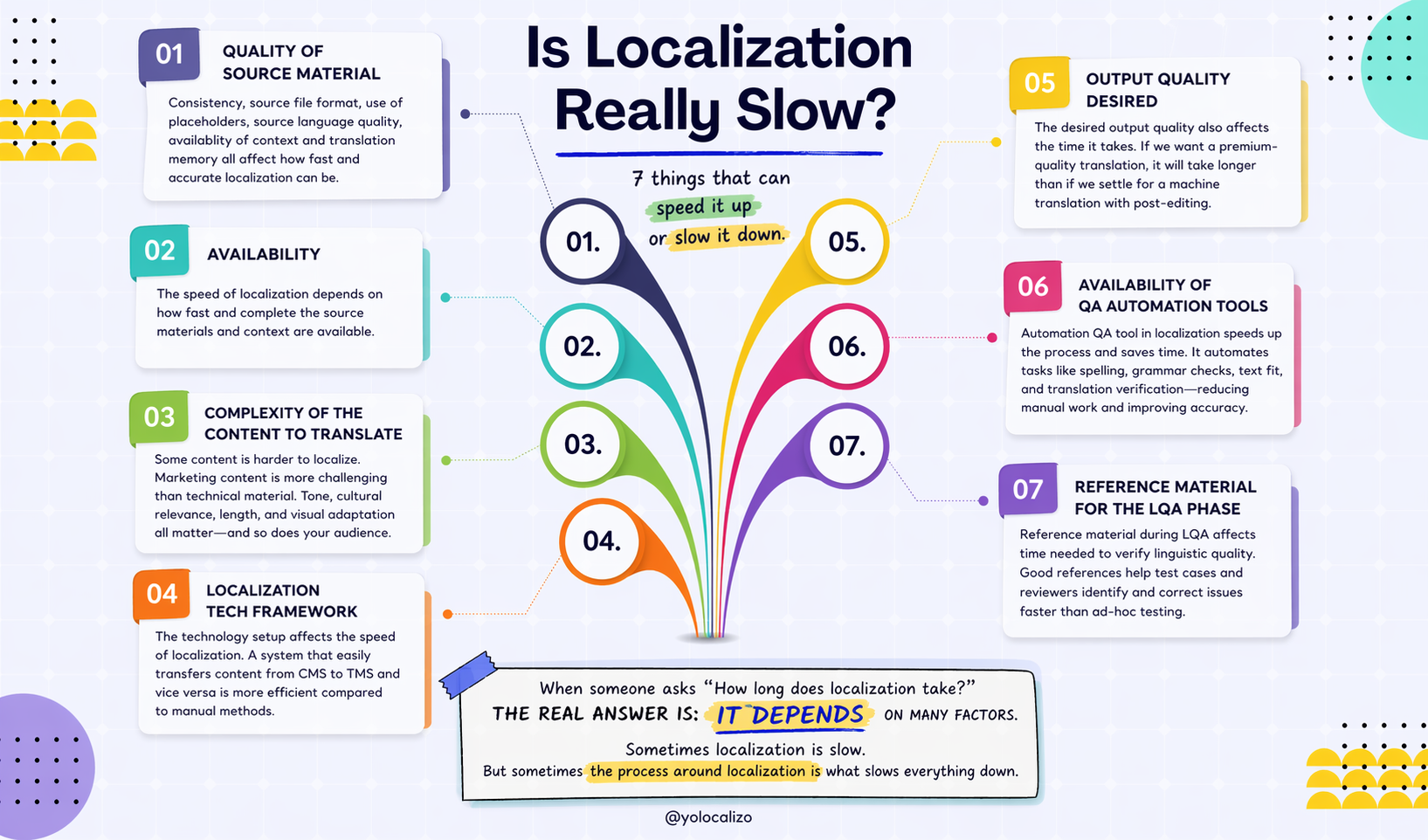
Time is another risk. AI can quickly create the first version, but that does not mean the full process is fast. If the content still needs to wait for a busy game designer, as in my friend’s case, the bottleneck has simply moved. Every hour my friend spends correcting AI copy is an hour he is not spending on game design.
Speaking the language is not the same as owning quality
I don’t want this to sound like I am saying bilingual employees should not be involved. They can be valuable in focus groups, language jams, market validation sessions, or product feedback discussions. They understand the local market and can quickly see if a message feels credible or strange. But there is a big difference between asking someone to validate market fit and making that person the quality strategy for AI translations.
In practice, we often put many different things under the term “review”: linguistic quality, product accuracy, market validation, legal approval, terminology, brand voice… but these are not the same task. When we ask someone to “review” without explaining what that means, we leave them to guess.
How I would approach it
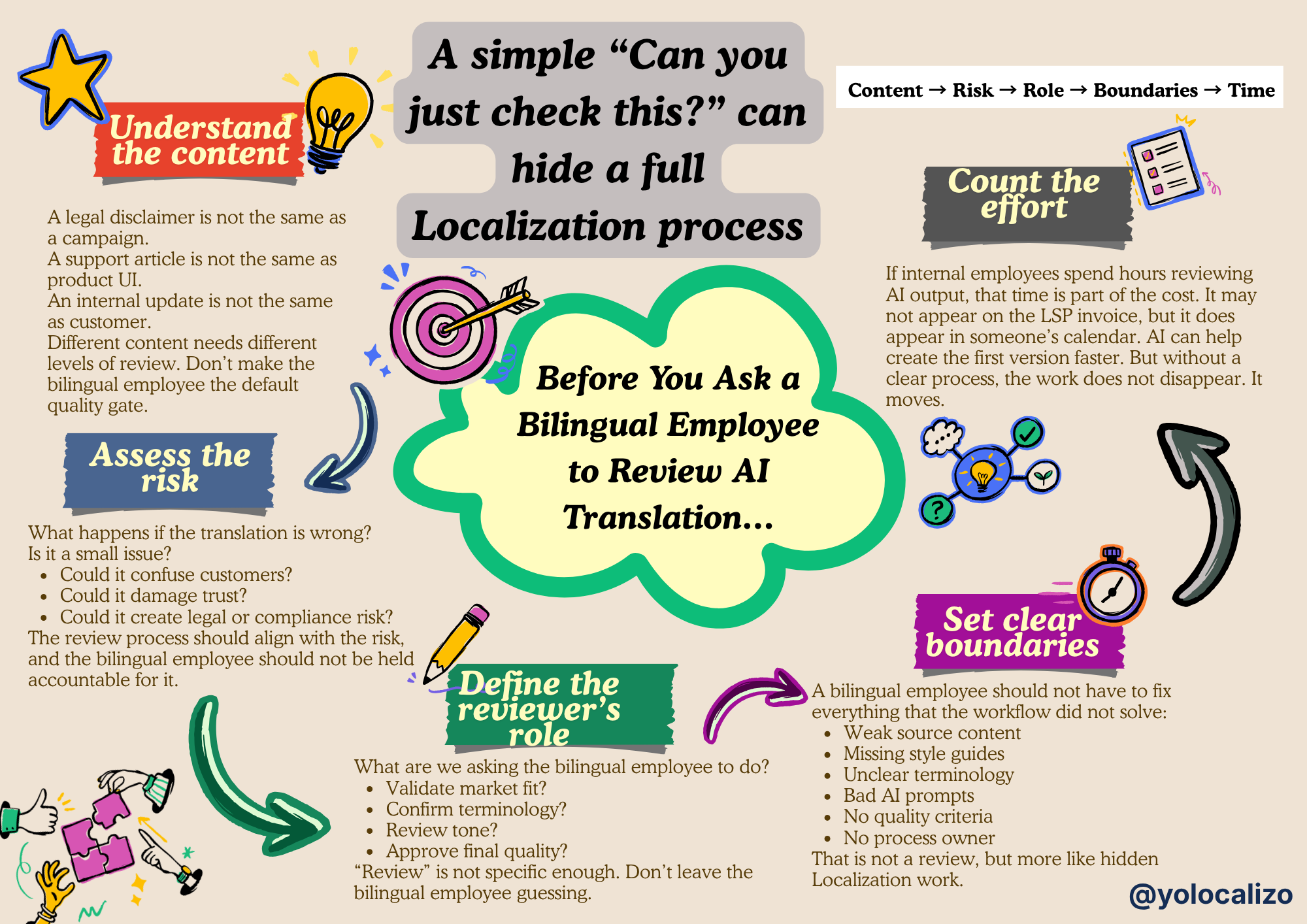
Click HERE to download the infographic
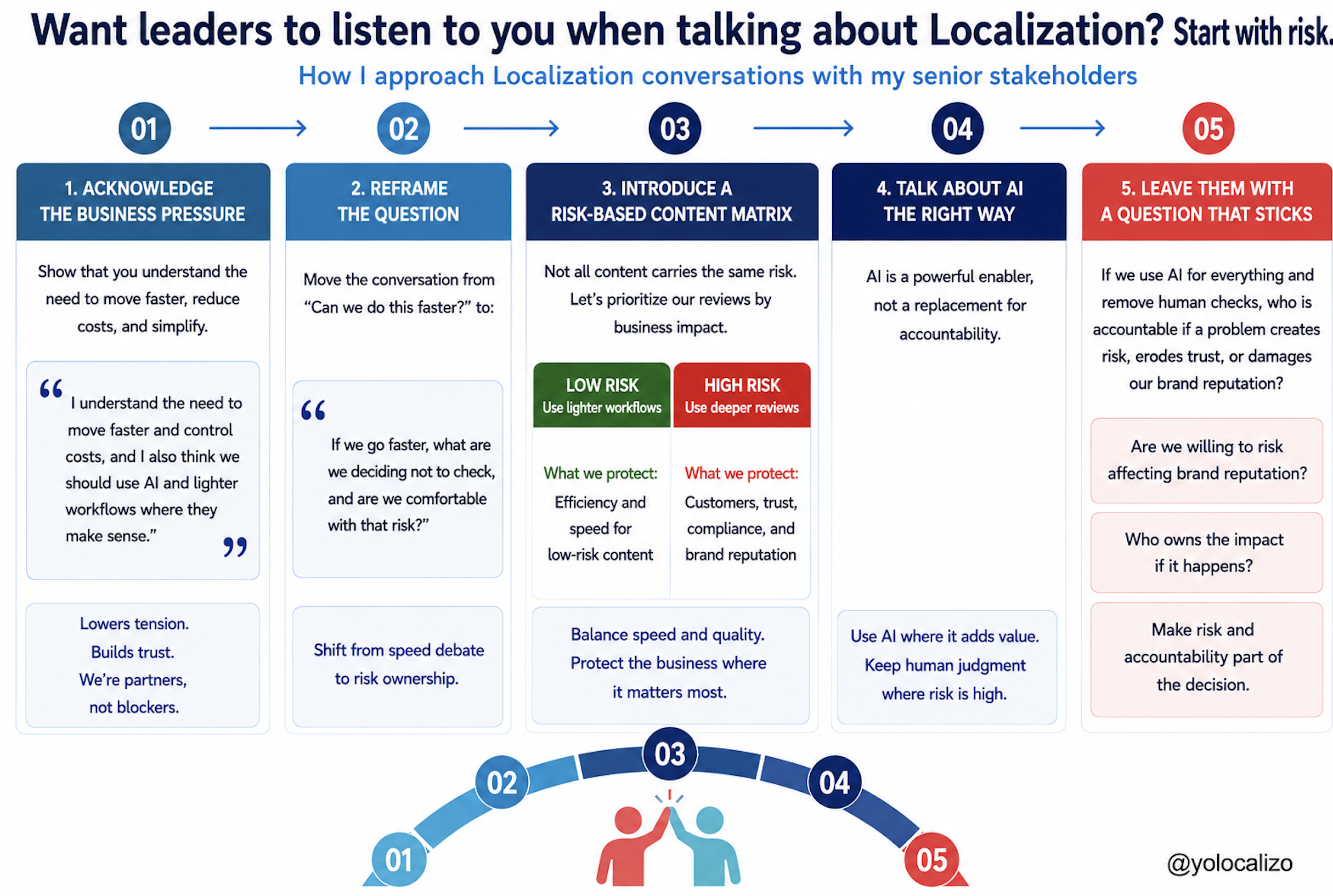
For me, a better approach starts by accepting that not all content should go through the same process. A legal disclaimer is not the same as an internal update. A paid campaign is not the same as a support article. Before asking someone to review an AI translation, we need to ask what content we are dealing with, who will read it, what happens if it is wrong, and whether speed matters more than polish.
The next step is to clarify the role of bilingual employees. Maybe we only need them to validate whether the message works for the market. Maybe we need product accuracy. Maybe we need terminology input. But if the expectation is that they fix everything that AI, weak source content, missing style guides, and unclear terminology did not solve, then the process is already asking too much.
We should also measure internal review time when discussing AI savings. If employees spend hours reviewing AI output, if launches are delayed, or if Localization spends more time coordinating feedback, those things should count too.
Final thoughts
I don’t think this should be a debate about choosing between AI, bilingual employees, or professional linguists. All of them can add value in the right context. What I find more useful is to define the role each one should play before the workflow starts.
If local teams bring market knowledge and customer reality into the process, that can add value. But if their role becomes “please fix whatever AI produced because you are bilingual,” then we may be creating a hidden problem.
Maybe the real question is not only whether a bilingual employee can check the AI translation, but what we are really asking that person to become. Are we asking for a quick market validation, or are we turning them into a reviewer, terminology owner, brand guardian, and final quality gate without saying it clearly?
AI may help us create the first version faster, but if the workflow after that is unclear, the work does not really disappear. It moves to someone’s calendar, someone’s review comments, and sometimes someone’s frustration.
@yolocalizo
What if asking AI the same question in English, Hindi, or Arabic leads to different levels of critical feedback? Anthropic’s latest research raises fascinating questions about culture, AI behavior, and why Localization expertise may become increasingly relevant beyond translation.