

In an economy where the average company finds it challenging not only to grow but sustain, it is worth considering which are the different ingredients needed to design a cross-cultural experience

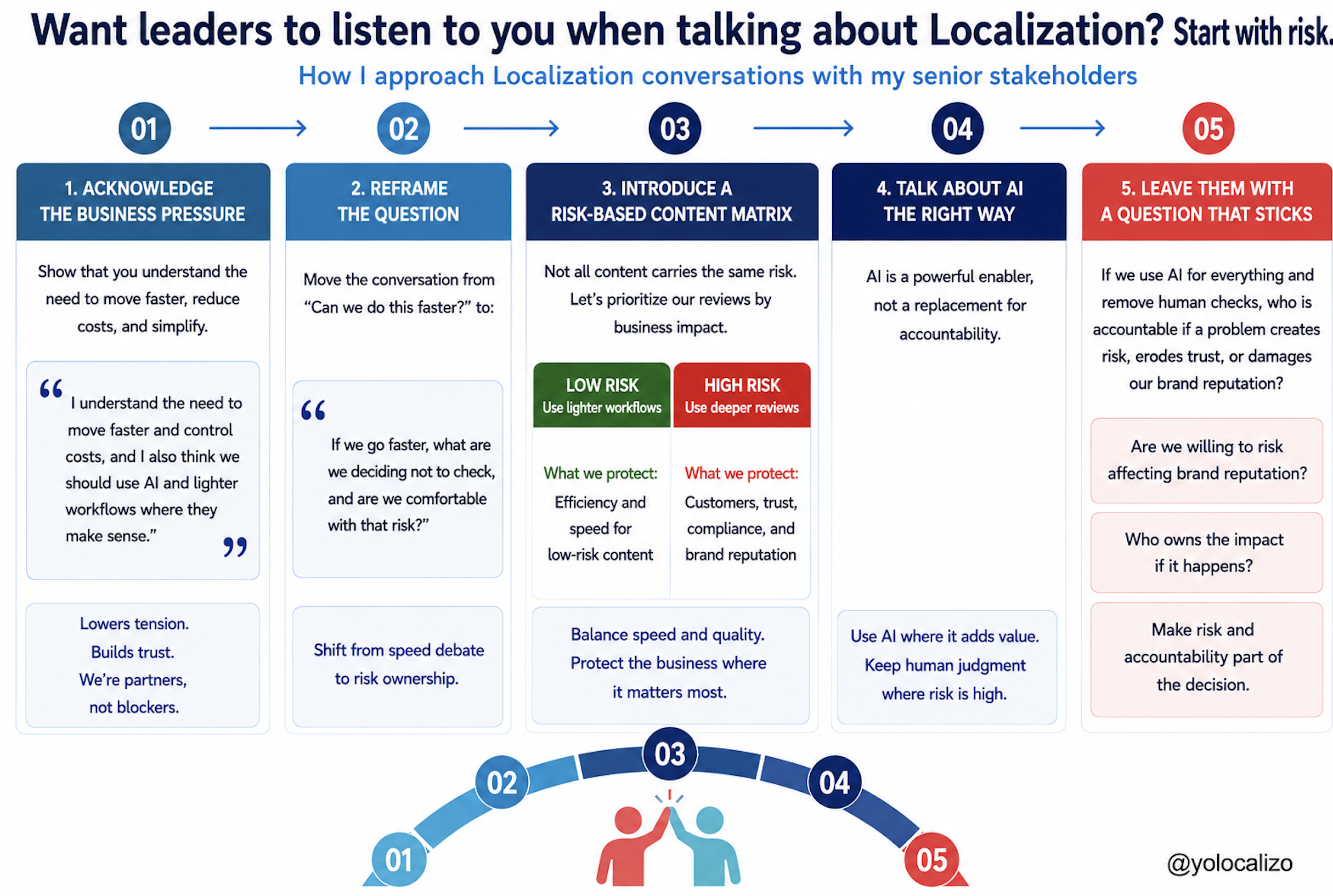
When leaders push back on localization time, resources, or AI, the strongest answer is not to defend every step of the process. It is to reframe the conversation around risk.
In this post, I explore why explaining Localization from a quality perspective, with too many process details, may not always be the best strategy when speaking with senior stakeholders.
This post explores the key differences between working on the buyer versus the provider side of the localization industry. While there are some tasks common to both, others vary significantly in areas such as people management, operations, strategy, and metrics. The article breaks these tasks into four categories, providing examples for each to highlight these distinctions
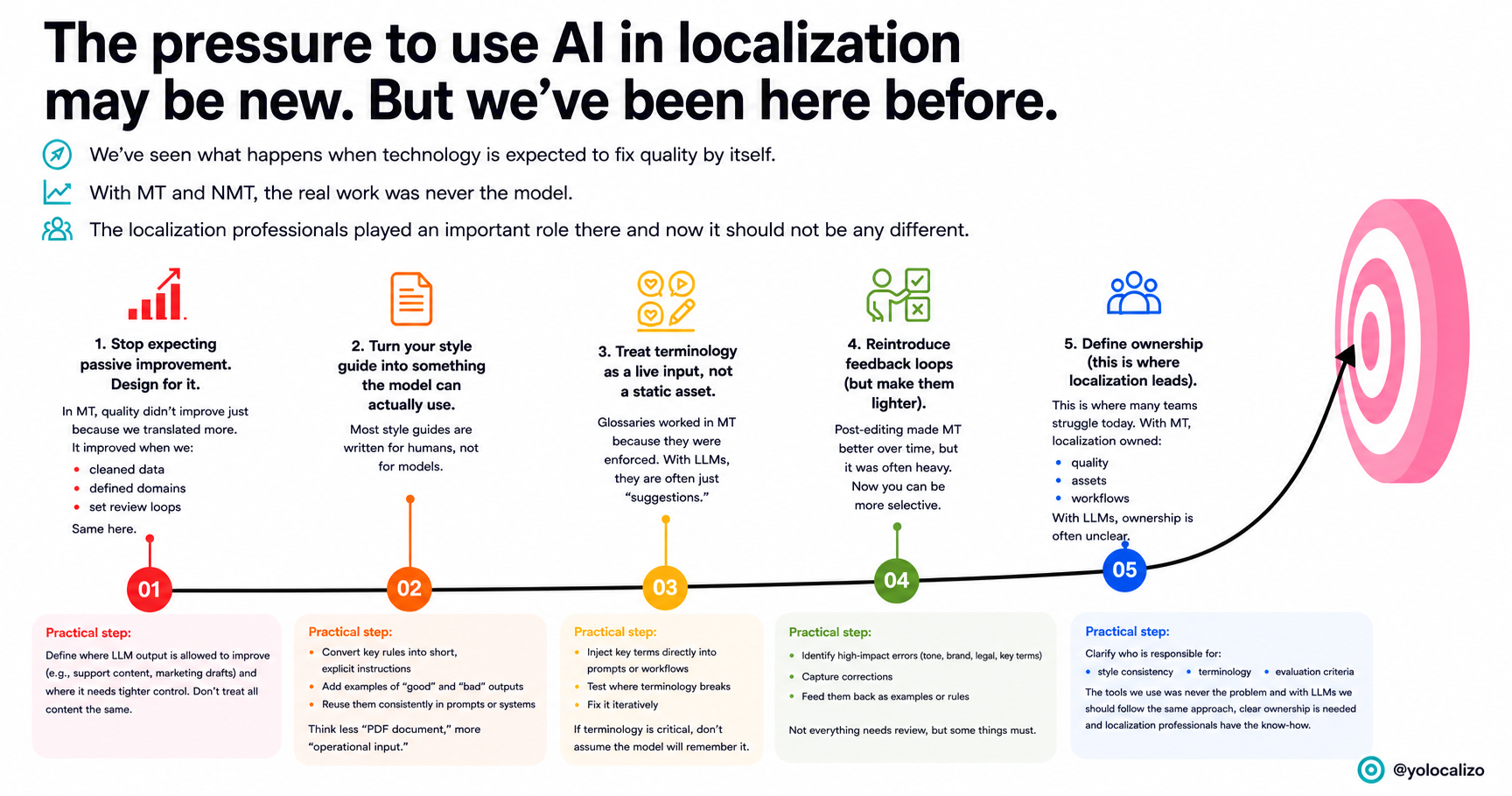
LLMs don’t learn your brand style just because you use them more. They improve when someone guides them, feeds them with examples, corrects them, and owns the outcome. In this blog post I reflect on how we can create a strategy to do that
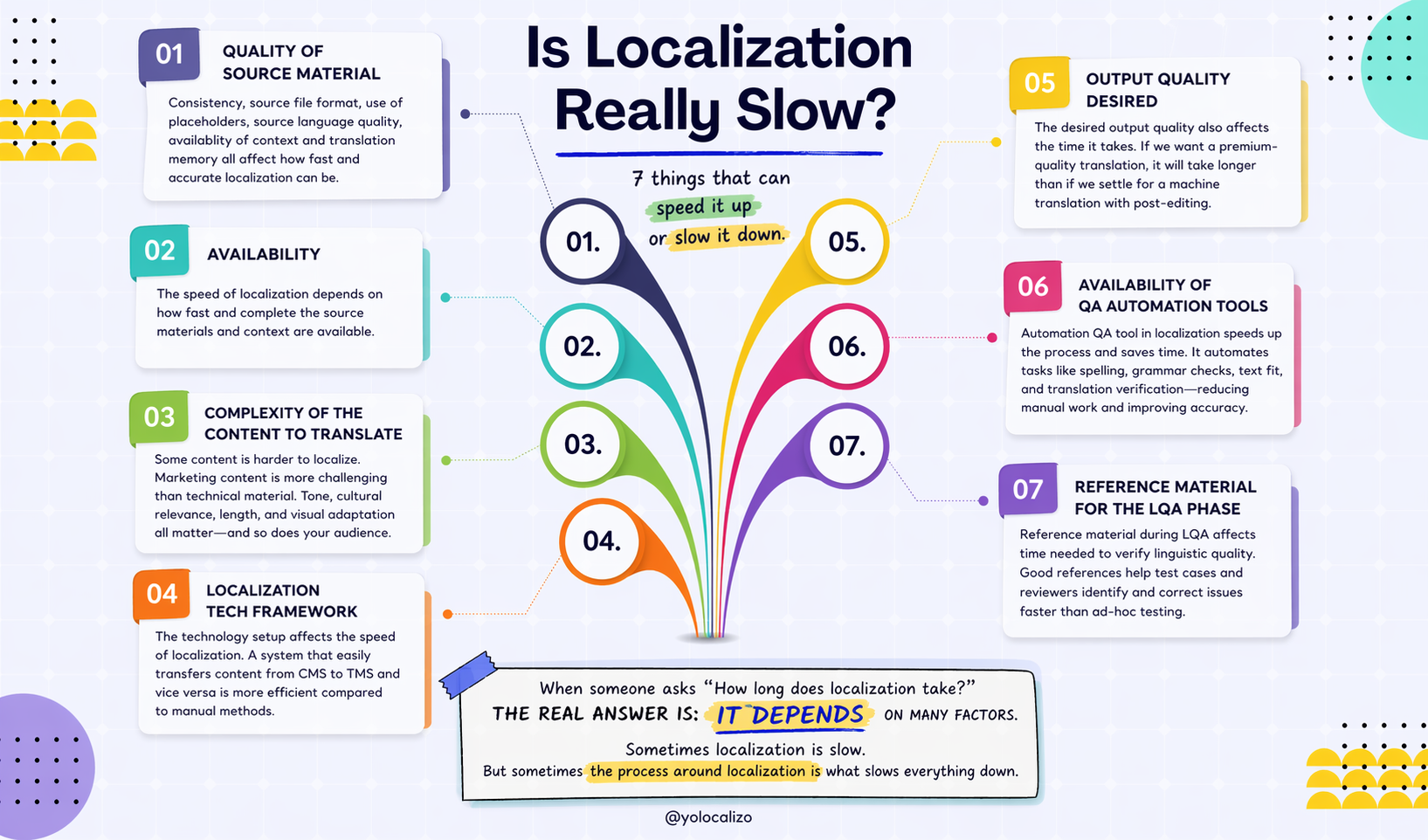
Several factors affect the duration of localization for a digital product, including translators' availability and the technology setup level. This blog post explores the various elements that impact the amount of time needed for product localization.
In some RFPs today, it is no longer so clear what buyers really value from LSPs. This post explores why. Based on my experience on the buyer side, I share why the real need may be shifting from pure execution toward something harder to explain, but often more useful in practice.
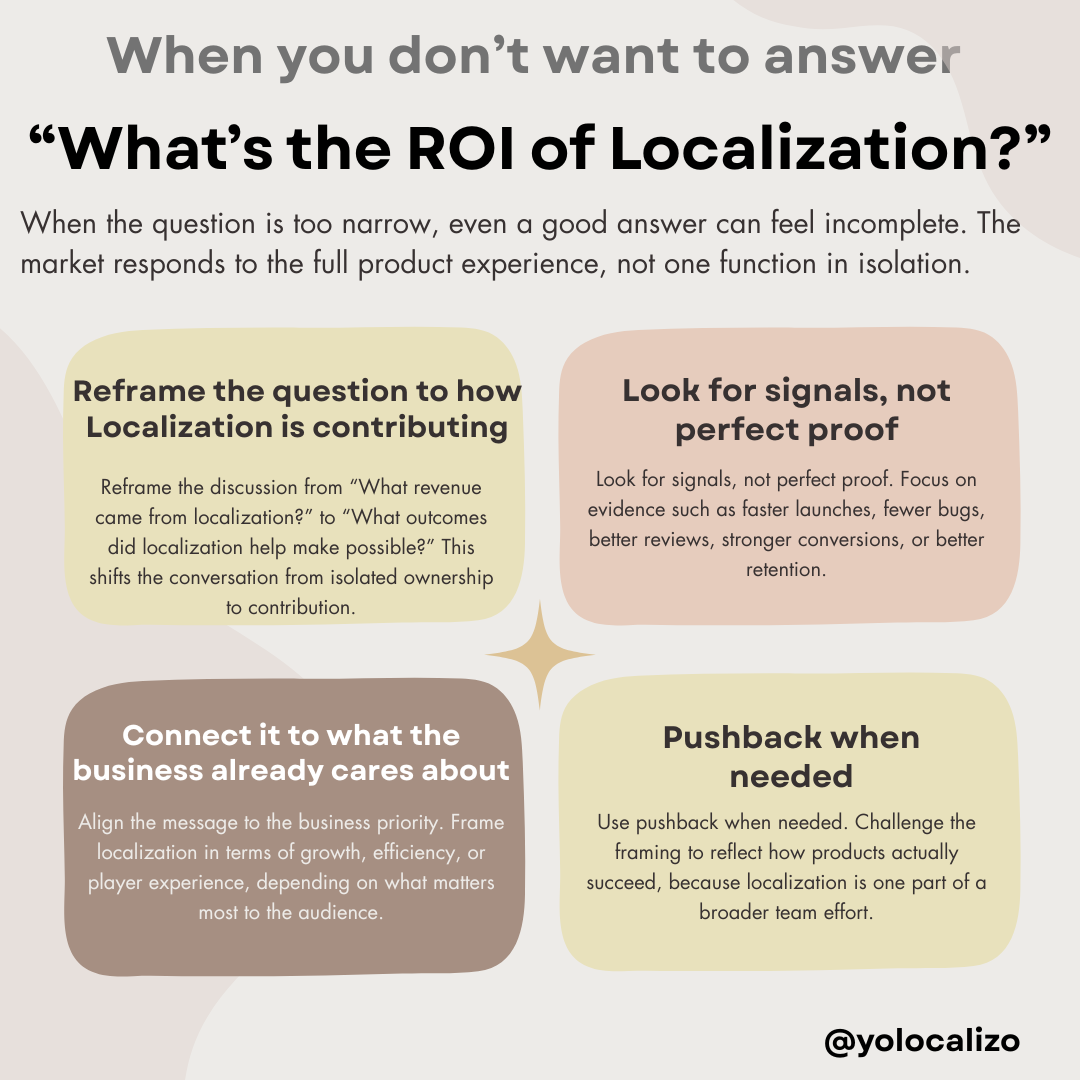
What do you do when someone asks for the ROI of localization and you know the question is too narrow from the start? In this post, I reflect on why I stopped trying to prove isolated ownership and started talking more honestly about contribution.
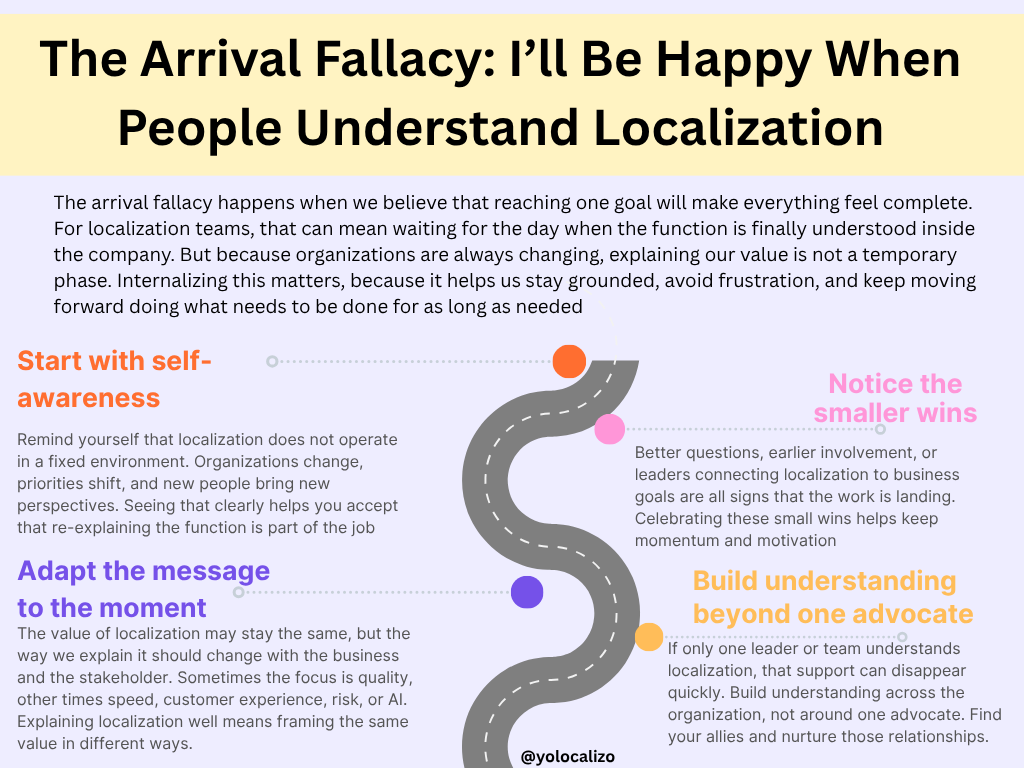
Reading The Myths of Happiness reminded me of the arrival fallacy: the belief that once we reach a certain goal, everything will finally feel solved. In localization, that can look like waiting for the day when people will finally understand what we do. But organizations keep changing, so that moment may never fully come. And maybe accepting that is exactly what helps us stay grounded, avoid frustration, and keep moving forward.
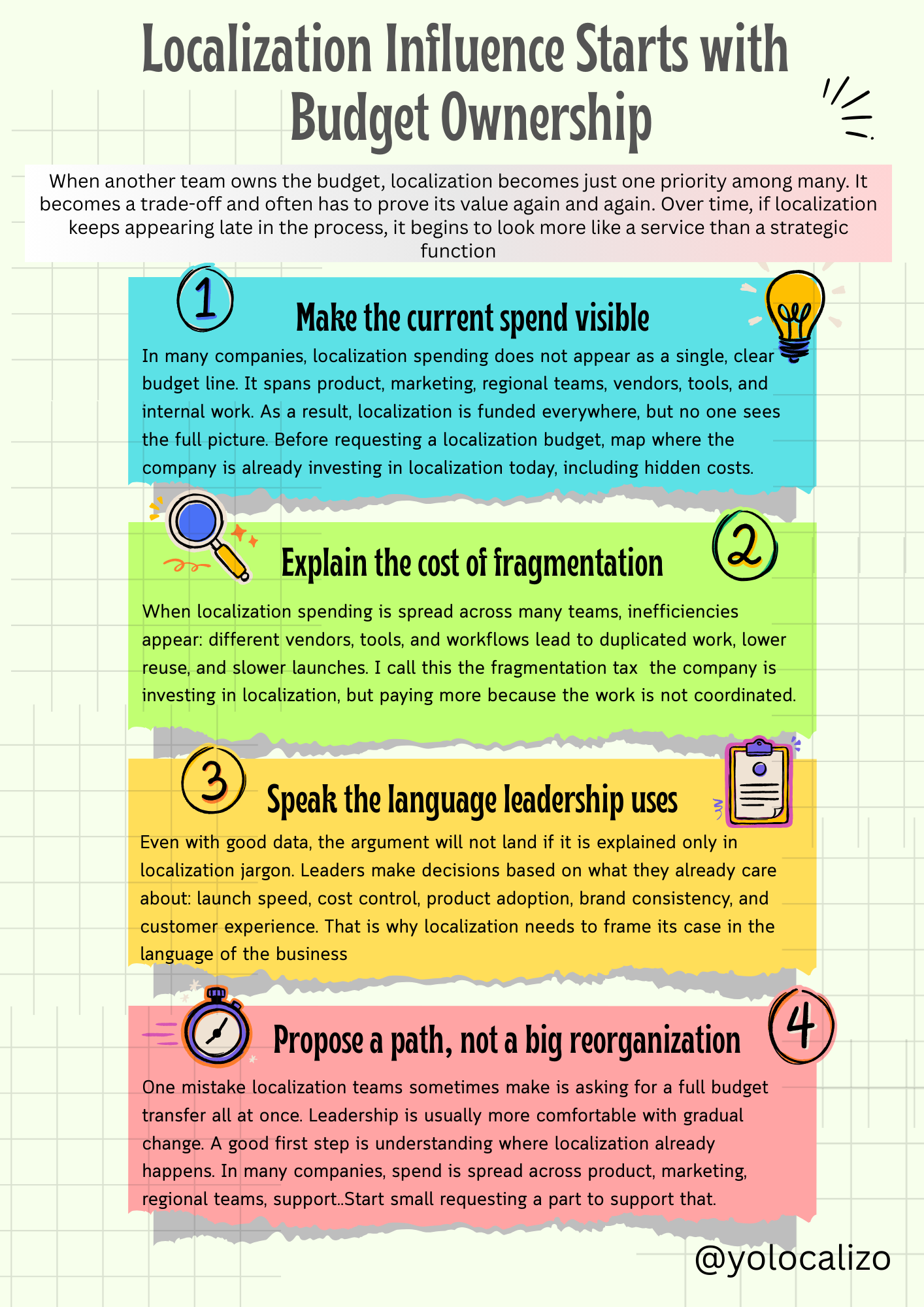
In many companies, the localization budget does not sit with the localization team. At first, that may seem like a small detail. But over time, it changes how localization influences strategy
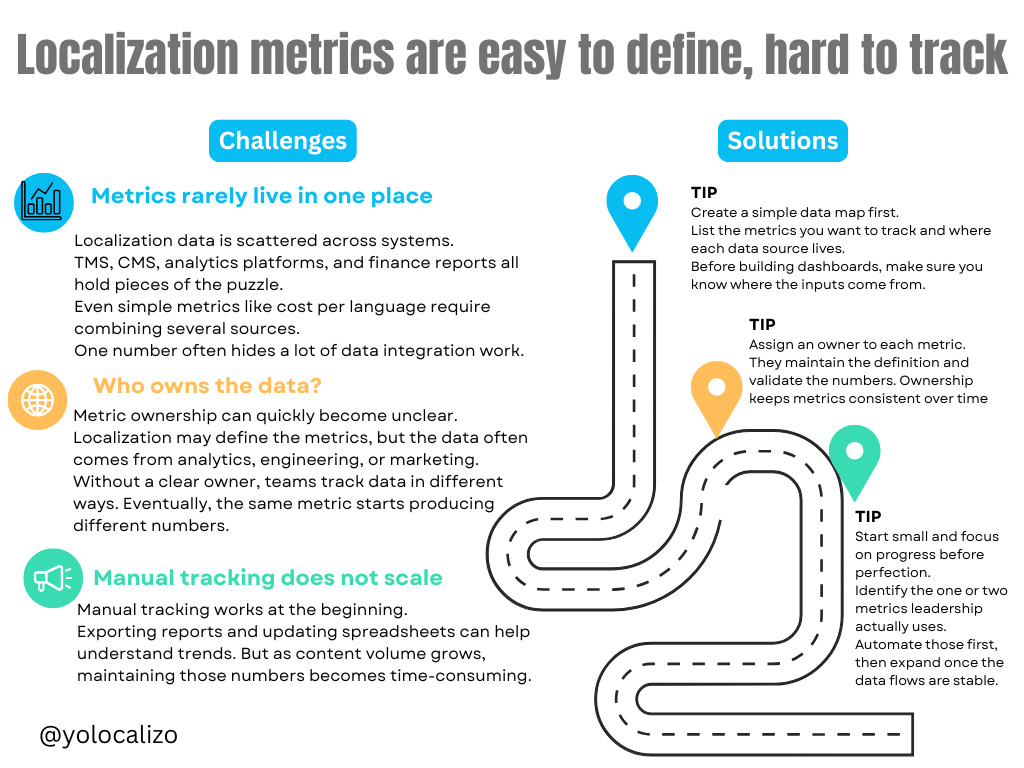
Defining localization metrics is relatively easy. In many cases, a team can write a reasonable list during a workshop, like the ones I mentioned above, or during a strategy session. The conceptual part of what to track and why rarely takes long. The real difficulty appears later: HOW you actually obtain those metrics.

“Welcome to my blog. The space where I document my passion about Localization, Project Management and Leadership”
In an economy where the average company finds it challenging not only to grow but sustain, it is worth considering which are the different ingredients needed to design a cross-cultural experience
We often have a disconnection between results and the speed with which we achieve them. We all want fast results; whether we are improving the level of a language we are learning or wishing to lose those extra pounds now that the summer is approaching. ... or .... in the Localization program, we are implementing in a company.
Unfortunately, many things in life do not follow linear progress. We face two types of curves when we want to achieve something.
And knowing which one we are in can significantly help us understand the skills we have to polish and the plan we have to follow.
The other day, I watched a movie in which the movie's central character infiltrates a drug gang. He gained their trust, which led him to get pretty much anything he wanted ... and my mind started to wonder what if I infiltrated inside the developers to motivate them to design the software with localization in mind from day one?
Sometimes, we can achieve good results by focusing on the essential parts and going back to the basics. In this post, I write about the crucial aspects to consider when defining a Localization strategy.
This year I don't have the typical list of goals to accomplish this year, no New Year resolutions. This year, I don't have goals, but I know the kind of person I want to become.
Identity-based concept, lessons learned from the book Atomic Habits adapted to my life as Globalization proffesional
Habits are formed following a sequence of 4 steps. Read this article to learn more about this fascinating topic of habit formation
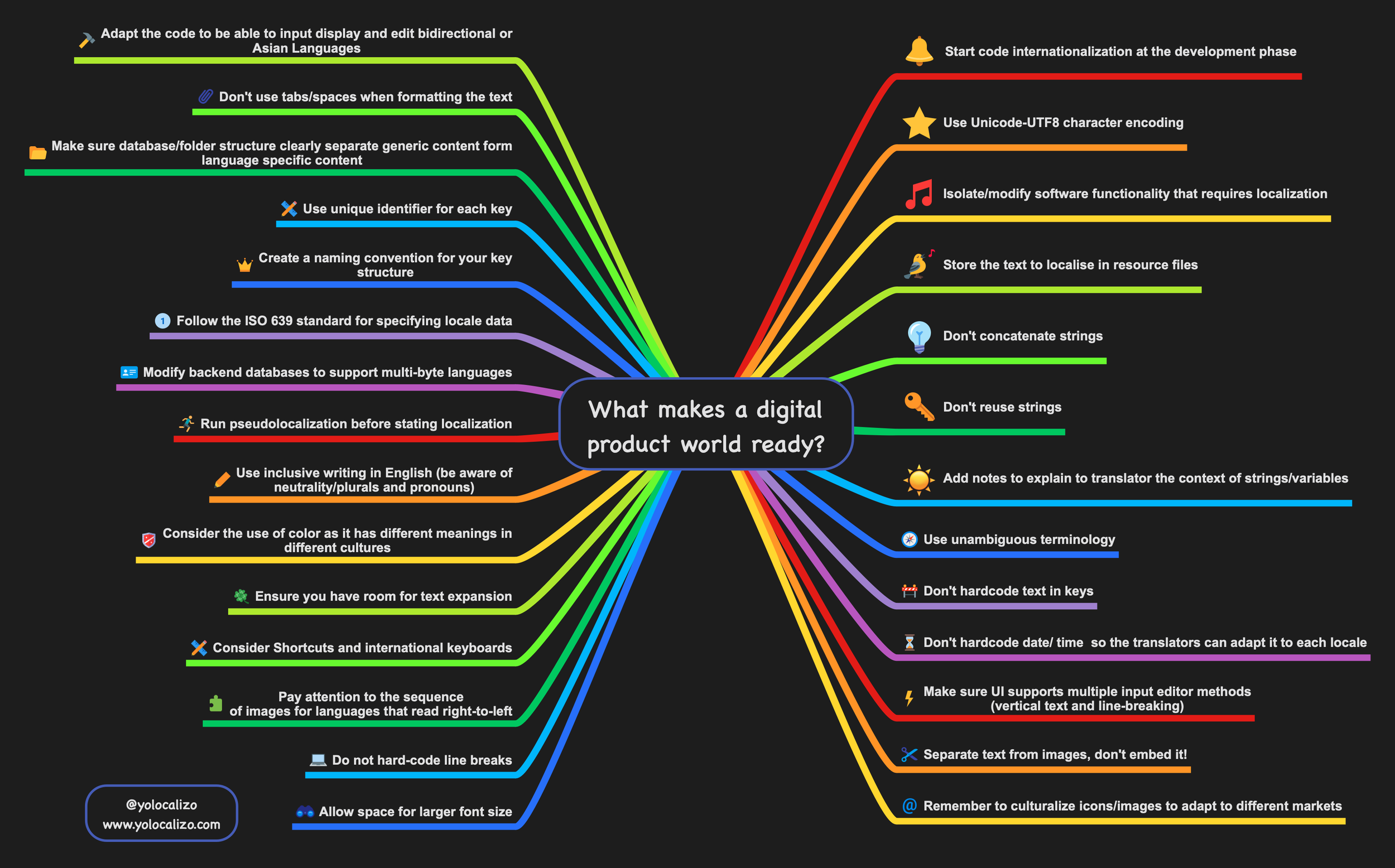
Localizability readiness is a series of processes and activities that optimize a product for a worldwide launch. In this post I explain how we can achieve localizability readiness by investing our efforts in improving the quality of the English content of the source text we create.
In this post I analyze the 7 areas that a Localization Service Buyer considers important when working with a Language Provider.
Software development using sprints are great for Localization teams! Please have a look at my post and let me know if you agree :)
Creating a localization budget is not an easy task as there are multiple variables to consider. In this article I explain the 3 that are the most important from my point of view
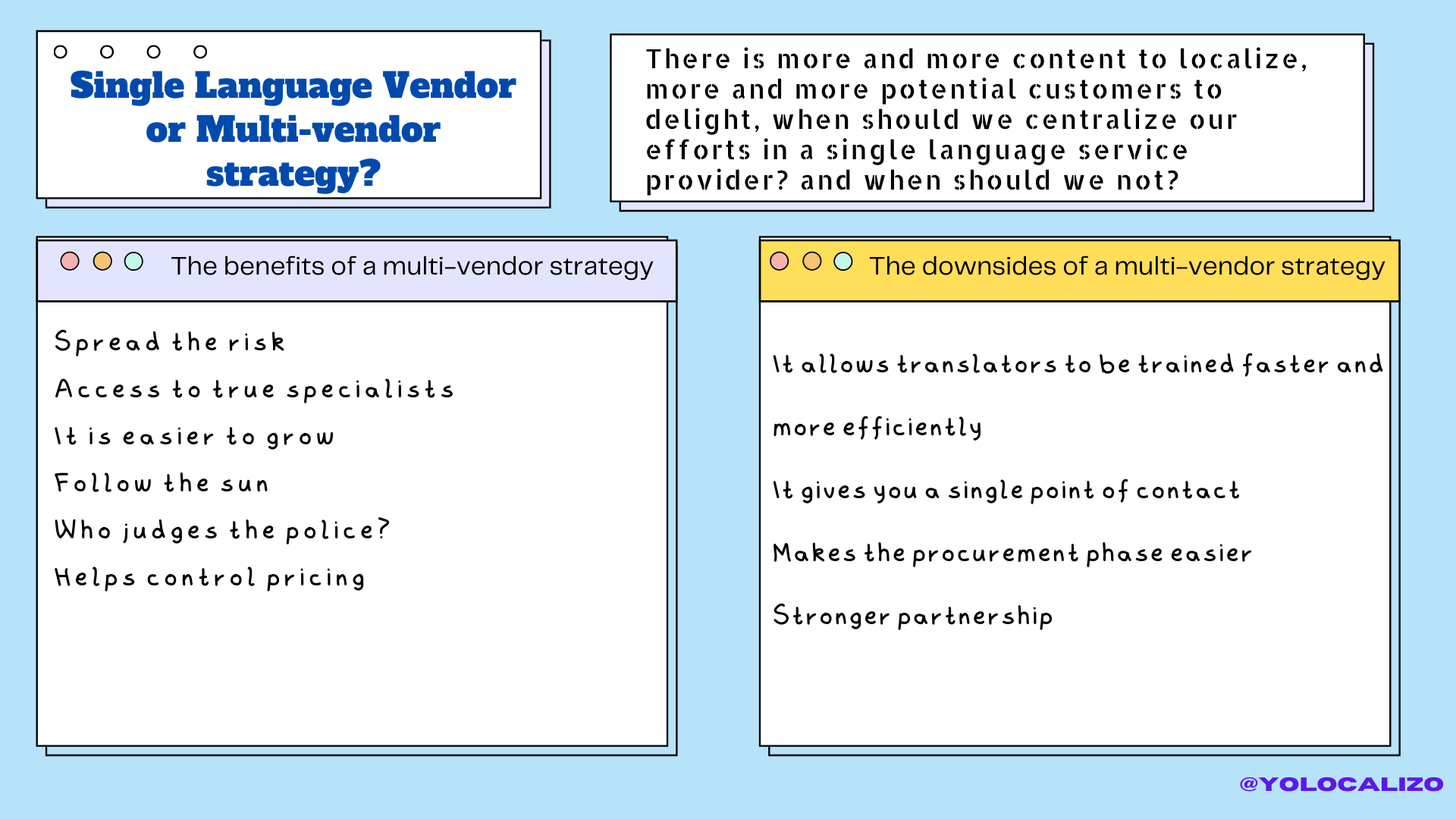
Some companies choose to have multiple vendors to execute their localization strategy while others prefer a more simplistic approach and concentrate their activities in a single partner. But what is it that can make us choose one option or the other?
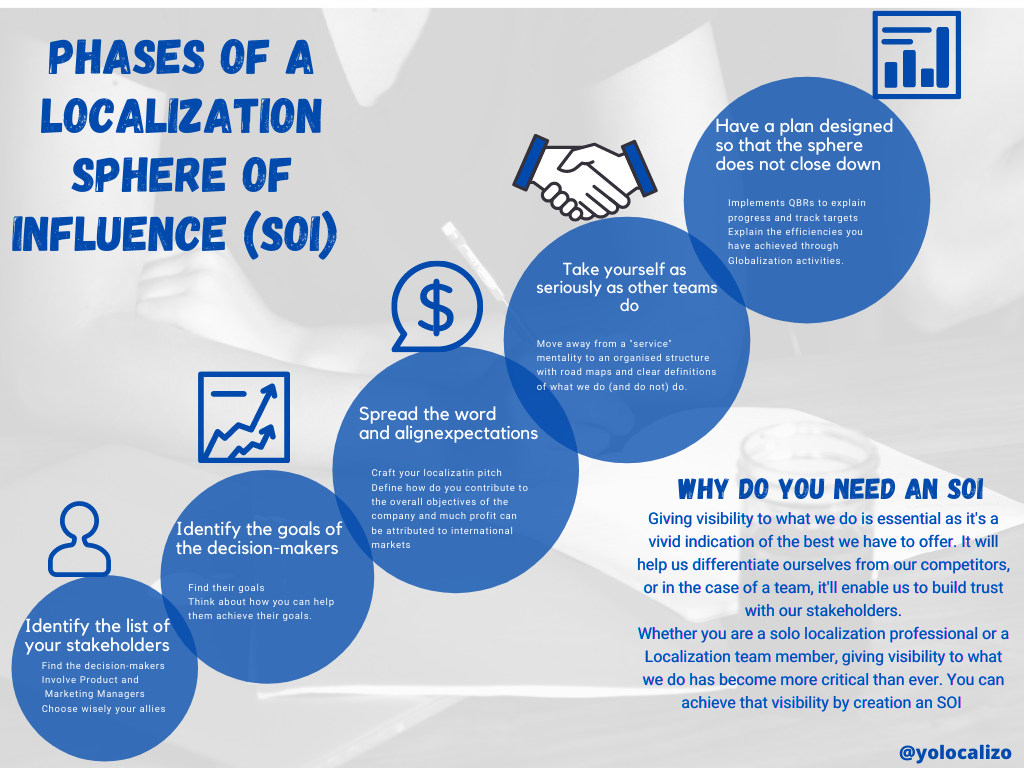
A Localization Sphere of Influence is something that can be extremely useful both to give visibility to the Localization activities we carry out and to provide us with professional development opportunities.
In this post, I explain the different phases you need to go through in order to create one and go into why it is important to have a Sphere of Influence (SOI) in your Localization strategy.
A multi-market expansion strategy for any product is most effective if the various Globalization (i.e.Localization, Internationalization) activities are understood as a cycle that runs parallel to the multiple phases of software development; This cycle repeats during the various product upgrades. It is not an activity that is executed as if it were a process once the home market version (usually in English) is finalized. It is not a transaction that simply sends files to a professional localizer shortly before the global release. No; Globalization is not a process. Globalization is a cycle that runs multiple times. It is a cycle that runs in parallel with the product research, design, and development phases.
Going global is tough. It is difficult to break into markets where you are not already present. How can we know which market has potential if we are not able to invest a lot of resources to assess which markets are the right ones for a product?
Copyedit is the process executed by a professional in the localization industry in which the editor looks for gross errors in the content they review. But how do you know you need copyedit?
On January 15, 2016, in a small but cozy hotel in London, this blog was born. In this post number 202, I make a summary of all the things I have learned by publishing a new post almost every Sunday in the last few years.
Sometimes hiring directly the services of several freelancers to carry out the Localization tasks of your project can be the best option. However, there are cases in which outsourcing all your work to an LSP/MLV may be the best localization strategy for your product.
Dealing with cultural diversity in Localization management in our industry is a dilemma in communication and stakeholders relationships. Such multicultural diversity puts in front of challenges that greatly hinder getting the best out of areas such as team dynamics or building alliances. The good thing is that today many resources can help us (a lot) raise our cultural competency and improve our cultural awareness.
Building Transparency in the Translation Supply Chain. How can we do it?
The localization industry is largely fragmented, and that fragmentation does not help achieve transparency and trust throughout the supply chain. Is this something that can change? It is not easy, but those who are in a position to buy services linguistic services can take the first step
Involving the Localization team in Playtest might be a great idea! Find out here why ☺️





AI promises faster localization, and that message is attractive. But in many teams, the real issue is not speed. The work gets delivered. The harder question is how much hidden coordination, unclear ownership, and workflow complexity it takes to get there.