


5 Types of Speeches to Communicate Our Localization Ideas Better
I have a feeling, based on everything I have seen over all these years working in the Localization industry, that Localization professionals do not lack technical knowledge. Not at all.
This industry constantly tests our technical skills through the many tools we use, the workflows we customize, and even the connectors we configure.
I do not think we have a cultural problem either. We understand the world. We understand geopolitical complexity. We understand how sensitive topics related to religion, legal matters, culture, and local expectations can be.
Where I think we struggle a bit more is in business strategy. In other words, connecting what Localization professionals do with company results.
And where I think we struggle even more is in explaining and communicating.
And I mean communication in the broadest sense of the word. I do not only mean explaining the value of metrics, or explaining how we run an AI localization process with automated LQA controls. I mean communication with impact. Persuasion. Or, if we prefer to call it that way, public speaking.
Because many times, before we explain something to stakeholders or to an audience at an event, we need to start from the beginning. And there is no better way to start from the beginning than by understanding what type of presentation we are actually going to give.
Very often, when we need to prepare a presentation, we jump straight into creating PowerPoint slides with everything we want to explain. And that is exactly where we need to change the mindset for the first time.
We need to move from what I want to say to understanding what the audience needs to hear.
It is about understanding what the audience needs to hear.
That mental shift is fundamental because there are different types of presentations with different goals. Understanding the type of presentation our stakeholders need to hear is the first step toward successful communication.
So, without further ado, let’s go through the different types of presentations we can use when we face the task of giving a presentation.
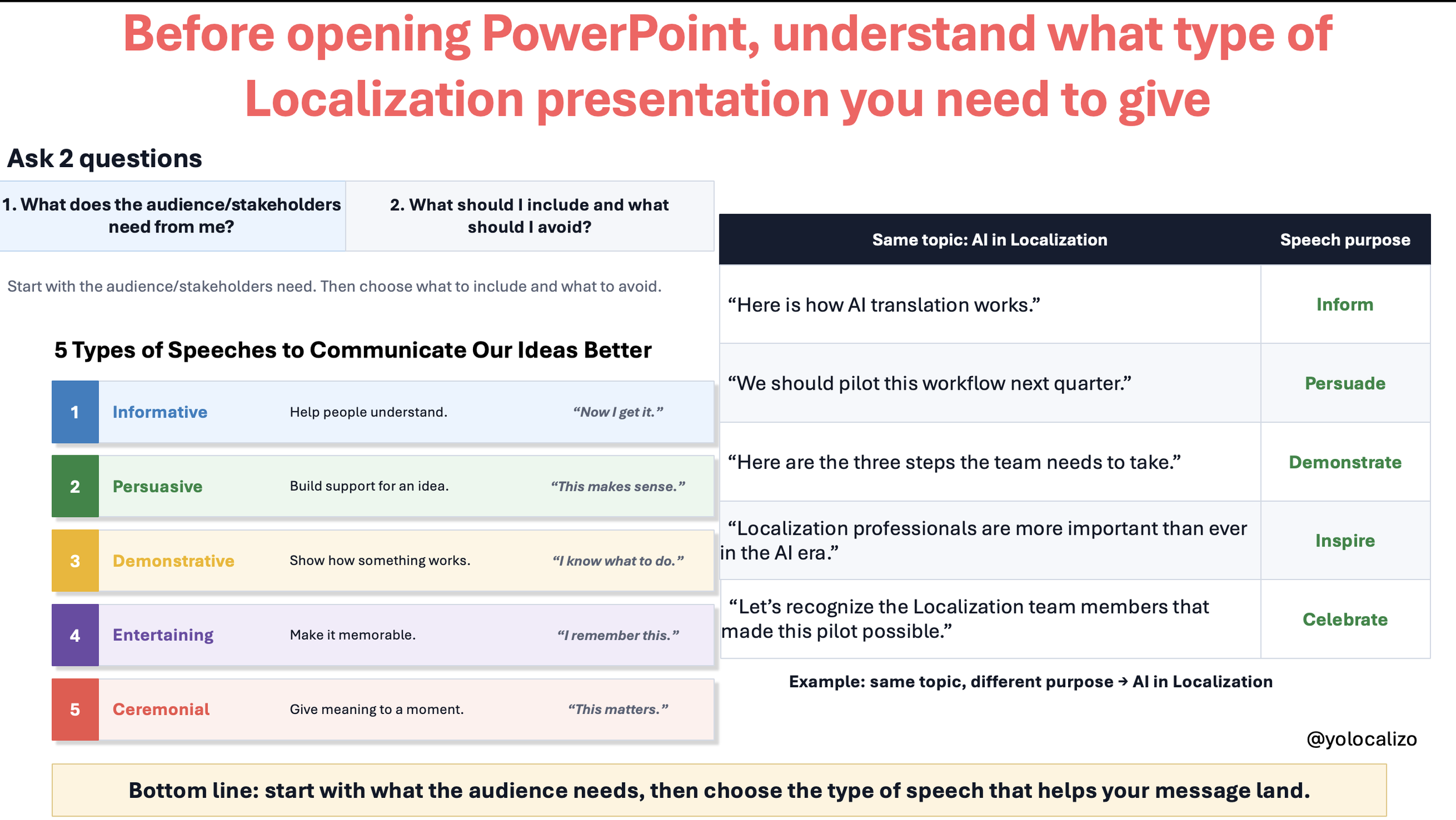
5 Types of Speeches to Communicate Our Ideas Better
Many public-speaking textbooks describe three classic purposes of a speech: to inform, to persuade, and to entertain. Some modern sources expand this to broader goals, such as inspiring, motivating, honoring, celebrating, or commemorating. The key idea is that a speech can combine several purposes, but it should usually have one primary purpose so the message does not become confusing.
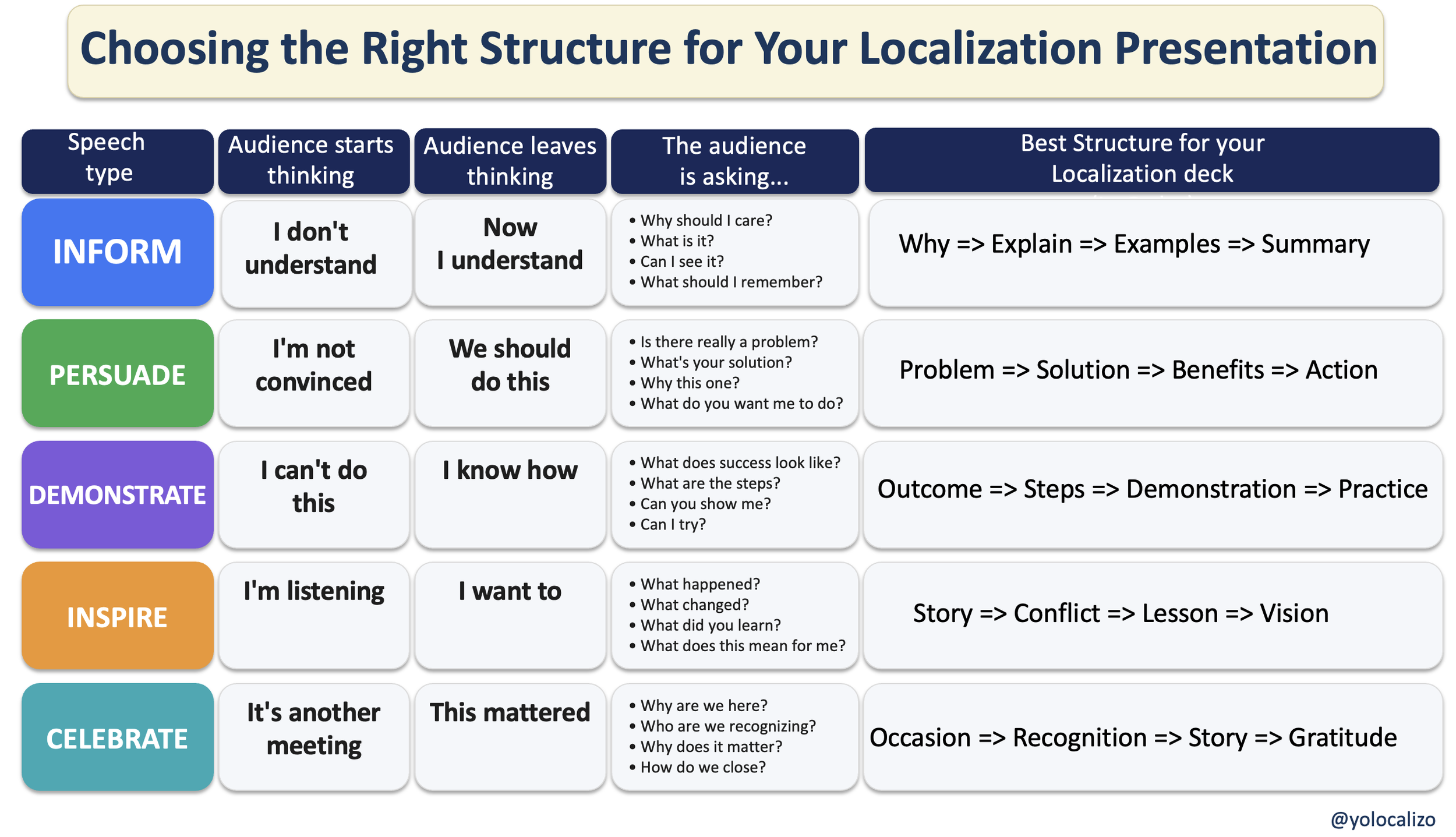
The table below summarizes the 5 types of speeches we have available. Understanding what they are and what their goals are is the first step toward effective communication.
Let’s look at a scenario to make this easier to understand.
Imagine the topic is AI in Localization. That is the topic I want to present about. But one thing is the topic, and another is the type of speech or presentation I am going to deliver.
That is why the first thing I need to ask myself is: what is the purpose of this presentation?
Am I going to inform people about something?
Do I want to change someone’s perspective?
Do I want to persuade them to do something?
Do I want to inspire my audience?
Every good presentation starts long before opening PowerPoint. It starts by asking: What is the purpose of my presentation?
The 2 questions you need before starting a presentation
Before opening PowerPoint, I think we only need to ask two simple questions.
First: what does the audience need from me?
Second: based on that, what should I include and what should I avoid?
If the audience needs clarity, I should focus on simple explanations, examples, and context.
If they need to support a decision, I should include evidence, trade-offs, and a clear recommendation.
If they need to learn how to do something, I should show the steps and avoid too much theory.
It sounds simple, but this small pause can change the whole presentation.
This pause is important because it helps us avoid the temptation to include everything we want to say in the presentation. And this happens often. We are so passionate about our Localization topic that we start adding too much information. Too much jargon. Too many examples. And while all of that may feel fantastic to us, it can make the presentation much harder for the audience to follow.
The goal is not to include everything I know.
The goal is to include what helps the audience get what they need.
Click HERE to download the graphic
Final thoughts
For a long time, I thought becoming better at public speaking was mainly about confidence. Speaking with less fear. Looking more natural. Controlling the nerves. And yes, all of that helps. But over time, I have realized that communication with impact starts earlier.
Much earlier.
Even before thinking about opening PowerPoint.
It starts by understanding what my audience needs to hear. It starts by resisting the temptation to explain everything I know. And above all, it starts by knowing the purpose of my speech.

Many companies claim to be customer-centric, but too often that promise stops at English. Surveys and focus groups are run in the US or UK and treated as if they represent the entire customer base, leaving most global customers unheard. In this post, I share a practical framework 5 audit questions to help leaders test if their strategy is truly customer-centric or just a slogan.