



Choosing the Right Structure for Your Localization Presentation
In my previous post, as part of this series on communication for Localization leaders, I talked about the different types of presentations, or “decks,” that I believe every Localization professional should have in their toolkit. My main message there was: before opening PowerPoint, we should first stop and think about what kind of presentation we are actually giving. Are we trying to inform? Persuade? Demonstrate? Inspire? Or celebrate?
But after writing that post, I kept thinking that this was only the first layer.
Because knowing the type of presentation is important, yes. But it is not enough on its own. In practice, what really makes a presentation work is not only the purpose behind it, but also the structure we choose to support that purpose. And that is where things become much more interesting.
I think this is something many of us do not always think about enough. We often spend a lot of time on the content itself, which is understandable, because we want to sound prepared and make a strong point. But the truth is that content alone does not always carry the message. Two people can talk about exactly the same topic, with exactly the same data, and still create very different reactions depending on how they structure the presentation. One can leave the audience clear, engaged, and convinced. The other can lose them halfway through.
That is why I wanted to go one step further in this post and reflect not only on the different types of presentations, but on the structure behind each one. Because once we understand how each presentation is built, it becomes much easier to decide what to include, what to leave out, and how to guide the audience toward the idea we want them to take away.
This, to me, is where communication becomes much more practical. And for Localization leaders, that matters because so much of our work depends on how well we explain ideas, frame problems, and help others see the value of what we do.
Choosing the Right Structure for Your Localization Presentation
Click HERE to download the infographic
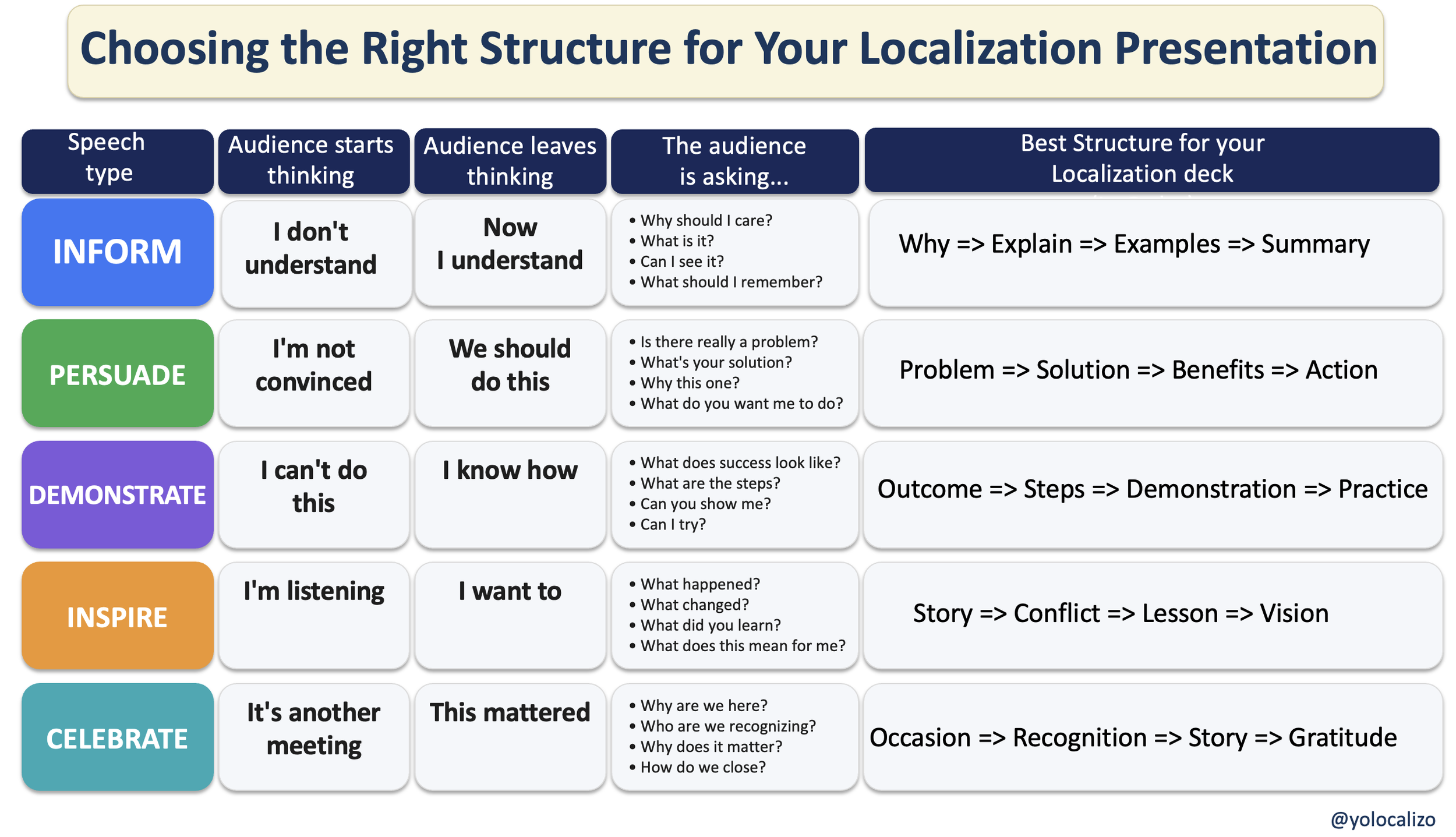
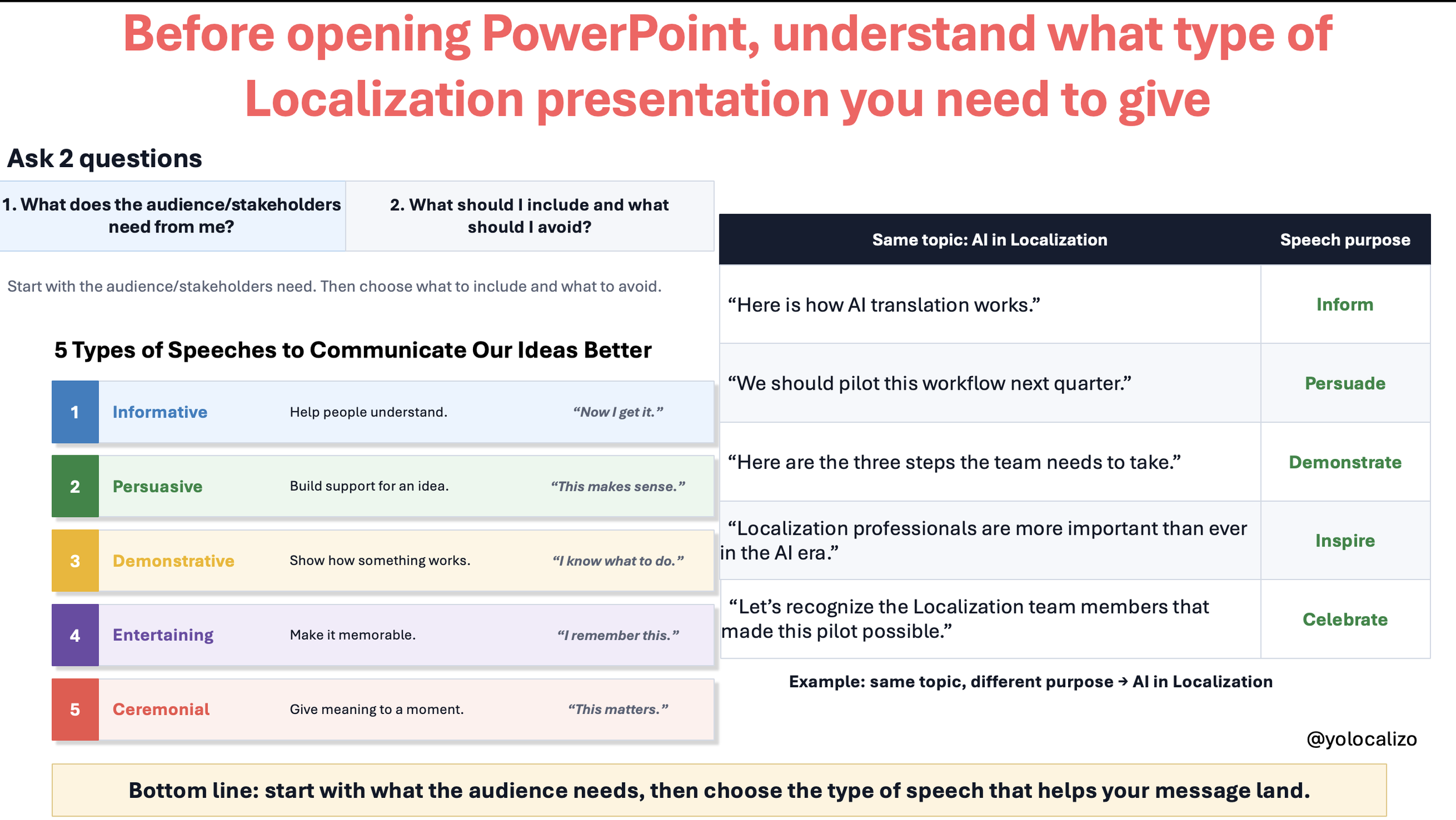
One of the biggest takeaways for me while reading about communication and public speaking is that there is no single “best” presentation structure. The right structure depends on the outcome you are trying to achieve. The table below summarizes the approach I have found most useful.
1.- Informative Presentations
The objective of an informative presentation is quite simple: to help our audience, or our Localization stakeholders, understand something they did not understand well before, or something they had not even stopped to think about. And that actually happens a lot. Very often, what a localization professional does is oversimplified. Of course, what we do is translation: we take text from language A, and it appears, almost like magic, in language B. But the truth is, many things happen in that black box called translation.
So, with an informative presentation, what we need to be clear about is that the audience is not looking to make a decision or learn a new skill. They simply need clarity and to understand what we are explaining.
And that is why the structure of this presentation has to start necessarily with the why. Before people decide mentally, “OK, I am going to listen,” or “OK, I will skip this and go back to my thoughts,” or even worse, pull out their phone every now and then to get distracted, they need to understand why the topic matters. Once they see the relevance, you can explain the concept, use examples to make abstract ideas concrete, and finish with a summary to reinforce the key takeaways.
Think of it as answering four natural questions in the audience’s mind:
Why should I care? → What is it? → Can I see an example? → What should I remember?
For example, if you are explaining AI-assisted translation, you would first explain why AI matters today for a localization professional, then describe how it works, show a real workflow, and finish by summarizing the main points.
2.- Persuasive Presentations
A persuasive presentation has a completely different objective. The audience already understands enough about the topic. What they have not done yet is decide.
And that is precisely why a presentation cannot start with the solution. You have to turn it around and start with the problem. And the better we explain, in the first slides, what the problem is, what the pain point is, and, with all the detail possible, what the pain of not solving the problem is, the closer we will be to solving it.
This type of presentation must unquestionably start with the problem. People are far more likely to support a proposal once they know that a problem exists. Once the problem is clear, present the solution, explain the benefits over other alternatives, and finish with a clear action.
For example … picture this: when you give a presentation to a developer about why it is a good idea to move localization activities to the left and involve the localization team much earlier, my counterpart is mentally going through a process like this:
Is there really a problem with the way I am working on translations? → What is your solution? → Why is this the best option? → What do you want me to do?
That’s why starting with the problem is so important in this type of presentation
3.- Demonstrative Presentations
In my opinion, these are the presentations that cost a localization professional the least to handle. Anything that involves explaining the ins and outs of our work in detail is something we usually do well. The problem we usually have is the opposite: we go too deep into details, we explain too much, and we lose the stakeholder, the audience. But the goal and approach of a demo presentation are to put us in our element, because demonstrative presentations are designed to teach something.
That is why the structure begins with the Outcome. Showing the final result helps people understand where they are heading before they start learning the process. And once they have seen a glimpse of the future, we break the work into manageable steps, demonstrate each one, and, whenever possible, let the audience practice.
For example, if you are teaching reviewers how to evaluate AI translations, first show what a completed review looks like, then walk through the workflow step by step before letting the team practice with sample content.
4.-Inspirational Presentations
Inspirational presentations are different because they are not primarily about knowledge or skills. In a more inspirational presentation, we are looking to change how people feel about the future.
And that is why storytelling works so well. Stories play a very important role because they capture attention from the beginning, especially when there is conflict. Conflict in any story creates tension and curiosity, and it is difficult for our brain to disconnect when we present it in a very engaging way.
Imagine speaking about AI and Localization. One way to begin could be with statistics, data, or metrics that illustrate what I want to talk about. But if I start by telling a personal story, for example, telling the story of my own reaction when generative AI first appeared, when I used it for the first time, and then I keep going in that direction and describe the uncertainty, explain what changed my perspective, and finish by sharing why I believe Localization professionals have an even more strategic role to play, the chances that my speech will stick with my stakeholders, with my audience, are much higher, and it becomes much easier to achieve the goal of my presentation.
5.- Celebratory Presentations
Celebratory presentations are the last type of presentation I want to cover here. Here, the objective of these presentations is not to teach or persuade. Their purpose is to bring more joy! The objective is to create meaning and recognize people or achievements.
The structure, therefore, starts with the occasion, explaining why we are here, and then, without further delay, comes the recognition, acknowledging the people involved. A personal Story gives the recognition emotional impact, and gratitude provides a meaningful closing.
For example, if you are recognizing a team after a successful global launch, do not simply list accomplishments. Share a story that captures the effort, collaboration, or challenge behind the achievement. Stories make recognition memorable.
Final thoughts
I have a feeling that many of us already know the content we want to present. The real challenge is deciding how to organize it. And perhaps that is one of the most overlooked communication skills in our profession.
@yolocalizo
A multi-market expansion strategy for any product is most effective if the various Globalization (i.e.Localization, Internationalization) activities are understood as a cycle that runs parallel to the multiple phases of software development; This cycle repeats during the various product upgrades. It is not an activity that is executed as if it were a process once the home market version (usually in English) is finalized. It is not a transaction that simply sends files to a professional localizer shortly before the global release. No; Globalization is not a process. Globalization is a cycle that runs multiple times. It is a cycle that runs in parallel with the product research, design, and development phases.