


Do You Have a Logline for Your Localization “Stuff”?
One of the things I see most in the Localization industry, and among those of us who work in it, is our tendency to get lost in the details when we explain our work. Whether it’s during a presentation, a business case we create to request budget for a new TMS or new headcount for our team, or simply explaining part of our Localization strategy in a meeting or on a video call.
I don’t really know why this happens to us, but it does. We get carried away explaining the details of what we do. We explain the how really well, but we struggle with the why. And we struggle even more when we try to connect that to the company’s strategy or its yearly goals.
And that’s a problem.
Being very good at explaining the how is great, but that approach works when we’re talking to colleagues at LocLunch or LocWorld, or with our own team. That’s where we feel like fish in water talking about our Localization topics.
But when our stakeholders don’t know much about Localization, our ability to explain what we want to say concisely breaks down.
I’ve had several situations where I received feedback like “Miguel, get to the point.” Or I noticed people who, for whatever reason, didn’t feel comfortable saying it out loud, but I could see from their faces or their general disengagement that I was going off on a tangent.
Expressing what we want to say concisely sounds easy.
It isn’t.
Since this is something I wanted to learn, I did what I usually do: I looked for help in books and from well-known communication experts to find techniques that could help me get to the point.



This time, the help came from Carmine Gallo, a well-known communication coach with many books on public speaking. Probably his best-known book is Talk Like TED (with permission from another of his bestsellers, The Presentation Secrets of Steve Jobs).
In The Bezos Blueprint, Carmine introduces the idea of the logline.
What’s a logline?
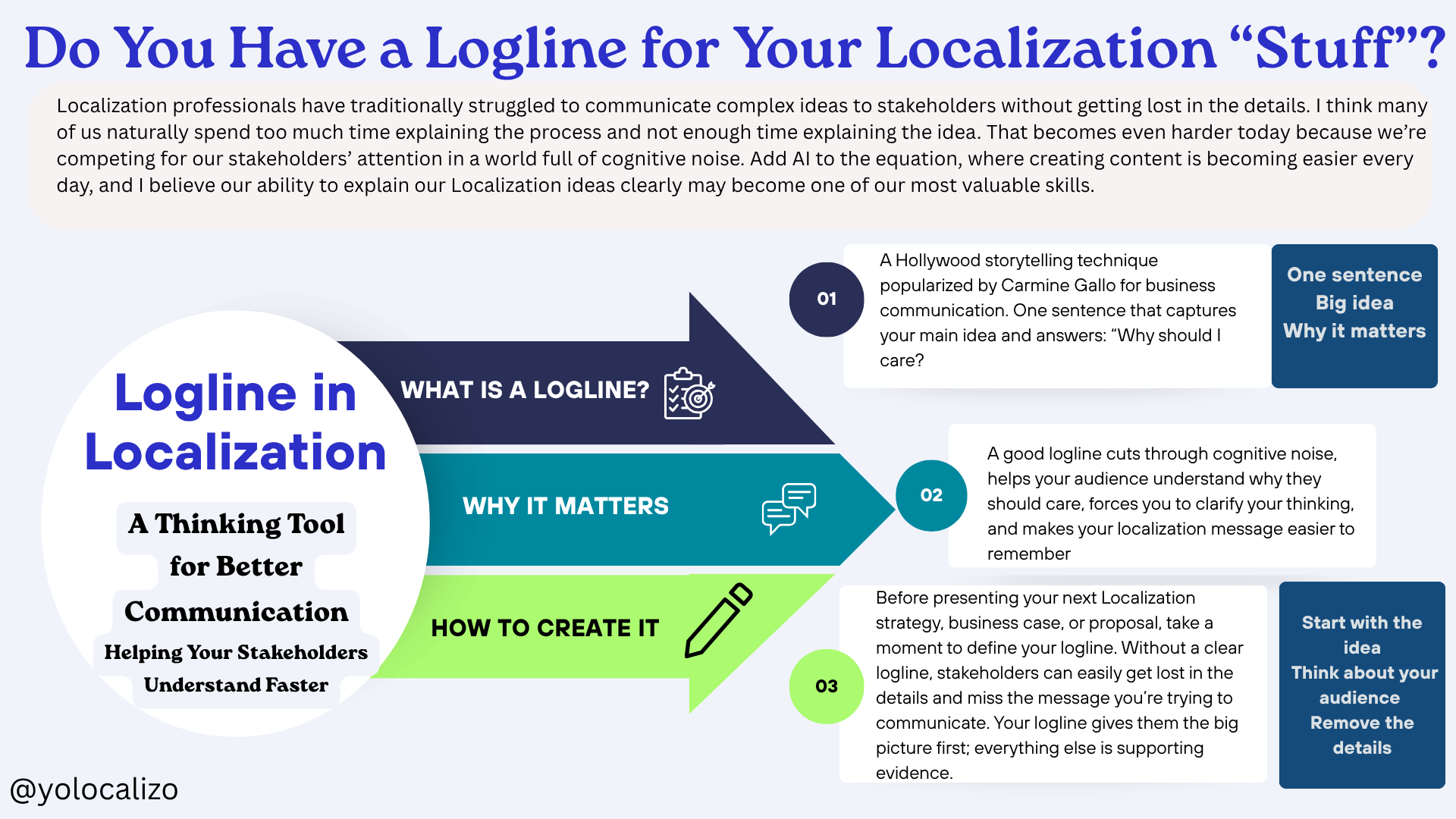
The term comes from Hollywood, where screenwriters use a single sentence to capture the essence of a movie and convince producers that the story is worth telling.
A good logline doesn’t reveal every detail of the plot. Instead, it explains what the story is about in a way that is clear, memorable, and intriguing enough to make you want to know more.
Loglines are very common in Hollywood.
Can you guess these movies? 🙂
When a giant man-eating shark terrorizes a beach town, a police chief, a marine biologist, and a shark hunter must stop it before it kills again.
A cowboy doll is threatened when a flashy new space ranger becomes his owner’s favorite toy, forcing the two rivals to work together to get back home.
A teenager accidentally travels back in time and must reunite his parents before he can return to the future.
Gallo argues that this idea shouldn’t stay in Hollywood. Companies like Amazon and Google have adopted the same principle because they understand that before people can evaluate an idea, they must first understand it.
Google logline “Google organizes the world’s information and makes it universally accessible.”
Amazon logline “Amazon is Earth’s most customer-centric company.”
A strategy, a presentation, a business case, or even an email can have its own logline: one sentence that clearly communicates the main idea and answers the audience’s implicit question:
“Why should I care?”
As I learned more about the logline, I realized it isn’t just a technique we can use to explain what we’re about to talk about. It’s also a thinking tool. Taking the time to craft the right logline forces us to think more carefully about our message and, more importantly, about the essence of what we want to communicate. And that, in turn, helps us get to the point, which ultimately is what this is all about.
If we can’t explain our idea in a single sentence, there’s a good chance we haven’t fully clarified it ourselves. That’s why, at its core, a logline is also a thinking tool. And if we struggle to explain our idea clearly, we shouldn’t be surprised if our stakeholders struggle to remember it.
Warren Buffett, who probably knows a thing or two about communicating ideas, given his incredible legacy, has often said:
“If you can’t communicate and talk to other people and get across your ideas, you’re giving up your potential.”
And that’s exactly one of the reasons why I’ve become so interested in learning how to communicate better.
Because I think Mr. Buffett is absolutely right! It’s a shame not to reach our full potential simply because we don’t know how to explain what we need to explain, when we need to explain it.
That’s why I like sharing what I’ve been learning about communication. I think it might help other people in a similar situation who are struggling to communicate their Localization ideas to their stakeholders.
Why the logline is important
The importance of a logline comes from the amount of cognitive noise we all face today. According to Microsoft’s 2025 Work Trend Index, the average knowledge worker receives 117 emails and 153 Teams messages every workday and is interrupted every two minutes by a meeting, email, or notification. Nearly half of employees (48%) say their work feels chaotic and fragmented. In a world like this, people don’t have the patience to wait until the end of a presentation to understand the point. They want to know the idea early and why it matters to them.
People listening to us want to know early what the idea is and why it matters to them.
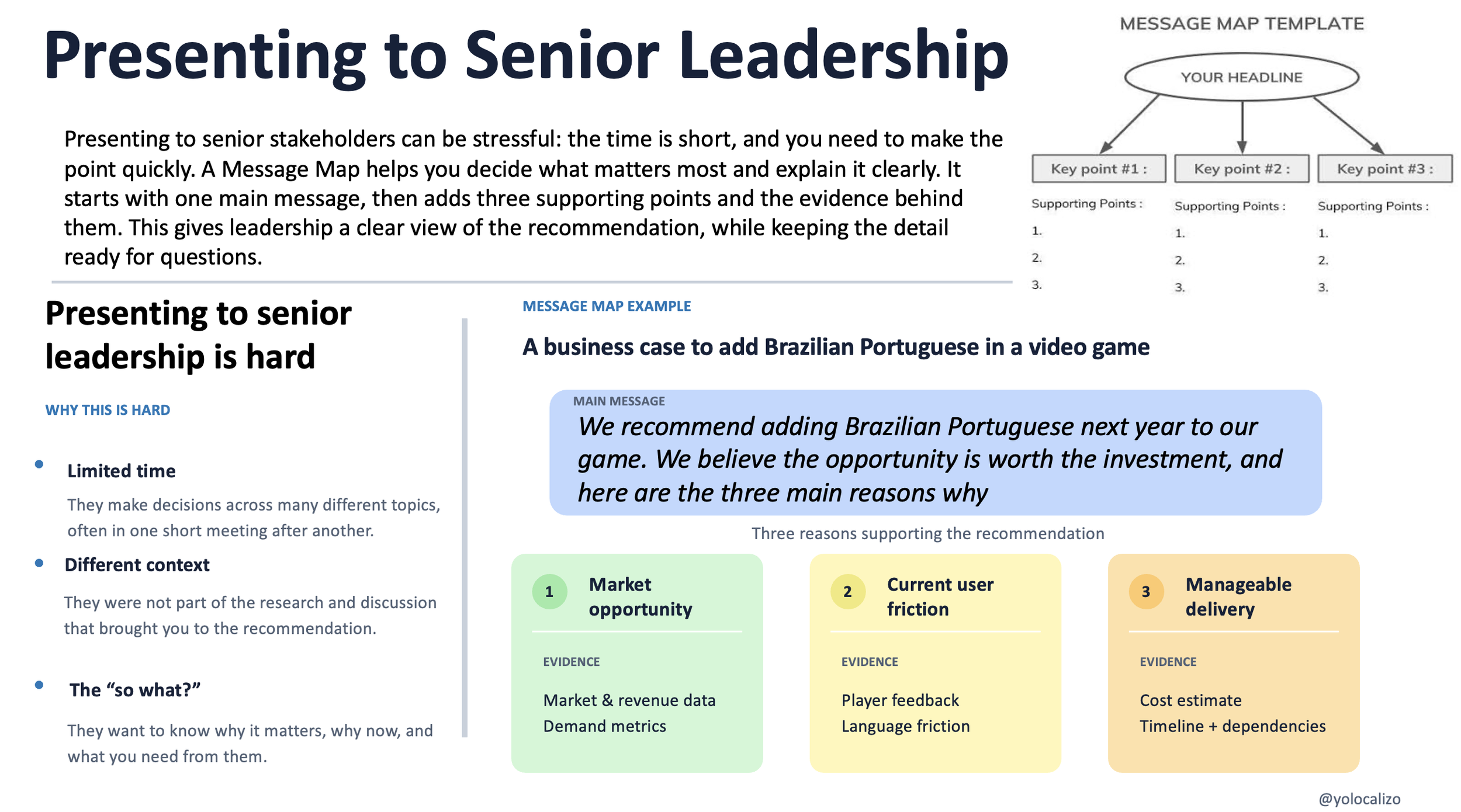
Click HERE to download the infographic
How to create your logline
A good logline has some elements such:
Is one sentence (typically around 25–30 words).
Communicates the big idea, not the details.
Is easy to remember.
Creates curiosity and encourages people to keep listening.
Answers the audience’s implicit question: “What’s in it for me?”
The good news is that creating a logline is a skill anyone can learn.
Before opening PowerPoint or writing your next email, ask yourself:
What’s the one idea I want my audience to remember?
Why should they care?
Can I express it in one sentence?
Why is this relevant for Localization professionals?
I believe this is especially relevant for Localization professionals. We are often very good at explaining how we work, but not always why our work matters.
Moreover, I think now matters more than ever because as AI continues to automate more of the operational side of Localization, our value will increasingly depend on our ability to explain the business impact of what we do and not just the process behind it.
Anyone can ask AI to translate content. Fewer people can explain how Localization helps the business reach more players, improve the player experience, reduce risk, or support global growth.
Without a clear logline, we tend to lose ourselves in the details. Our presentations become longer, our meetings become less focused, and different stakeholders leave with different interpretations of the same message.
In an AI era, where attention is scarce and information is abundant, clarity is becoming one of our most valuable skills.
Closing
If someone stopped you today and asked,
“What’s your Localization strategy?”
…could you answer in one sentence?
If not, maybe this article about creating a logline will be helpful for you 🙂
@yolocalizo
Choosing a TMS is not an IT vs Localization decision. Localization understands the business problem and the workflow; IT understands the technical ecosystem. The best result comes when both work together, with clear roles, shared criteria and a selection process that looks beyond the vendor demo.