


Presenting to senior leadership
Often, we complain that we do not have enough opportunities to discuss our Localization work with senior leadership.
We imagine things like: damn, if I could just get a meeting with them and explain this idea I have for Localization, that would be great… but also sometimes the opposite happens.
We actually have the opportunity to put forward an idea to a vice president, or to discuss market expansion and growth with a senior product leader. Our level of stress then shifts from 'damn, I never get the chance to show what I can contribute' to now being nervous…. what am I supposed to say to these people in the 30-minute meeting they've just arranged with me? I have so many things to tell them!
Senior executives are a different audience. Even if you are a good presenter, the dynamics are different. The first reason is obvious: their time is limited. We are all busy, but senior executives also have to make many decisions, often about very different topics.
Very quickly, they want to understand the “So what?”
Why does this matter to the business? Why are you telling me this now? What do you need from me?
That is why the message, and how you structure it, matters so much. And that is what this post is about: how to structure a presentation so senior leadership understands what you really want to say.
So, as Fabrizio Romano says, when a football transfer is about to happen...
Here we go :)
We like to start at the beginning
When a subject is known well, there is a tendency to explain it in the same sequence as that in which it was experienced. We begin with the background, then move on to the problem, followed by the analysis, the data, the options considered, and, finally, the recommendation. This sequence seems logical since it follows the order of our own experience, and perhaps it took us weeks to reach the conclusion, but the executive sitting in front of us never went on that journey and probably does not need to go through all the steps.
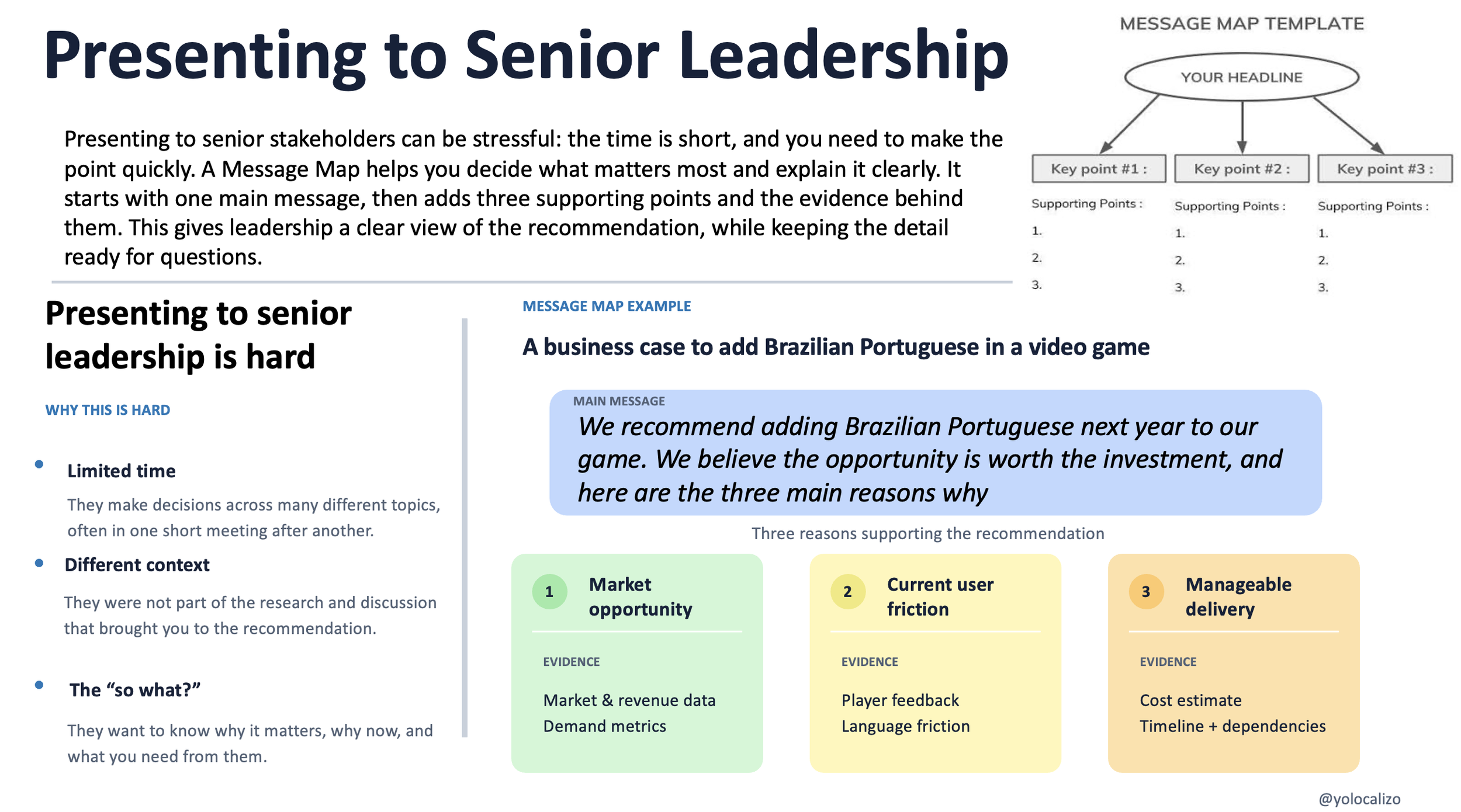
Suppose, for instance, that you are making a business case in favor of adding a new language to a game :). You might spend weeks examining revenue, market size, player behavior, competitors, localization costs, and technical complexity, and of course, all that work is important since it has helped you to reach your conclusion. But, I wouldn't begin the presentation with a slide entitled "Market Overview". Instead, I would start much nearer to the final answer by saying, "We recommend adding Brazilian Portuguese next year to our game. We believe the opportunity is worth the investment, and here are the three main reasons why."
Once that sentence has been made,everyone in the room already knows where the presentation is heading, and then you can judge how much detail you actually need to include in the discussion. For me, that is likely the most difficult aspect when we are very familiar with a subject: deciding which small part of all that we know is really worth the limited time we have with that seior nd special audience.
A Message Map before PowerPoint
A few weeks back, I came across a communication method by Carmine Gallo that I think is well-suited to this kind of presentation: the Message Map. He describes it in The Bezos Blueprint, (which, by the way, is an excellent book on the communication style that Jeff Bezos used when building his multibillion-dollar company)
The concept upon which the Message Map is based is very simple: you begin by identifying the one most important message that you would like your audience to remember, then back it up with three key messages, and under those, you put the evidence that supports your argument, such as data, research, examples, customer feedback, stories, or any other relevant material.
What interests me is that this kind of logic is also found in other communication frameworks. For instance, in Toastmasters, we apply the Temple idea, something Florian Mueck explains very well in his books, and in his workshops https://www.florianmueck.com/pushyourpitch/, one main idea backed by strong supporting points. Barbara Minto, a former consultant at McKinsey, uses an approach very similar to this one with the Minto Pyramid Principle: you begin with the main answer or recommendation, follow it up with a few key arguments, and then put the evidence below. Although the frameworks differ, the logic is similar: the main message comes first, followed by the supporting points, then the details.
Great book for executive presentations!
If we look at the example of adding Brazilian Portuguese, the key point would be: "Brazilian Portuguese should be added to game X next year since the business opportunity makes the investment worthwhile." Below this, I could give three reasons: that Brazil presents a significant growth opportunity, that the presence causes difficulties for users who speak Portuguese, and that the cost and technical complexity are acceptable. I would then put the evidence in the appropriate place, such as market and revenue data, player research, costs, timelines, and technical requirements.
That is most likely the reason I prefer this kind of structure, since you are not getting rid of all the details which you have taken so much trouble to gather; you merely assign them a place and make it easier for the audience to see why each piece of information is important.
Why three?
There's also an interesting point: Gallo uses three supporting messages. A number of communication techniques suggest that ideas should be grouped in threes, a principle generally referred to as the Rule of Three, and we've followed this practice for centuries. Julius Caesar provided us with “Veni, vidi, vici”
I came, I saw, I conquered. Shakespeare offered us “Friends, Romans, countrymen”. We have The Good, the Bad, and the Ugly, and it's even the Three Wise Men who appear as a group of three :)
There is something about the number three that makes it easier to understand and remember ideas, but for me, there is also a practical advantage when addressing senior leaders; it forces you to prioritize. Although we might have, like, I don’t know, let’s say, seven reasons in support of our recommendation, the likelihood is quite low that anyone will remember them.
For me, the Rule of Three probably has the most valuable aspect in that it prompts you to carefully consider which of the few points you really want your audience to remember after the presentation has ended.
The hardest part might be the sentence at the top. Gallo first described the top part of the Message Map as a brief, "Twitter-friendly" headline.
Twitter has changed a lot since then, in fact, it's no longer even called Twitter at all :) So I'd be less concerned about the number of characters and more focused on the concept behind it.
Could you put the main point of your presentation into one clear sentence?
It is quite easy to reach twenty slides without having that sentence. Maybe it should be the other way around. I probably wouldn't open PowerPoint unless I could make it clear to them what I want leadership to understand. PowerPoint is excellent when it comes to helping us produce slide 21, but it isn't so good at considering whether slides 1 to 20 were actually needed at all :) That is why I prefer the Message Map; for me, it is not primarily a technique for presenting information but one for thinking.
Click HERE to download the infographic
While you are constructing it, you may find that you, in fact, do not know what your primary message is. It is better to find out when starting with a blank sheet of paper than when having ten senior leaders waiting for you to begin.
Thirty seconds or thirty minutes
Another thing that I appreciate about the Message Map is that it allows greater flexibility when you're in the middle of a meeting. For instance, you may have planned a 30-minute presentation, but after just five minutes, an executive says, "Right, I understand the market opportunity. Tell me more about the technical complexity." If this is what they want to know, then I'll go into that topic rather than carrying on with the next six slides just because that was the original plan.
That's why it's so useful to have the Message Map clearly in your mind: you know your key message, which points back to it, and where the evidence is located, so you can navigate your presentation without losing sight of the story you're trying to tell. It's quite possible for senior leadership meetings to turn into conversations rather than conventional presentations, and I believe this is, in fact, a positive development.
This also takes away some pressure from me, since I no longer need to complete every slide I've prepared. As long as the discussion is progressing in a useful way and the people in the room are receiving the information they need, the presentation is fulfilling its purpose. The slides are merely there to assist me in explaining the idea and to support the conversation.
Final thoughts
So when the meeting you've been asking for finally shows up in your calendar, the first thing you should do, perhaps, isn't to open PowerPoint. Instead, get a piece of paper and consider your Message Map. What is the single point you want them to understand? What are the key points that back it up? What evidence do you need? And what do you want from them at the end? You probably know a great deal more about the subject than you can possibly explain in thirty minutes; that's perfectly all right. If the meeting ends and they are clear about your idea, its importance, and what you need from them, then I would consider those thirty minutes well spent. And hopefully, the next time you secure that valuable meeting with a VP, you'll feel a bit less like 'damn, what am I going to tell them?' and a bit more like 'OK, I know exactly what I want them to understand.' :)
@yolocalizo
Many companies claim to be customer-centric, but too often that promise stops at English. Surveys and focus groups are run in the US or UK and treated as if they represent the entire customer base, leaving most global customers unheard. In this post, I share a practical framework 5 audit questions to help leaders test if their strategy is truly customer-centric or just a slogan.