


Localization has a framing problem
I have always been curious about people who seem to influence others just by the way they talk. They can take an idea that sounds difficult, risky, or even unrealistic and somehow make people see it differently. You probably know a few, maybe people from work, friends, people you know, or business gurus.
Steve Jobs is probably one of the clearest examples. When I read his biography, one thing that stayed with me was what people who worked with him described as his “reality distortion field.” They said Jobs could make something seem possible even when it first looked impossible.
A good example was the iPhone. He convinced Apple engineers that a phone could be almost all screen, without a physical keyboard. He also argued that a stylus was not needed. As he used to say, styluses get lost and break, and we already carry 10 styluses with us all the time: our fingers :)
Do you want to sell sugar water, and how I started to get curious about the framing techniques
In the early 1980s, Steve Jobs wanted John Sculley to leave Pepsi and join Apple. From Sculley’s point of view, it was not an obvious move. He was the president of Pepsi-Cola and had a successful career in a huge company. PepsiCo was a very big name. Apple was younger, still not very well known, a bit niche, and working in an industry that looked very promising but still had many unknowns. So there was Sculley, with a senior, well-paid job in a massive corporation, while Jobs was building something that still felt a little like a start-up that was beginning to grow. And Jobs was trying to convince him to leave the safety of PepsiCo and join an adventure with a lot more uncertainty.
Looking at it today, it is easy to see what Apple has become. But Sculley did not know that then. Jobs could have talked about the CEO role, the money, the growth. Instead, he famously asked him:
“Do you want to sell sugar water for the rest of your life, or do you want to come with me and change the world?”
Wow, brilliant. Jobs reduced everything PepsiCo represented to “sugar water.” Of course, PepsiCo was much more than that, but Sculley could no longer stop thinking about the comparison Jobs had put in front of him. Apple was still risky, and Pepsi was still a great company, but the frame had changed.
So what exactly is framing?
I came across this idea again recently while reading Zoe Chance’s Influence Is Your Superpower, a very interesting book that brings together different ideas and techniques to help us become more influential.
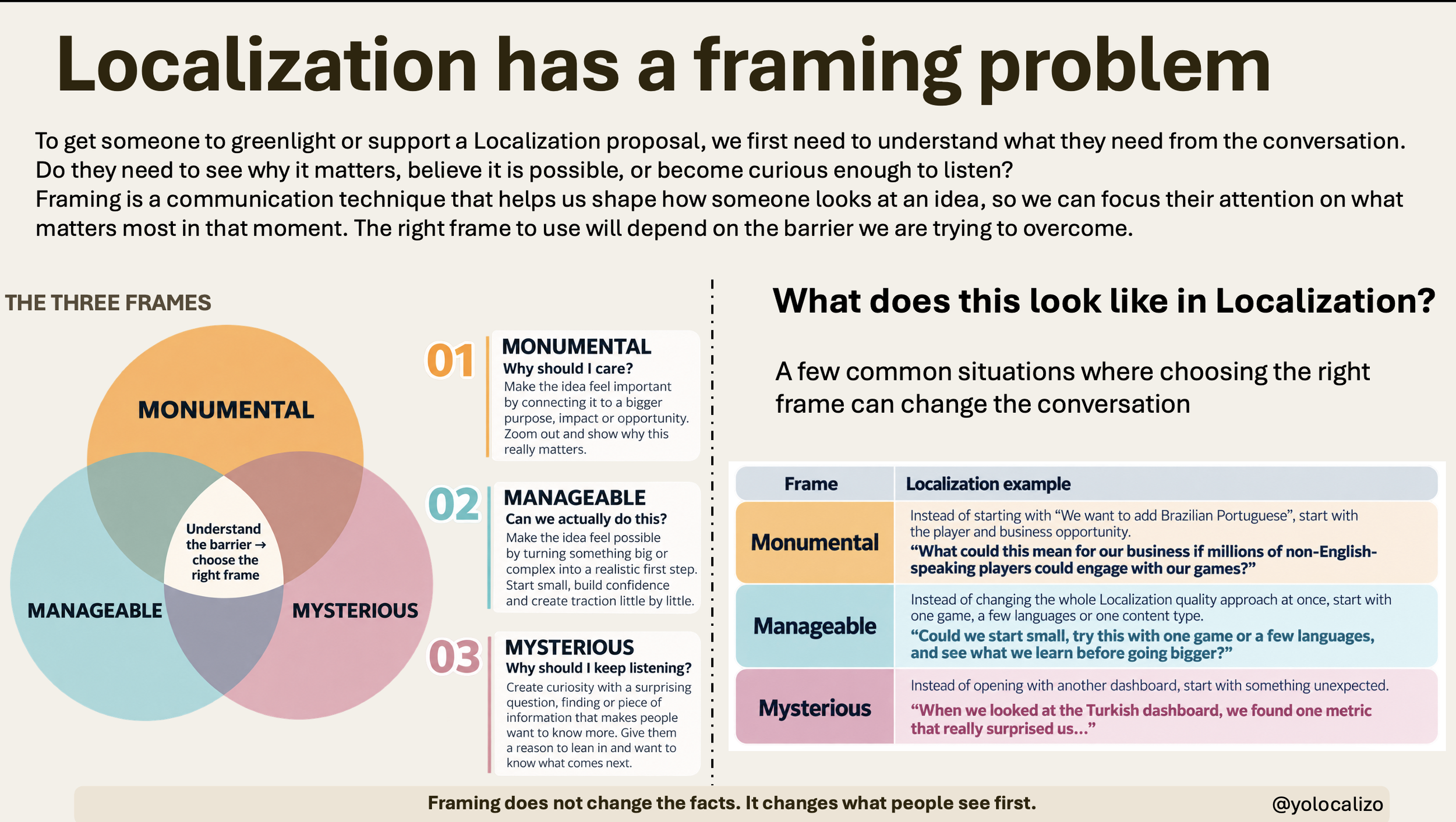
A frame is the way we invite someone to look at a situation. The facts stay the same, but depending on how we present them, people may focus on very different things. Framing is not about hiding bad news or making something sound better than it is. It helps people focus on what matters before getting into detail. Chance describes three types of framing that I found easy to connect with every day life situations and with Localization. These frames are Monumental, Manageable and Mysterious. Let’s go through them one by one to better understand how to use them.
The Monumental frame helps people see why something matters by connecting the task with a bigger purpose, impact or opportunity.
I really like this approach because I often talk in my posts and presentations about the importance of explaining the why behind what we do. In the context of my work, that means explaining why Localization matters to the company and to our stakeholders, not just what the Localization team is doing.
In Jobs’ case, the Monumental frame is very clear. He used it brilliantly with Sculley by making the decision about much more than simply changing jobs.
The Manageable frame is useful when people understand why something matters, but the idea feels too big or complicated. The goal is to make the first step easier and more realistic. With a Manageable frame, what we are trying to avoid is analysis paralysis. If something feels too difficult or overwhelming, sometimes we do not even know where to start. This is where the idea of baby steps becomes useful. A few years ago, I was overweight and the idea of losing several kilos and going to the gym regularly felt quite overwhelming. So instead of thinking about the whole challenge, I gave it a more Manageable frame: I would go to the gym for 30 minutes, three times a week. That felt much easier to start. Over time, those 30-minute sessions became longer and more frequent.
The Mysterious frame is about curiosity. Sometimes the first challenge is simply getting people interested enough to listen. A surprising result, a question or something unexpected can make people want to know more.
What I like about these three frames is that they make you think about what the other person might need. Do they understand why something matters? Does it feel too difficult? Or have we simply not given them enough reason to pay attention yet? And I think this becomes especially important in Localization, where so much depends on our ability to influence. In many cases, we do not have the “role power” to simply make things happen. We need other teams, stakeholders or leaders to support an idea, give us resources, change a process or prioritize something.
That is why learning these frames, understanding when to use them and how to combine them can be very useful. They can help us become better at influencing decisions that affect Localization.
What would this look like in Localization?
Let’s see this in action. In the table below, I have added a few examples of frames we could use in situations that will probably feel familiar to most Localization professionals: adding a new language to a project, changing the way we approach linguistic quality, or creating curiosity by choosing the right metric to show a stakeholder.
There is no single “best” frame, and I think this is important to clarify. The key is to understand what barrier we are facing when we are trying to influence a stakeholder and get support for the idea we are pitching Understanding that barrier can help us choose the frame that is more likely to work.If people see a new language mainly as another Localization cost, I probably need to explain the player or market opportunity behind it. But if everyone already agrees that the market is important and the concern is complexity, I need to make the proposal more Manageable, perhaps by starting smaller and learning from it. I want to ensure this does not look too difficult or too intimidating
The Mysterious frame solves a different problem.For example if i’m presenting in an stakehodler meeting and If I only have ten minutes in a leadership meeting, I first need to give people a reason to listen. Something genuinely surprising in the data could work better than simply opening another dashboard.
This is more useful to me than thinking about framing as a list of persuasive words. I am less interested in asking, “How can I make this sound more convincing?” and more interested in asking, “What is stopping this person from engaging with the idea?”
We probably frame Localization more than we realise
Click HERE to download the infographic
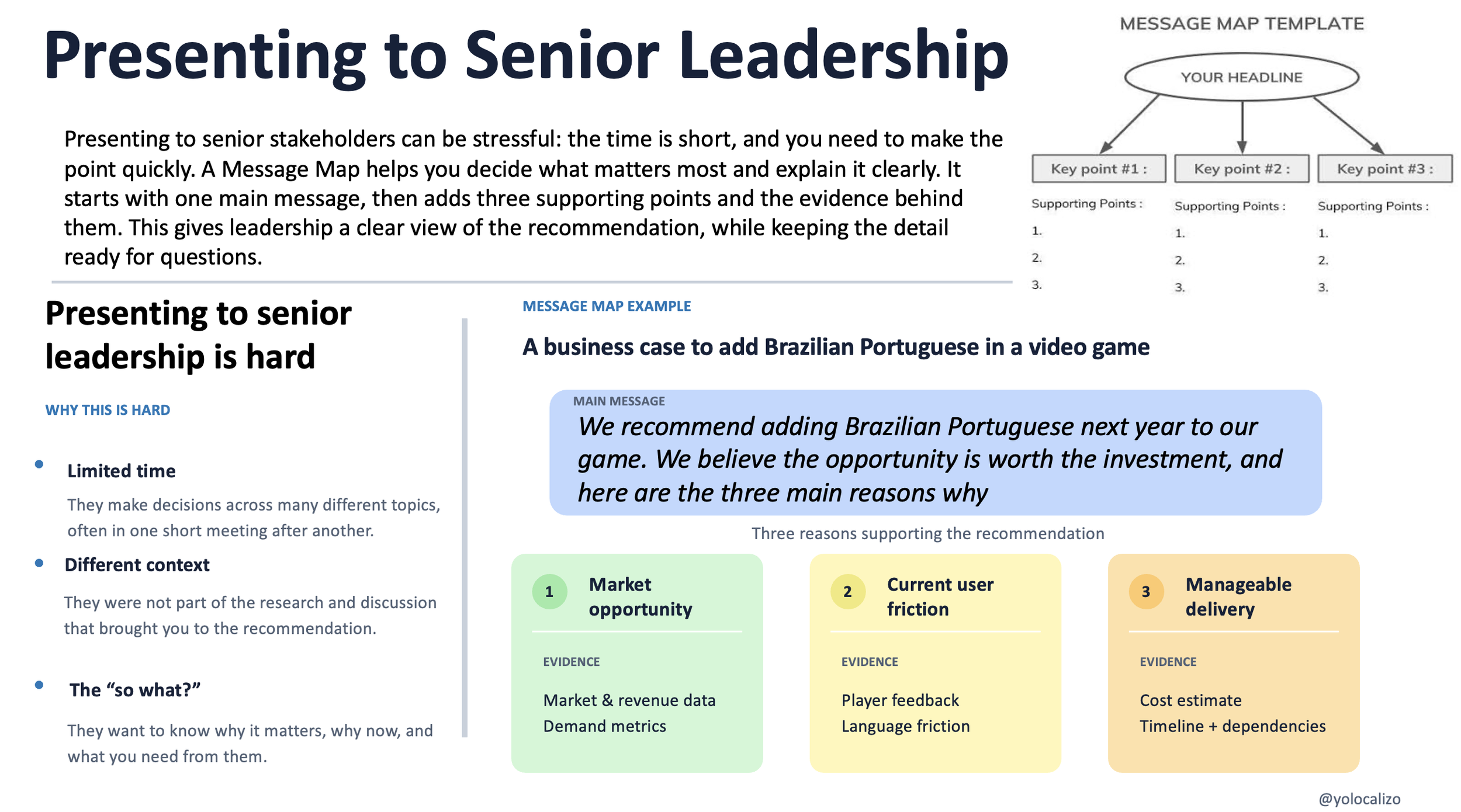
A simple example is adding a new language. If I say, “We want to add Brazilian Portuguese,” the conversation will probably move quickly to cost, volume and timelines. But if I start with the Brazilian players, their current experience and the market opportunity, the same recommendation is framed around players and business impact first. The same applies to a TMS. Instead of starting with “we need a new TMS,” start with the workflow problem, manual work or limitations. The TMS then becomes the solution, not the topic.
Framing also changes the questions we get
Metrics make this very clear. If I ‘m preparing a status report and i have something in a section something like
Localization spend increased by 15%.
the discussion will probably focus on cost. But if I explain that player activity and engagement are growing, and that the extra Localization spend is helping us support that growth and open new markets, the same 15% starts to look less like a cost and more like an investment. That’s a good framing change!
Final thoughts
The more I think about framing, the more I realise we already use it all the time. The way we open a presentation, choose a metric or introduce a recommendation shapes how people look at the topic.
What I find useful about framing is that it makes me stop and think about the person in front of me, and what they need to understand first before I start explaining everything else So before my next stakeholder conversation or business case, I want to ask:
How am I framing this conversation, and what am I asking the other person to see first?
Maybe Localization does not always have a value problem. Sometimes the value is already there, but we need to frame it better
@yolocalizo
Choosing a TMS is not an IT vs Localization decision. Localization understands the business problem and the workflow; IT understands the technical ecosystem. The best result comes when both work together, with clear roles, shared criteria and a selection process that looks beyond the vendor demo.