




Does everyone really need to care about Localization?
The other day, I was waiting for a dentist appointment, in pain, listening to a leadership and management podcast. Maybe not the ideal waiting room soundtrack 🙂
I was listening to Unlocking Workplace Influence by Learning to Manage Up with Melody Wilding, from the She Said/She Said Podcast.
Melody is an executive coach, and they were talking about managing up. At one point, she brought up relationships and dynamics within companies. One thought stayed with me
You don’t matter to everybody, and everybody shouldn’t matter to you. That’s why you should always be asking yourself, “Who do I need to be aligned with?
My first reaction? That sounds harsh. Then I let it sink in, and I agreed with the message. Not as a judgment of anyone’s worth, but as a reminder that alignment isn’t the same as everybody liking your idea.
And it made me reflect on Localization. How could that mindset help us, and how could it work against us?
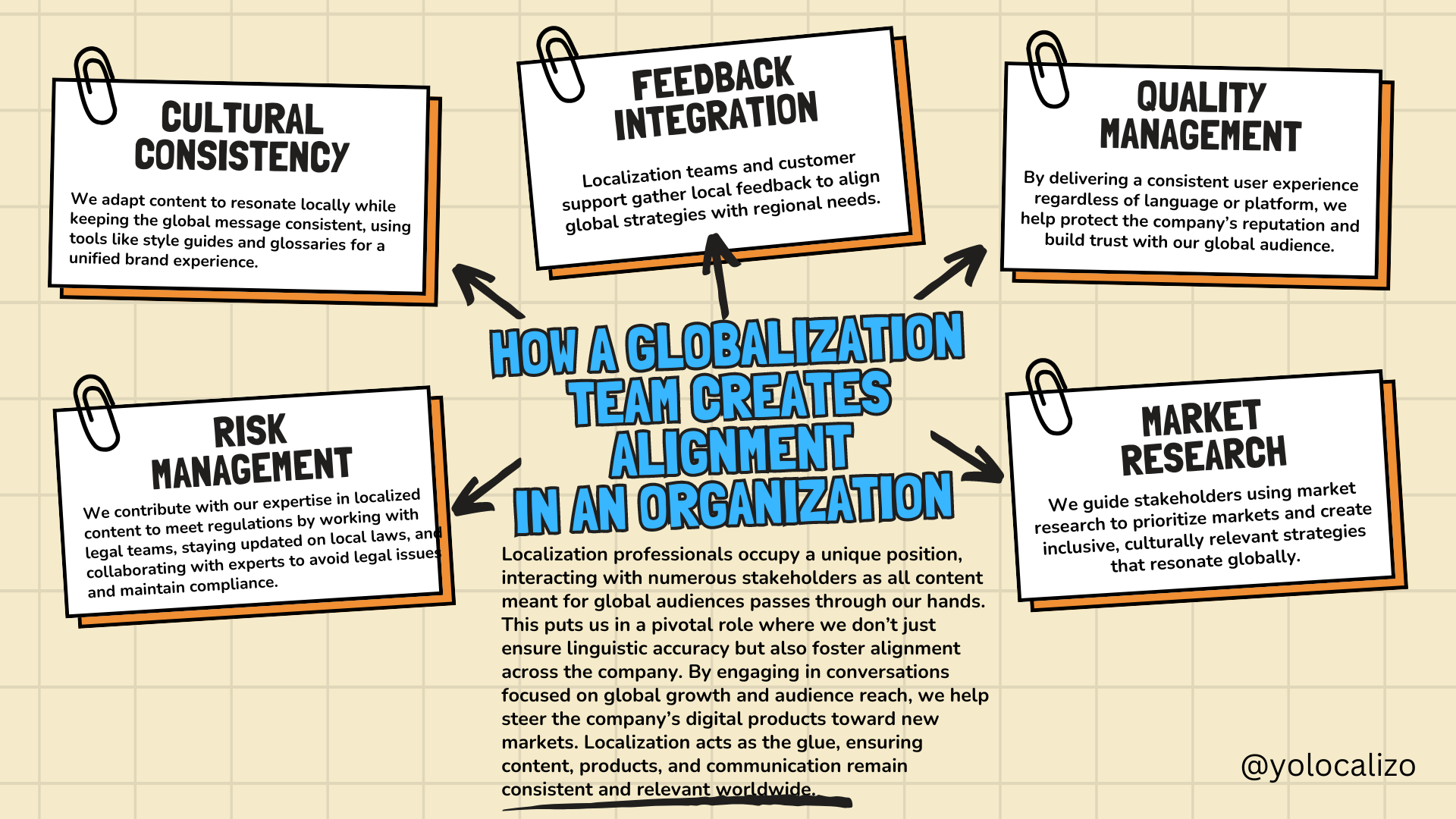
It could help by pushing us to seek alignment. The uncomfortable part is accepting a truth about ourselves. As Localization teams, we tend to be agreeable and try to please everyone. Maybe that comes from our traditional position as an afterthought in software development. Maybe it’s because we want to be helpful and live up to our service role, contribute, or find a way to be better liked. But the reality is that we try to matter to everyone. That’s why Melody’s comment made me a little uncomfortable at first.
So, what technique could help us change that mindset while also helping our projects?
Meet the power map technique
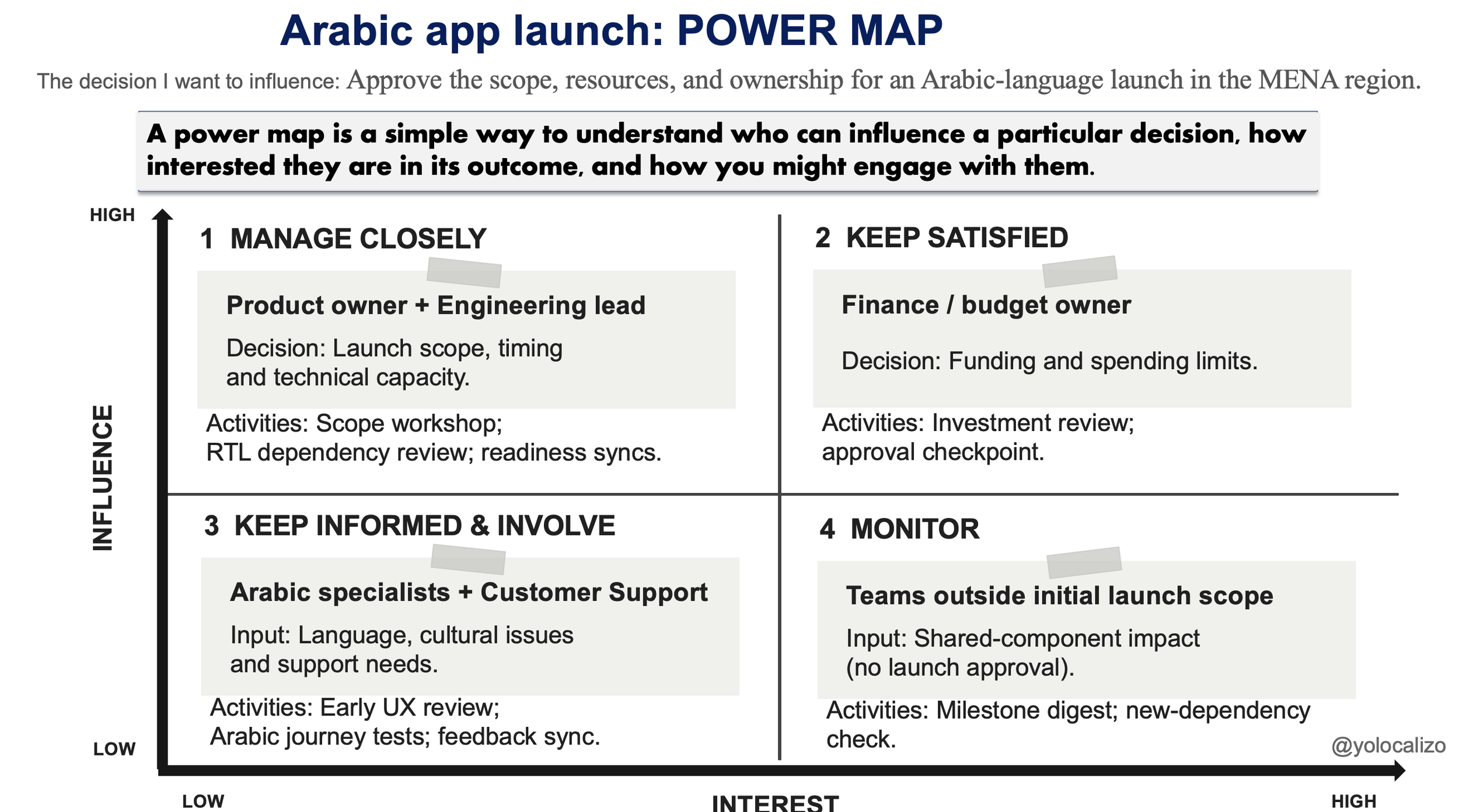
On the podcast, they introduced the power map matrix. A power map is a simple way to understand who can influence a particular decision, how interested they are in its outcome, and how you might engage with them. It goes beyond the org chart: influence can come from budget authority, but also from expertise, trust, or relationships.
Click HERE to download the graphic
For us as Localization professionals, it helps connect what we want to achieve with the people whose support and input we need.
A power map helps us to achieve 4 things
Find the right conversations: who can approve resources, change a workflow, or help the proposal move forward?
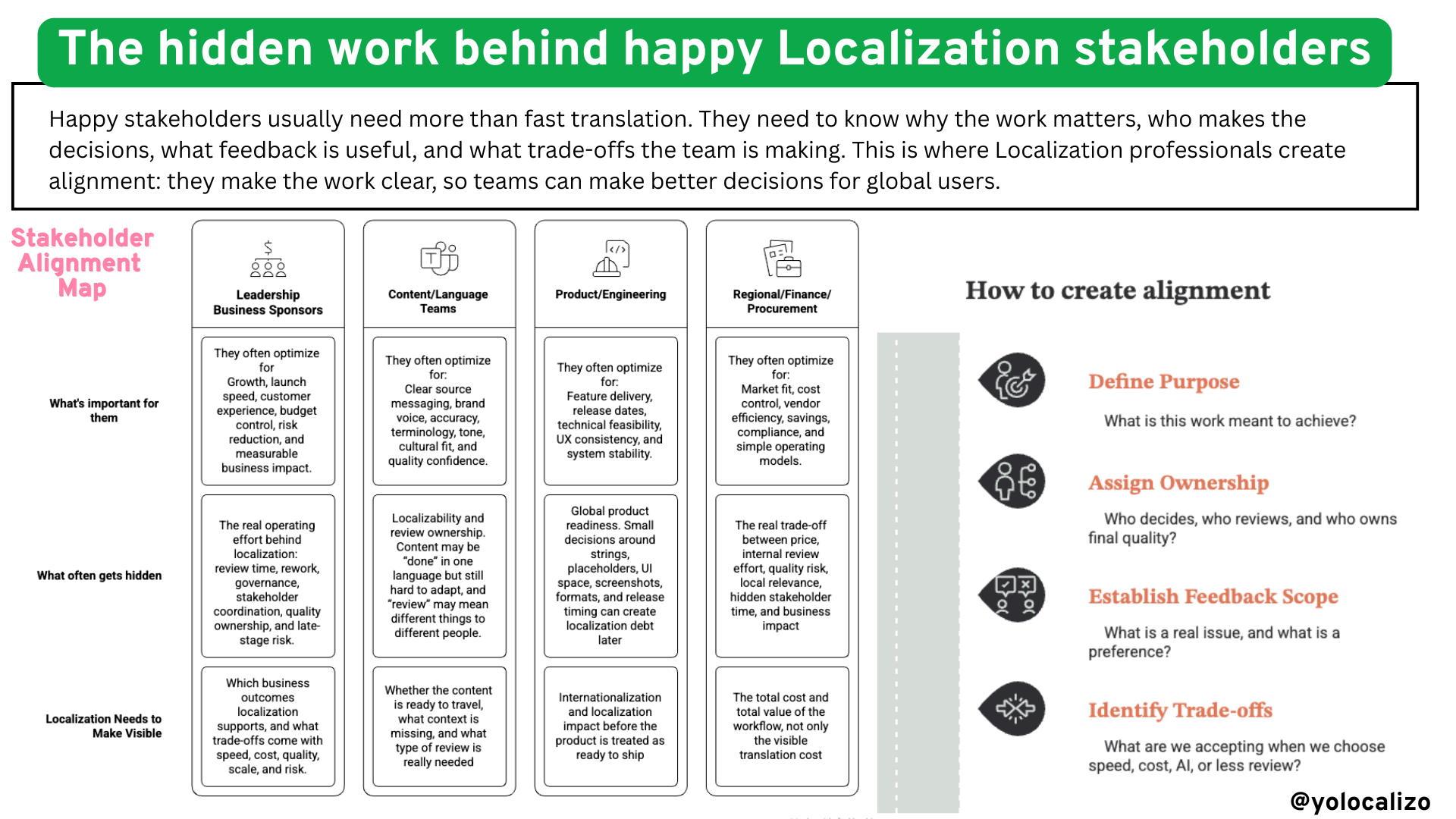
Understand different priorities: Product might focus on release timing, Finance on costs, and language specialists on the customer experience.
Include expertise, not just authority: someone without a senior title may spot a risk or suggest a solution others miss.
Engage people earlier: identify who needs to be involved before a decision becomes a last-minute negotiation.
At this point, you might be wondering whether this is just a RACI matrix. Or perhaps it’s reminding you of one. But they serve different purposes.
I can see the similarity: both help us think about the people involved. But the question is different. RACI helps us agree on who does what. A power map helps us understand how to build the alignment needed to move forward. Having someone marked as “Consulted” doesn’t tell us what matters to them, whether they have concerns, or how much influence they have over the decision. That’s why I see these tools as complementary, not interchangeable.
Four quadrants, four different conversations: creating the power map
To create a power map, we need to start with a specific decision, not a list of all our stakeholders. Start with the decision we want to influence. Then, and only then, map the people who can influence it against their level of interest in its outcome.
Let’s use an example I encounter fairly often: we want to add Arabic to our new app to support expansion into selected MENA markets.
The decision we need to influence is: Approve the scope, resources, and ownership for an Arabic-language launch in the MENA region.
Now we know what we’re mapping influence over. Someone might have considerable influence over budget approval but less influence over the language approach. With that distinction in mind, we’re ready to draw our power map.
For this hypothetical launch, think beyond the people who will translate or perform LQA on the strings. Zoom out. Our potential stakeholders might include:
Product: market priorities, scope, and roadmap.
Engineering and UX designers: right-to-left layouts, internationalization, and the user experience.
Localization and Arabic-language specialists: language approach, cultural context, and linguistic quality.
Finance or the budget owner: funding and investment.
Marketing: positioning and customer acquisition.
Legal: requirements in the selected countries.
Customer Support: readiness to serve Arabic-speaking users.
Once you’ve identified your stakeholders, grab some Post-its and a large sheet of paper:
Write the decision at the top. For example: “Agree on the scope and resources for our Arabic app launch.”
Draw two axes: influence from low to high vertically, and interest from low to high horizontally.
Write one stakeholder per Post-it. Ask: Can they shape, approve, or block this decision? That determines influence. Then: How directly does it affect their goals or work? That determines interest.
Place each Post-it in a quadrant:
High influence, high interest: work closely together.
High influence, low interest: keep satisfied with concise, relevant updates.
Low influence, high interest: keep informed and give meaningful opportunities to contribute.
Low influence, low interest: update proportionately and monitor changes.
Make the next conversation useful
Once the map is ready, turn it into a conversation plan.
High influence, high interest: involve them in decisions and trade-offs.
High influence, low interest: give concise updates and clear requests when their input or approval is needed.
Low influence, high interest: seek their expertise early enough to shape the plan.
Low influence, low interest: share relevant milestones without overwhelming them.
A power map is just decoration unless you use it as a communication tool: turn it into purposeful conversations, regular meetings, and focused syncs that build alignment.
Final thoughts
I didn’t expect a dentist’s waiting room to send me back to thinking about Localization strategy. But here we are. Being helpful to everyone isn’t the same as building alignment. A power map helps us move from trying to please every stakeholder to having the conversations our strategy needs.
Pick one Localization decision this week, map the people involved, and schedule the conversation you need to move it forward.
@yolocalizo
Does your Localization team need to please everyone or build alignment where it matters?
A podcast in a dentist’s waiting room got me thinking about the difference.
In this blog post I reflect about how a power map can help us understand influence, involve the right people, and turn our strategy into purposeful conversations