


Charisma can be learned and localization professionals need it more than we think
What is the first thing that comes to mind when you think about charisma? Most of us probably think of some kind of superpower. That person who walks into a room and, somehow, immediately attracts attention. As if they had a special aura around them that makes people want to look at them, listen to them or follow them.
We probably all have our own image of what a charismatic person looks like. For me, working in technology and being a declared fan of Apple products, it is difficult not to think about Steve Jobs. In movies, we might think about Marilyn Monroe, Julia Roberts or George Clooney. On television, someone like Oprah Winfrey. Very different people, but all associated in one way or another with what we normally call charisma. One of the most common misconceptions about charisma is that it works in a binary way: either you are charismatic or you are not. As if it were some kind of gift you are born with.
Of course, some people may naturally start with certain advantages. But many of the behaviours we associate with charismatic people are exactly that: behaviours and skills.
And skills can be practised.
Don’t believe me? Search YouTube for one of Steve Jobs’ early interviews or presentations and compare it with the launch of the first iPhone. The difference is huge. The way he spoke, moved, used silence and controlled the stage evolved enormously. The Steve Jobs who presented the iPhone did not simply appear one day. He was built over time.
So what does any of this have to do with Localization?
I would say: quite a lot.
Our work requires us to influence constantly, often without having formal authority over the people who need to make the decision or do the work.
Do we want to enter a new market? We need to convince a Product Owner, Country Manager or leadership team that the opportunity is worth it.
Do we want to implement WeChat Pay in China? We need producers and developers to understand why the opportunity justifies the development effort.
Do we want a website to become more culturally relevant or inclusive? We need designers and other stakeholders to understand the problem and care enough to act.
A large part of our job is exactly this: getting other people to believe enough in an idea to do something about it. And that is where charisma becomes interesting.
Charisma types
Charisma expert Olivia Fox Cabane, who has spent years studying charisma and charismatic people, encourages us to get rid of the idea that charisma is something you either have or you do not have. It can be learned. But she also gives us an important warning: the type of charisma we choose to develop should feel aligned with who we are. If we are naturally very empathetic and suddenly start trying to behave like an extremely authoritarian person, it probably will not work. It will lack credibility, and people will notice.
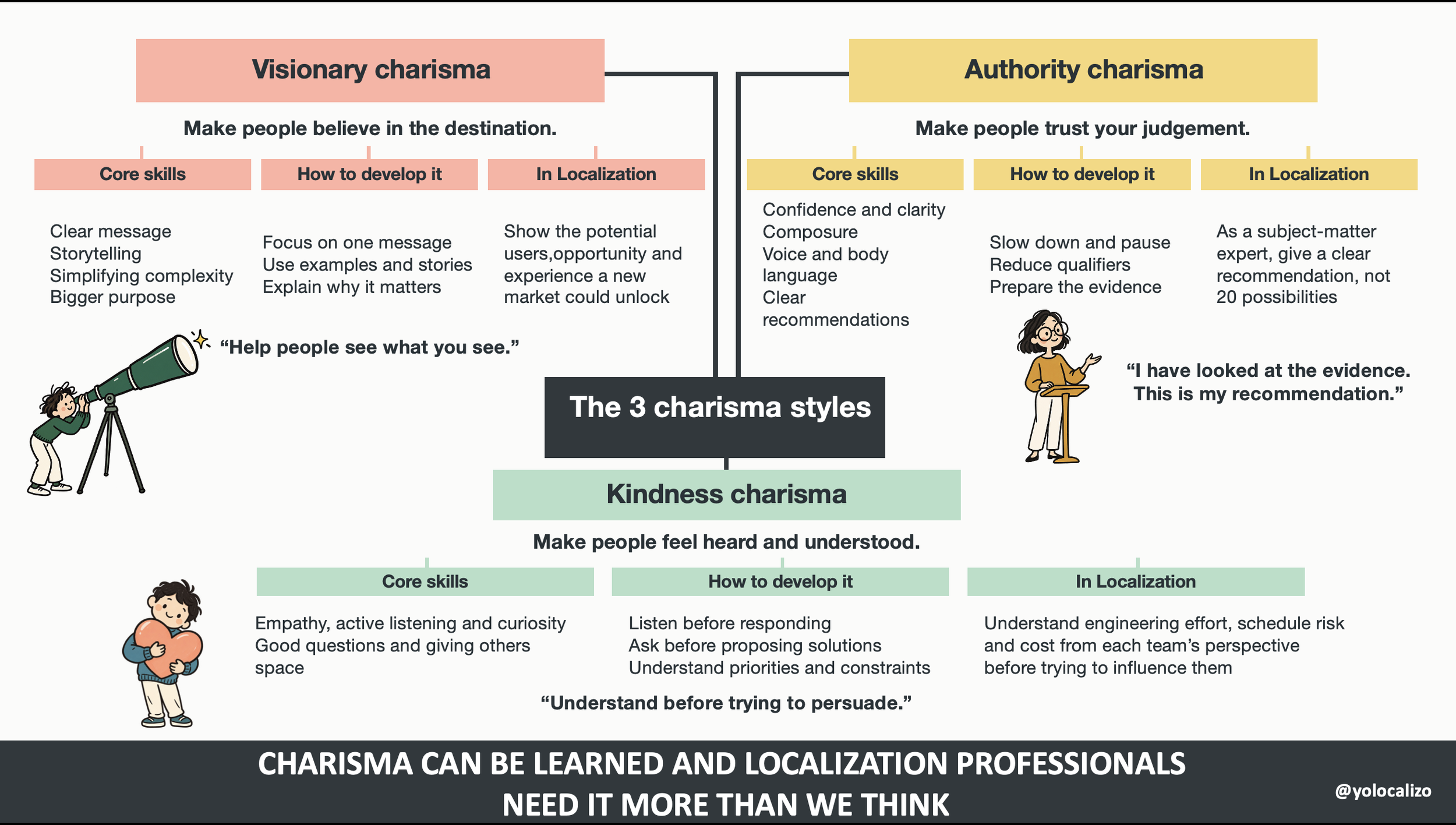
We cannot, and probably should not, try to fool ourselves. So the first suggestion is simple: find a type of charisma that feels natural to your personality. If we try to simplify the different ways charisma can show up in people, there are three styles that emerge quite clearly: visionary charisma, authority charisma and kindness charisma.
So let’s look at what each one means, the skills behind it, and how they can show up in our Localization work.
Click HERE to download the graphic
1. Visionary charisma
Visionary charisma is about making people believe in an idea, a possibility or a future that does not exist yet. People with this type of charisma are able to make others see what they see. They create excitement around a direction and make people feel that there is something worth moving towards. The skills behind visionary charisma include having a clear message, simplifying complex ideas, using stories and examples, and connecting day-to-day work with a bigger purpose. And these are skills we can train.
We can get better at communicating a vision by being clear about the one thing we want people to remember, by using examples instead of abstract explanations, and by showing people not only what we want to do, but why it matters. Steve Jobs comes to mind when I think about this. He was very good at making people believe in the future he was describing.
But visionary charisma is not only useful when you are trying to build one of the biggest companies in the world.. It can be useful in Localization too.
Let’s say I’m pitching the idea to enter in a new market. We can talk about budget, word count and development effort, or we can help our stakeholders to see the opportunity: the clients we could reach, the market we could unlock and the experience we could improve. The data still matters, of course. But visionary charisma helps give that data meaning. It helps people see not only what the initiative will cost, but why it may be worth doing.
2. Authority charisma
Authority charisma is different.
It is less about making people dream about a future and more about making people feel that we know what we are talking about. It is associated with confidence, credibility and presence.
Margaret Thatcher is a good example of authority charisma. She projected confidence, control and a strong sense of conviction, both through her words and the way she carried herself. People displaying authority charisma tend to communicate in a deliberate way. They do not rush unnecessarily. They use pauses. They speak clearly. They are comfortable with silence and with taking space. The skills behind this style include clarity, composure, body language, good use of the voice and the ability to communicate a recommendation without sounding uncertain about every word.
This does not mean becoming aggressive or pretending that we always have the answer.
Authority is not:
“I am right because I am the expert.”
It is much closer to:
“I understand this problem, I have looked at the evidence and this is my recommendation.”
We can improve these skills by slowing down, using pauses instead of filling every silence with “erm”, “maybe” or “I think”, preparing our recommendations better and working on things like posture, eye contact and how we use our voice. Pasted markdown In Localization, authority charisma can be especially useful because many of us operate as subject-matter experts.
A producer may ask whether launching in a market is culturally safe. A stakeholder may ask whether a quality issue is serious enough to delay a release. A team may want to know whether a certain approach is likely to work in Japan or China. There are moments when stakeholders do not need another twenty possibilities.
They need a clear point of view.
Something like:
“Based on the research and the issues we have identified, my recommendation is that we do not launch this version yet. There are two things we should fix first.”
That is authority charisma in practice.
3. Kindness charisma
Kindness charisma is about making people feel comfortable, understood and valued.
It comes from warmth, empathy and genuine attention.
Oprah Winfrey is a good example. She projects warmth and genuine interest, making people feel listened to and understood. The skills behind this type of charisma include active listening, empathy, curiosity, eye contact, asking good questions and giving other people space to speak.
And again, these are things that can be developed. We can learn to listen without preparing our answer while the other person is still talking. We can ask more questions before jumping into a solution. We can try to understand other people’s priorities before pushing our own. This style is useful also in Localization because our work is extremely cross-functional.
We work with developers, producers, designers, marketers, legal teams, vendors, linguists, researchers and many other stakeholders. And they all have different priorities. A developer may see a Localization request as additional engineering work. A producer may see risk to the schedule. Finance may see cost.
Kindness charisma helps us understand those perspectives before trying to influence them. Pasted markdown
Instead of starting with:
“This market adaptation needs to be changed because it is culturally inappropriate.”
We might say:
“I can see why this direction works from a global brand perspective. The concern is how it may be perceived locally, so let me show you what we found and how we could adjust it without losing the original intent.”
The objective has not changed.
But the way we bring people into the conversation has.
And in a discipline where we often need other teams to help us achieve our goals, that can make a big difference.
Final thoughts
If there is one idea I would like you to take from this post, it is this one: I really don’t think charisma is something you either have or you don’t have. Of course, there are people who naturally start with some advantages. They may be more confident, more expressive, better storytellers, better listeners, whatever. But many of the behaviours we associate with charismatic people are exactly that: behaviours.
And behaviours can be learned. So perhaps the question we should ask ourselves is not:
“Am I charismatic?”
But:
“What kind of charisma feels more natural to me?”
Maybe you are someone who naturally connects with people through empathy and listening. Maybe you are better at creating a vision and making people excited about an idea. Or maybe your strength is clarity, confidence and giving people the feeling that you know where you are going.
Start there.
Understand which style fits better with your personality, identify the skills behind it, and work on them deliberately. Because charisma is not necessarily about becoming someone different. It is probably much more about understanding the behaviours that already fit who you are, and learning how to use them better.
@yolocalizo
Many companies claim to be customer-centric, but too often that promise stops at English. Surveys and focus groups are run in the US or UK and treated as if they represent the entire customer base, leaving most global customers unheard. In this post, I share a practical framework 5 audit questions to help leaders test if their strategy is truly customer-centric or just a slogan.