



Leaving London thinking about the value of Localization today (and how to explain it to stakeholders)
Well, here we are at T5 at London Heathrow, waiting for my flight to Spain. The airport already feels like Christmas; trees decorate the different waiting areas, and the shops have already gone all out for their Christmas campaigns. It feels too early to me; Christmas is still a month and a bit away! That feeling that there always has to be something to sell overwhelms me a little…. as soon as Halloween ends, Christmas begins. But anyway, talking about consumerism isn’t the point of my post :) What I bring here today are some reflections. This week, I had the opportunity to attend and speak at the Language Media event, organized by the University of London, at Senate House.





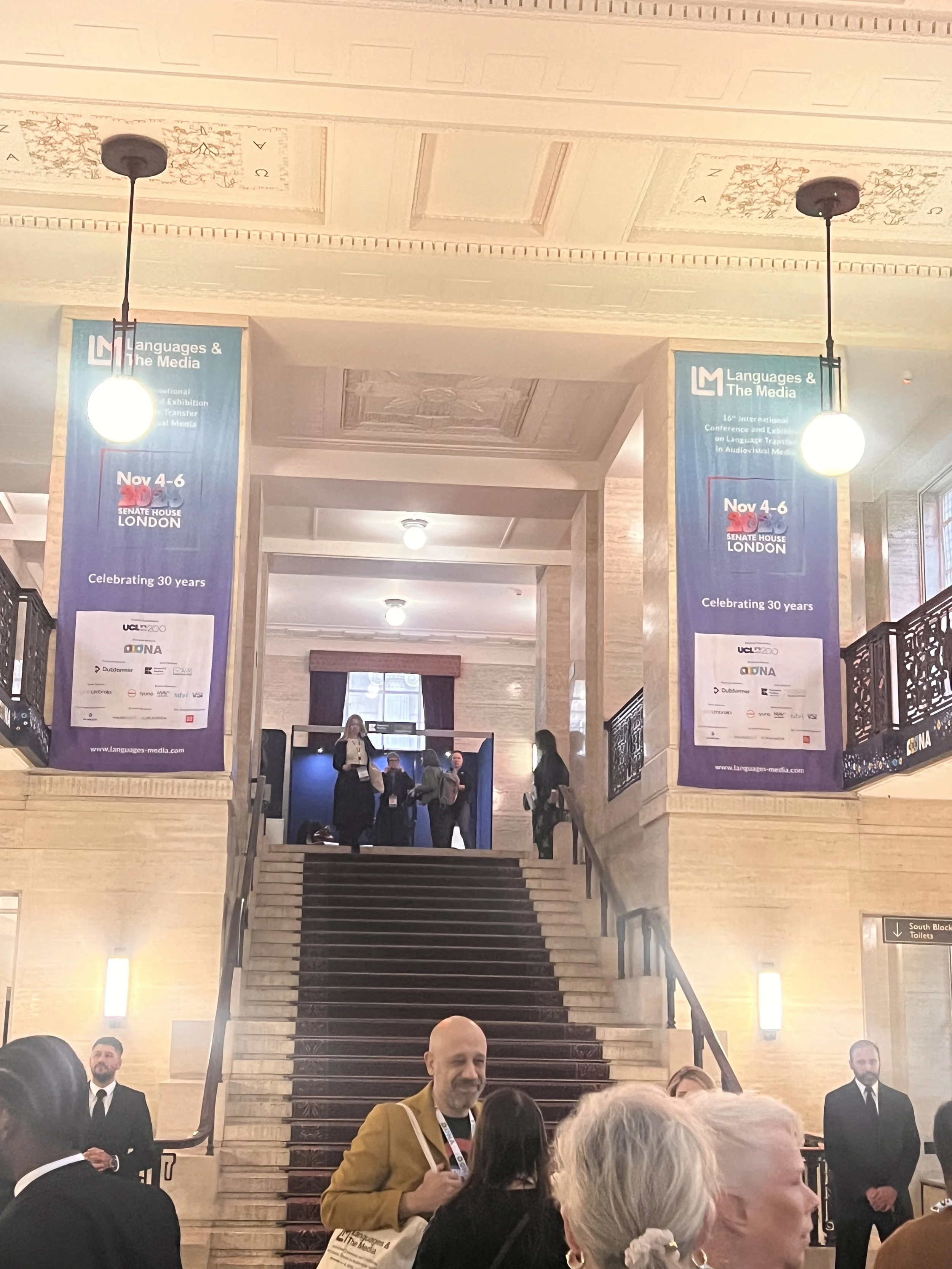
Being here is a very interesting experience for me for different reasons. First of all, the flashbacks to my student years keep coming. When I see a classroom, a corridor, or the cafeteria, I can’t help but go back to the 90s, when I was studying computer engineering. Another reason I found the experience interesting is that I don’t have many opportunities to see localization from the academic world. I’m very much immersed in the corporate world. Working, as I do, at one of the largest technology companies in the world, I can’t help comparing the perspective of the tech giants with the conversations I had with different participants during the event, or what I heard in the talks I attended.
In those conversations and presentations, the topic of AI was, obviously, everywhere. There were discussions about moving away from the “good enough” mindset when it comes to the quality we deliver, or opening the debate about whether we should clearly disclose that AI has been used to generate content, whether words, special effects, or audio. There was also frustration with terms and approaches such as “human in the loop,” “human at the center,” “human in the driver’s seat,” and so on. I understand the frustration of translators and LSPs who are under what I would describe as unprecedented pressure to use AI and, along the way, deliver faster, more often, and/or cheaper.
Click HERE to download the infographic
I understand that “quality is the most important thing,” which I heard repeatedly during the conference, is one of the pillars the community holds on to. I understand the argument that a translator’s creativity is infinitely better than an LLM’s, but I also understand the other perspective, the one I live with every day. In that reality, process optimization is important, budget optimization is critical, and quality is not an end in itself. It is a means of getting to something. And that “something” is what I tried to unpack during the panel led by Belén Agulló from Terra, where I had the opportunity to share perspectives with Marina from Riot Games and Gaëlle from Wizards of the Coast. The panel was called “Towards Outcome-Based Localization Models .”
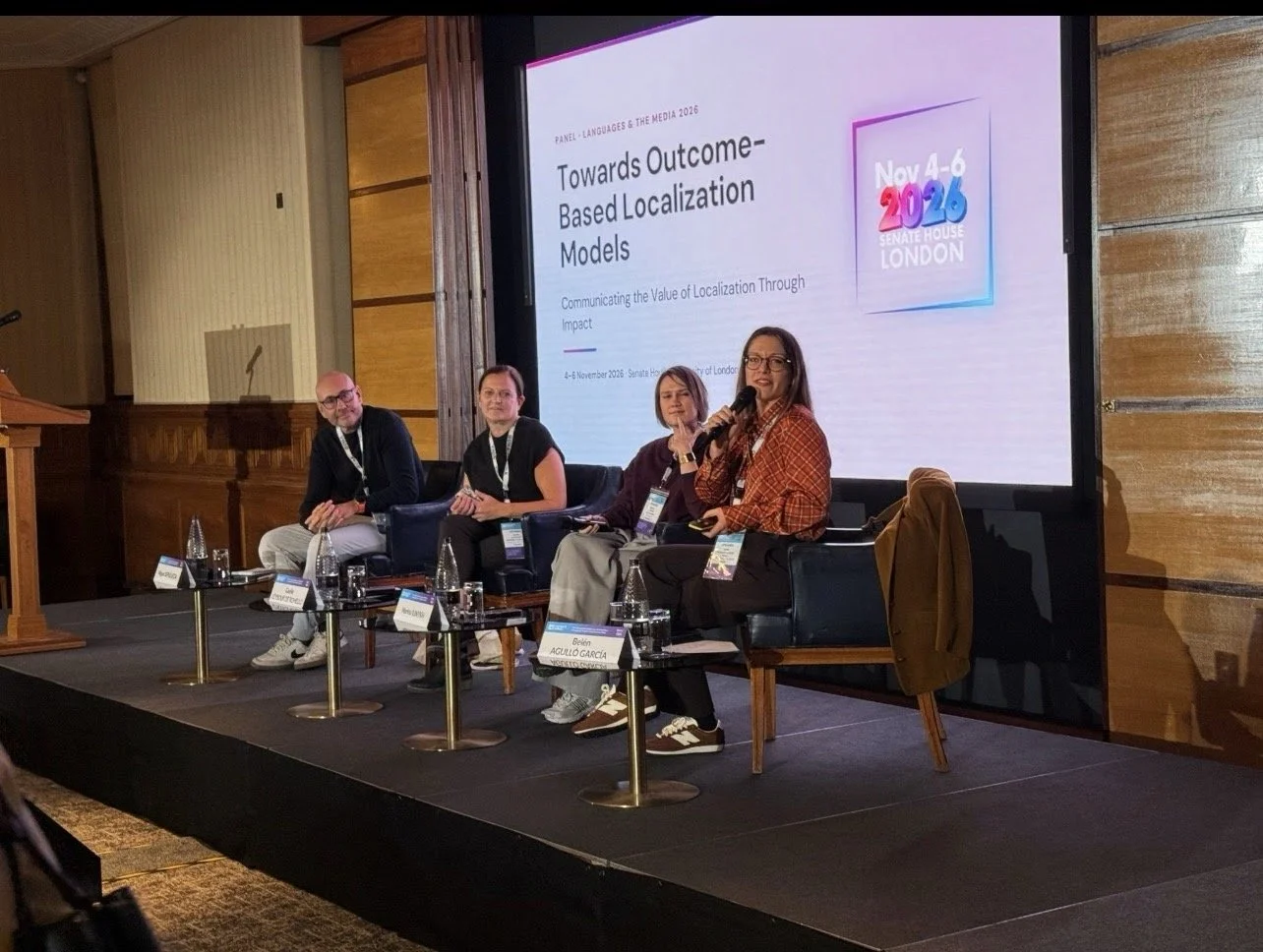
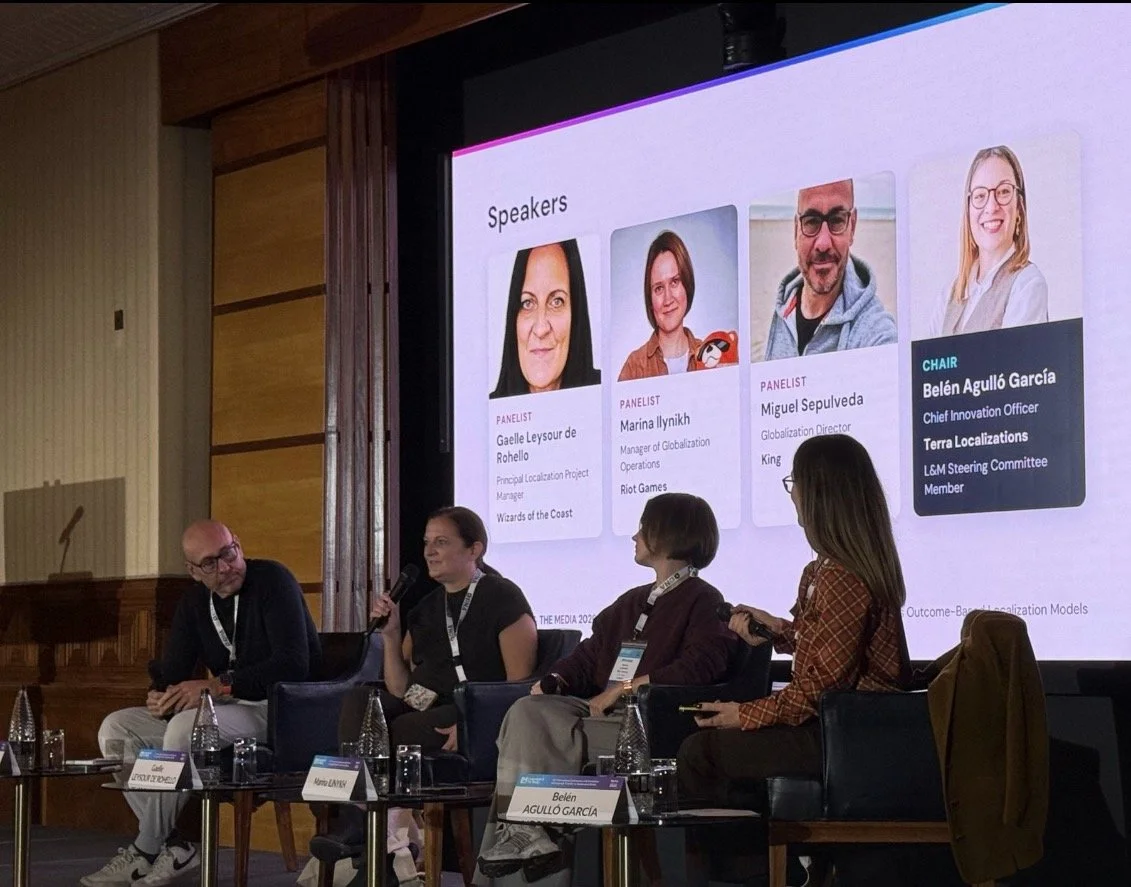
And that outcome is the “something” that I believe should bring both perspectives together: academia, freelancers, and LSPs on one side, and buyers on the other.
I’m not a big supporter of the voices arguing that a translator’s quality is ALWAYS better than an LLM’s. I’ve been buying translation services for many years, and there have been times when the quality of the deliveries was quite questionable. They screamed MTPE all over the place, but without the PE part, because I would look at the translated content, then at the invoice… and say to myself, “How is it possible for a ‘human’ translator to deliver this?” The point is that, from my perspective, the “something” that should bring both views together needs to focus on answering what quality is for and what localization is for. That was the central pillar of my contribution to the roundtable, and that is where metrics play a fundamental role.
In the roundtable, on my blog, or in the workshops I run, metrics play a prominent role because they help explain the “something” I sometimes feel we, as localization professionals, struggle to articulate. And that is the discussion this post aims to continue, following my participation in the panel.
Thinking in terms of an outcome model requires a complete change in how we approach explaining what localization does and what it is for.
The way I see it, we need to operate at two levels, and each serves a different purpose. But both are necessary. We shouldn’t discard one because we are working at the other. What we need is to become very fluent in moving between them, depending on who we are talking to or what we want to achieve through those interactions.
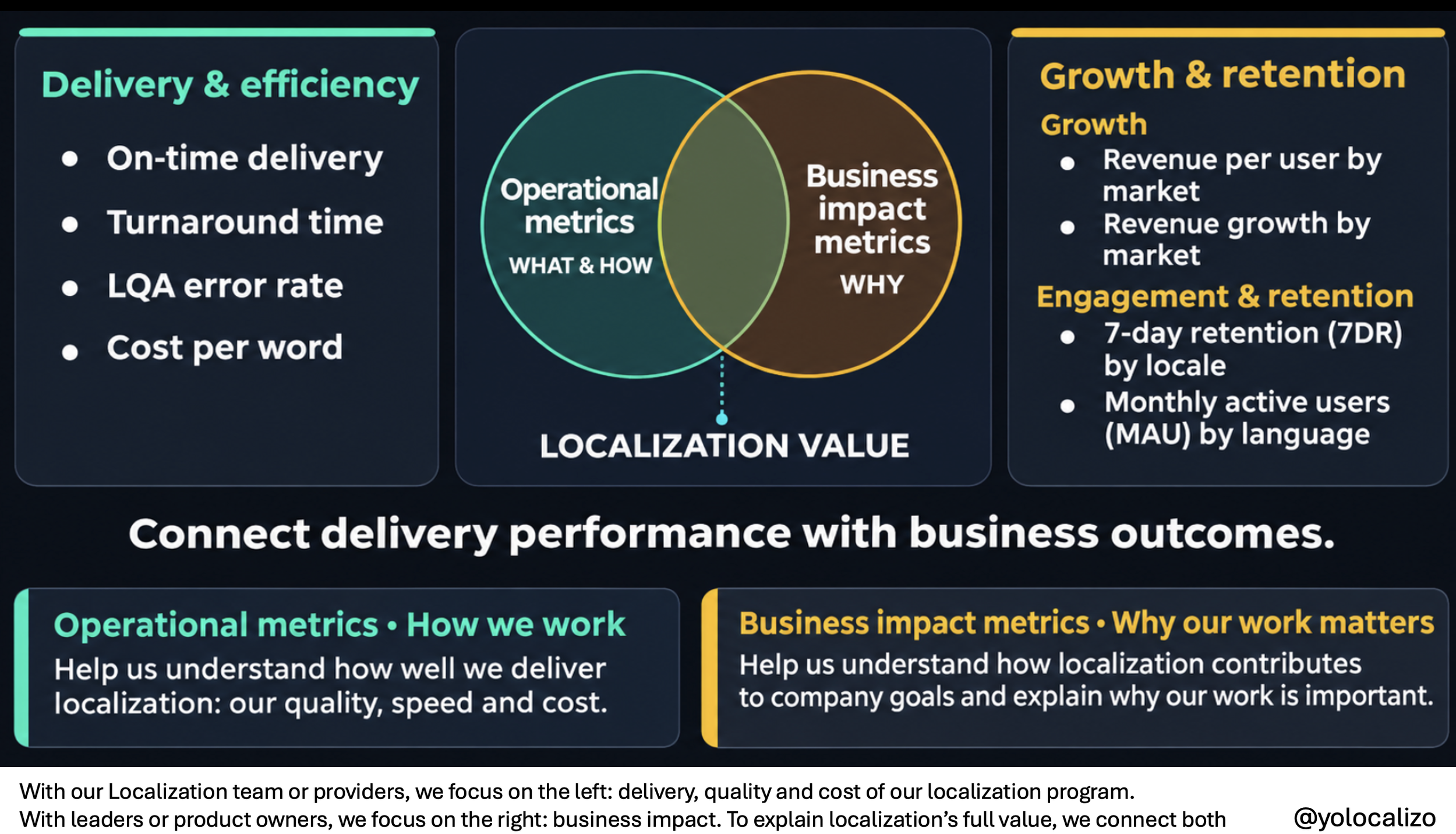
If we see these as two hemispheres, two sides, on the left we have operational metrics. Here we have the usual groups of project management, quality, or financial metrics. This is where we measure the typical metrics we have always measured in our Localization world, such as on-time deliveries, word counts, cost per language, LQA bugs, glossary issues, truncations, i18n issues… All these metrics help us assess our language strategy internally and determine whether the quality we have is the quality we want. These are what I usually call “housekeeping” metrics, where the objective is to make sure the work we do is done well. They audit our localization program.
But if we stop at those metrics, we are missing “something,” the something I referred to in the previous paragraphs. These operational metrics are not useful for explaining what our work is for. They are not useful for measuring the business impact of my day-to-day work. And that is the other hemisphere we need to reach, the right-hand side.
On the left, the operational side, the work happens, and that is where I collect metrics explaining what I do and how I do it. Having no delays in a partner’s handoff tells me the vendor is delivering on time, but it doesn’t explain why that matters. It doesn’t explain the business impact of on-time delivery. On the left, we explain what we do and how we do it. On the right, we explain why we do it. And that “why” is why developing an outcome mindset, as Marina, Gaëlle, Belén, and I tried to explain, is so important for remaining relevant as a craft in a world where we hear voices pushing localization toward becoming just another commodity.
That is why we need to focus our efforts on creating a framework and a way of working in which selecting the right metrics and explaining their impact on the company become automatic, as if we were on cruise control.
During the panel, the question came up of how we explain this and which metrics we can use on this right-hand side, the business impact side I’m referring to. My suggestion for explaining the impact of localization was to collect market-segmented metrics and, where possible, categorize them. In this scenario, my favorites, especially for mobile digital products, are revenue per market (or gross bookings per locale), engagement metrics such as day 2 and day 7 retention, and monthly active users.
Measuring what we do is the first step: the left-hand side. Connecting it to the product and its business impact is the second step: the right-hand side. And bringing the left and right perspectives together is what helps explain the impact of the work we do and why it matters.
Final thoughts
Attending this Language Media event has been very eye-opening, giving me a closer look at the struggles many service providers and freelancers face. I hope the perspective I shared in conversations over coffee breaks and lunches, along with my participation in the roundtable, offered a different view.
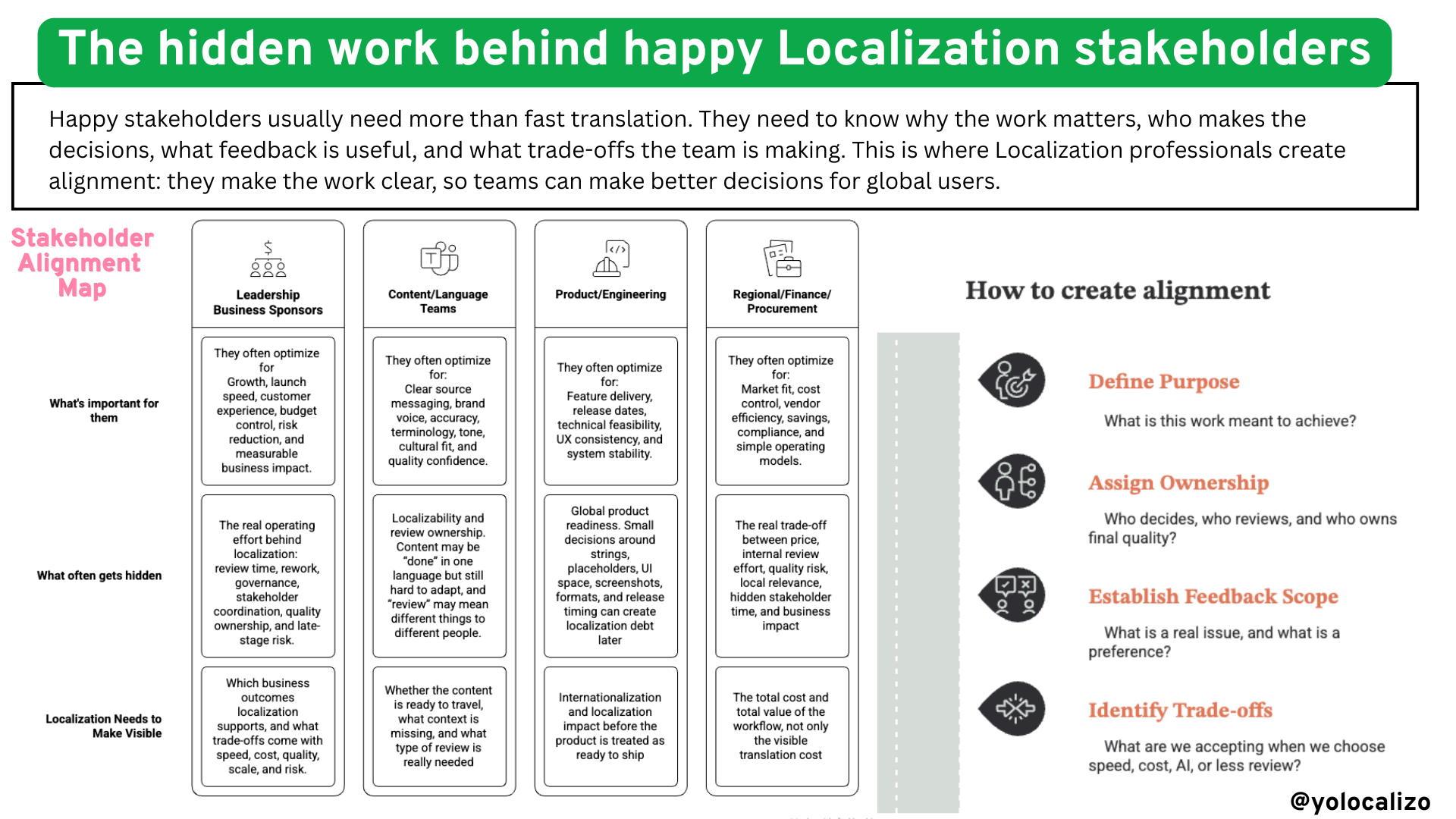
From my perspective, and after years of working with senior leadership teams at a corporate level, I’ve realized that learning to explain what we do, learning to explain why our work matters, is just as important as doing the work itself. I could even argue that it is more important.
Can you spot me? :)
@yolocalizo
In this post, I reflect on my attendance at the Language and the Media conference. Quality, speed, and cost matter, but so does connecting what we deliver with business goals.
Some reflections on the value of localization nowadays, amid the increasing pressure of AI on our industry…. (and also some thoughts on metrics, stakeholders, and why we need both sides to tell the full story)