


Habits are formed following a sequence of 4 steps. Read this article to learn more about this fascinating topic of habit formation

In some RFPs today, it is no longer so clear what buyers really value from LSPs. This post explores why. Based on my experience on the buyer side, I share why the real need may be shifting from pure execution toward something harder to explain, but often more useful in practice.
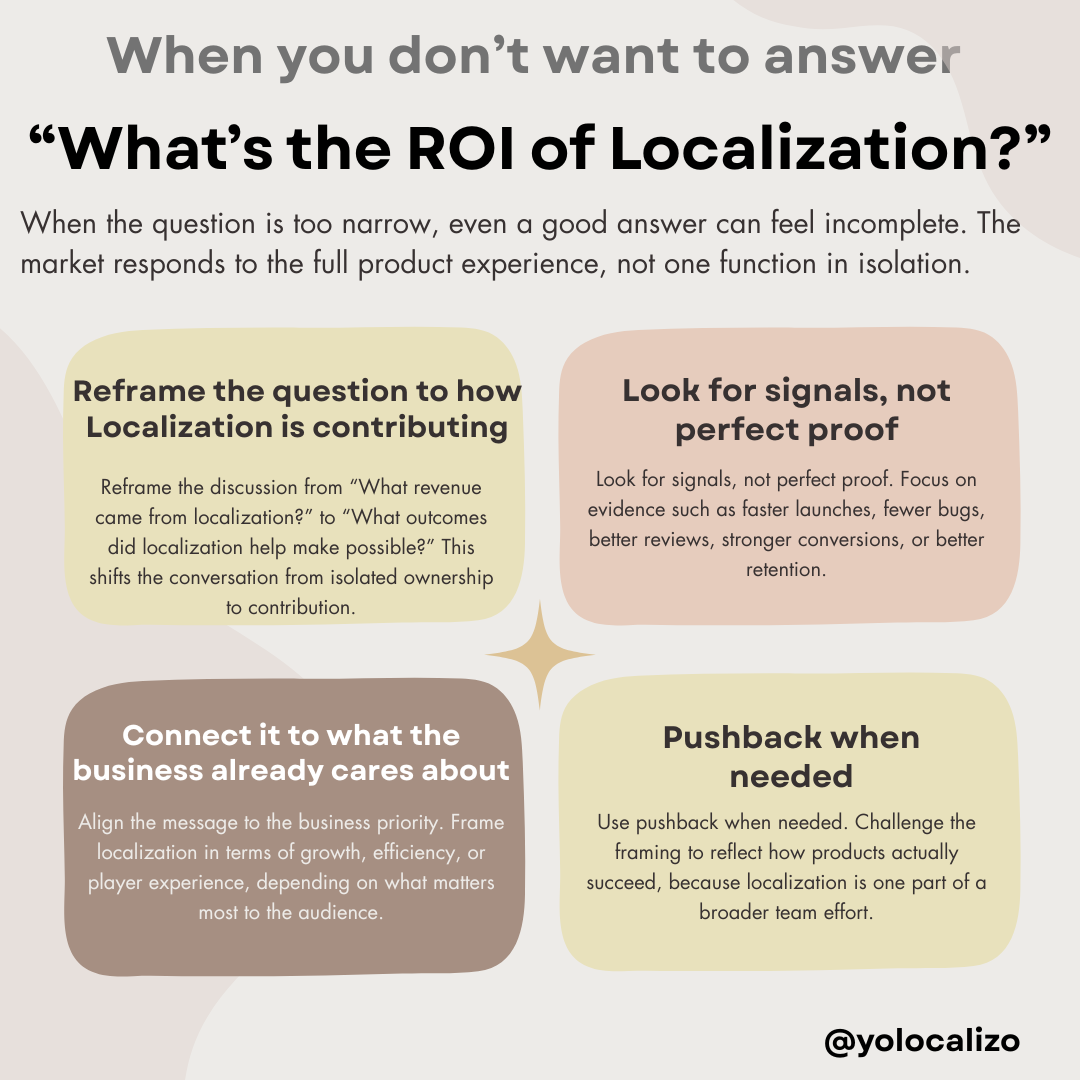
What do you do when someone asks for the ROI of localization and you know the question is too narrow from the start? In this post, I reflect on why I stopped trying to prove isolated ownership and started talking more honestly about contribution.
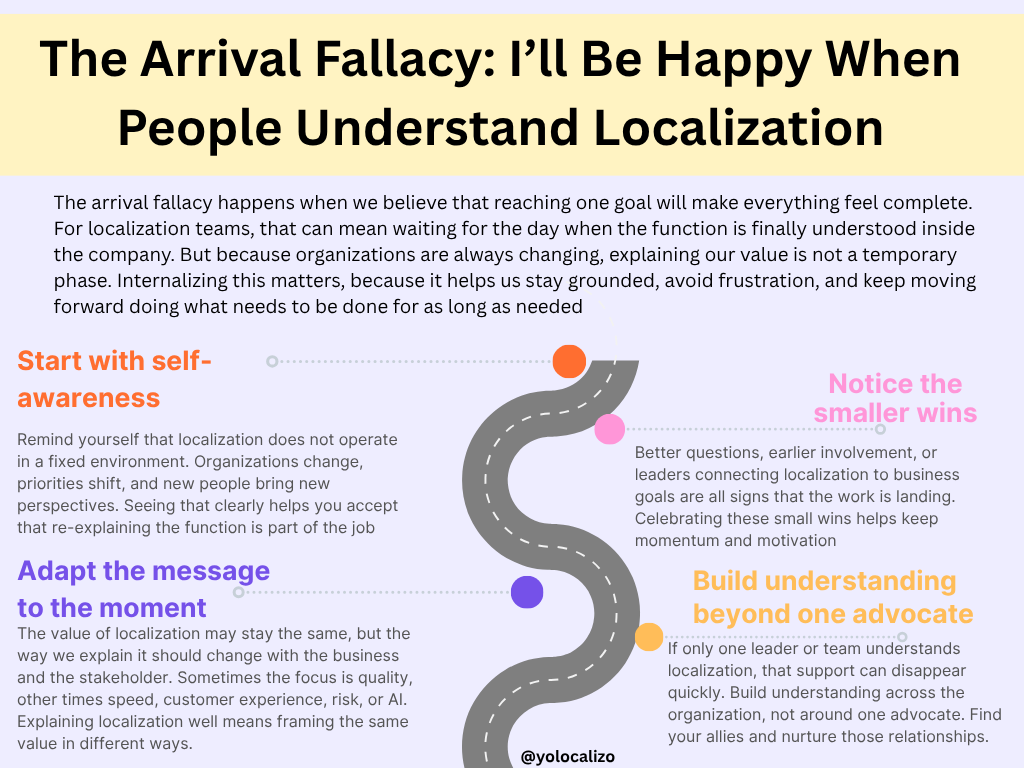
Reading The Myths of Happiness reminded me of the arrival fallacy: the belief that once we reach a certain goal, everything will finally feel solved. In localization, that can look like waiting for the day when people will finally understand what we do. But organizations keep changing, so that moment may never fully come. And maybe accepting that is exactly what helps us stay grounded, avoid frustration, and keep moving forward.
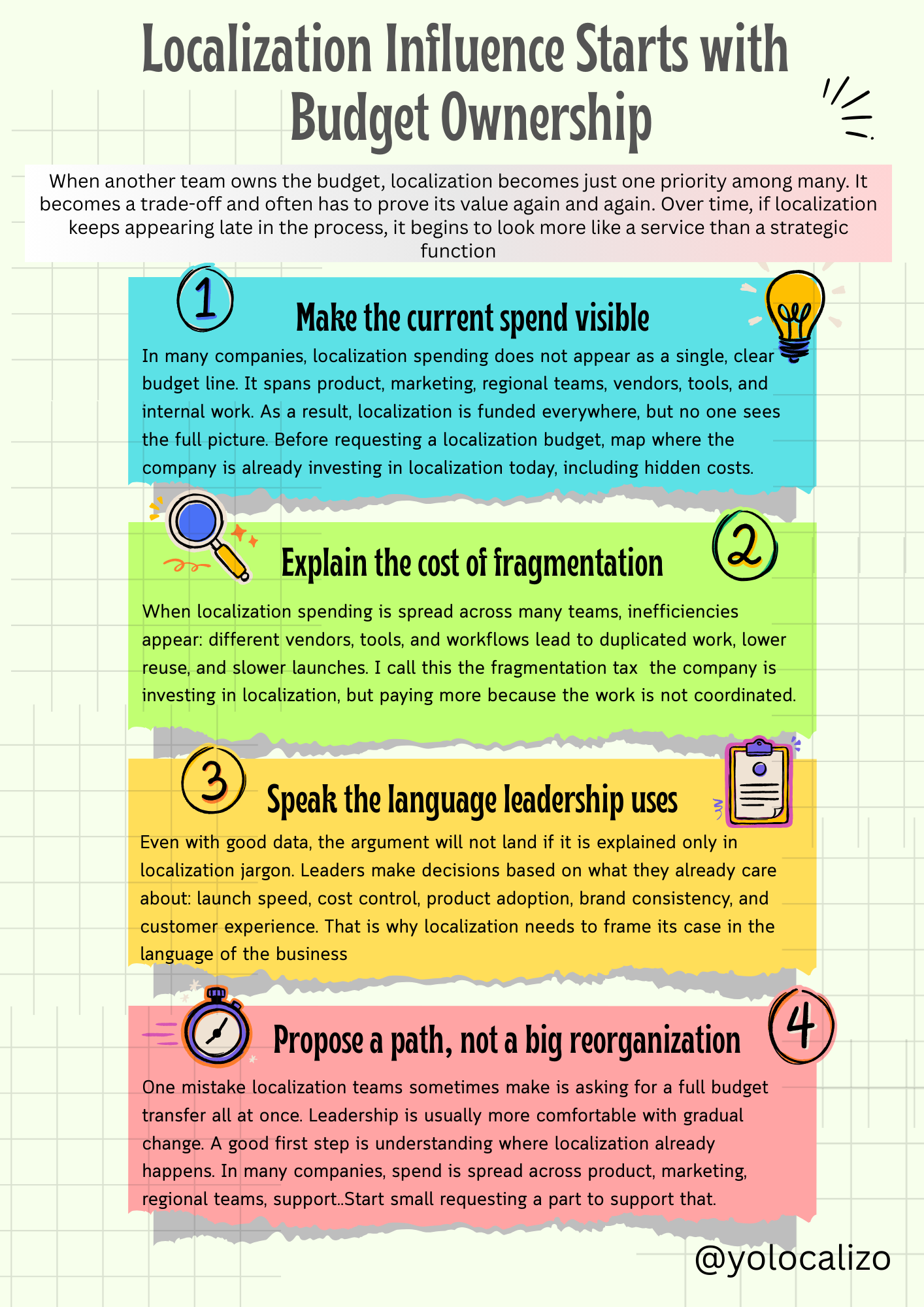
In many companies, the localization budget does not sit with the localization team. At first, that may seem like a small detail. But over time, it changes how localization influences strategy
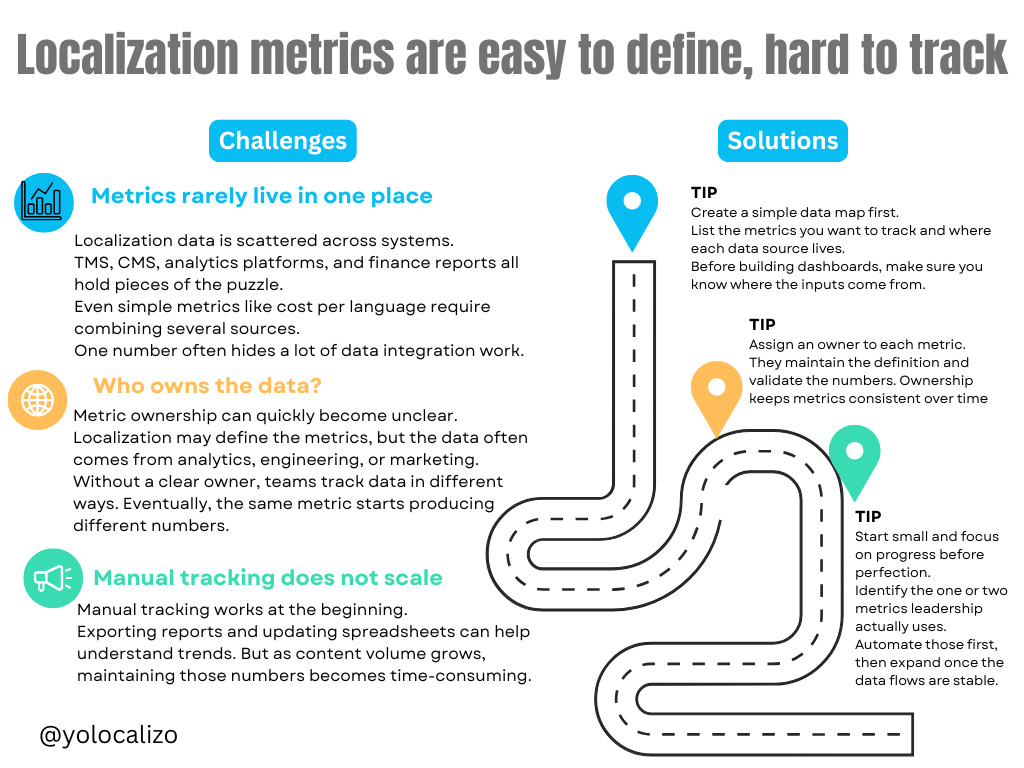
Defining localization metrics is relatively easy. In many cases, a team can write a reasonable list during a workshop, like the ones I mentioned above, or during a strategy session. The conceptual part of what to track and why rarely takes long. The real difficulty appears later: HOW you actually obtain those metrics.
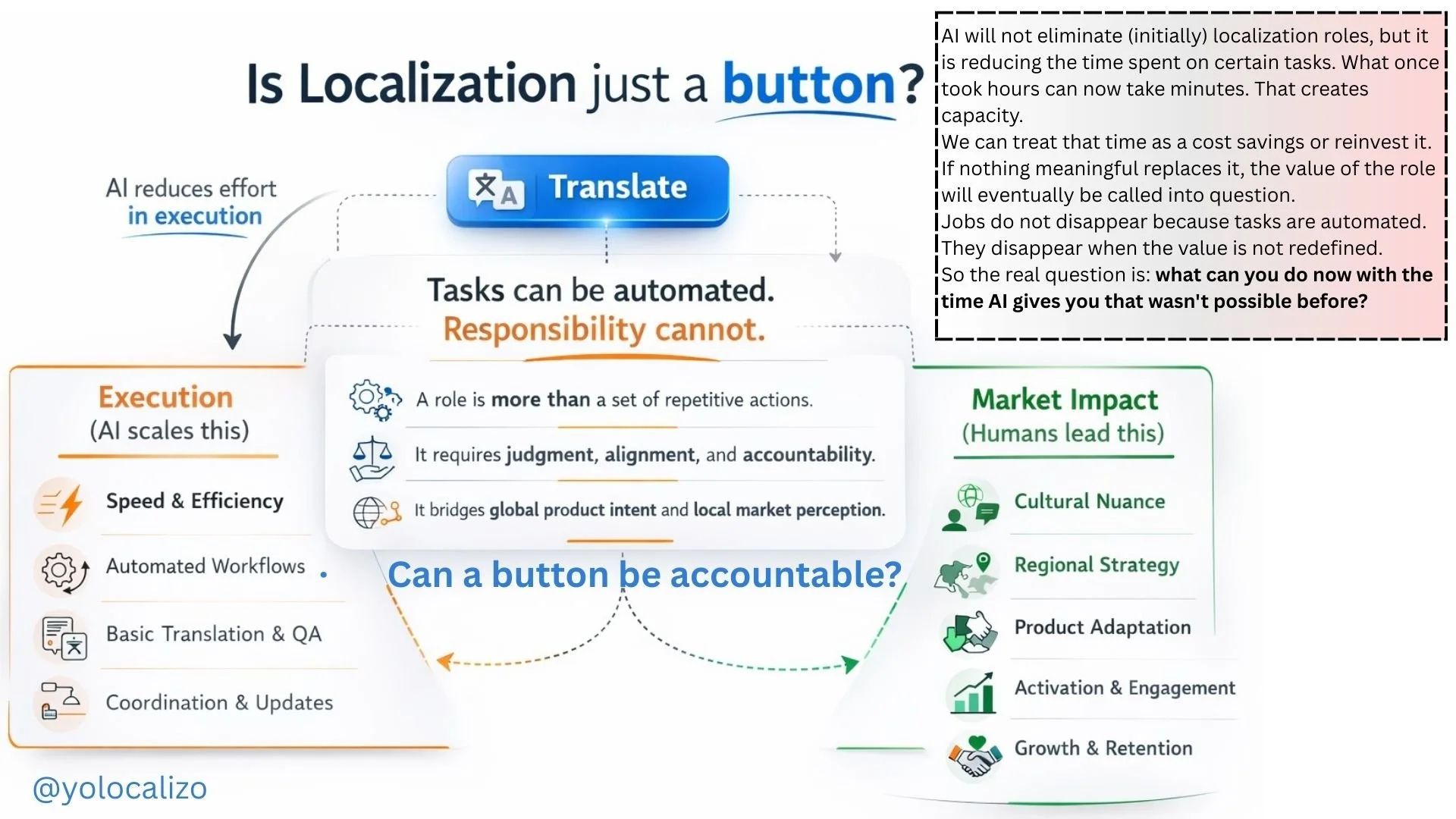
AI will not eliminate (initially) localization roles, but it is reducing the time spent on certain tasks. What once took hours can now take minutes. That creates capacity.We can treat that time as a cost savings or reinvest it. If nothing meaningful replaces it, the value of the role will eventually be called into question.Jobs do not disappear because tasks are automated. They disappear when the value is not redefined.
So the real question is: what can you do now with the time AI gives you that wasn't possible before?
The world of localization is full of small, hidden details.
Some things are deeper than they seem, and I often see between in-context review and LQA in the world of Localization. They might seem the same, but if we scratch beneath the surface, we'll see they're not what they seem.
In this post, I want to focus on explaining the differences between in-context review and LQA, which is something I see being confused quite frequently, and although the tasks are similar ... they are not the same.
AI is not eliminating localization. But it is removing the illusion that execution alone is enough.
Layer 1 accuracy, delivery, quality was our playfield. Now AI scales it faster and cheaper. And when value is framed only around execution, the conversation shifts to cost and headcount.
Meanwhile, executives focus on retention and growth.
That’s Layer 2 cultural impact.
In the age of AI, localization must operate in both.
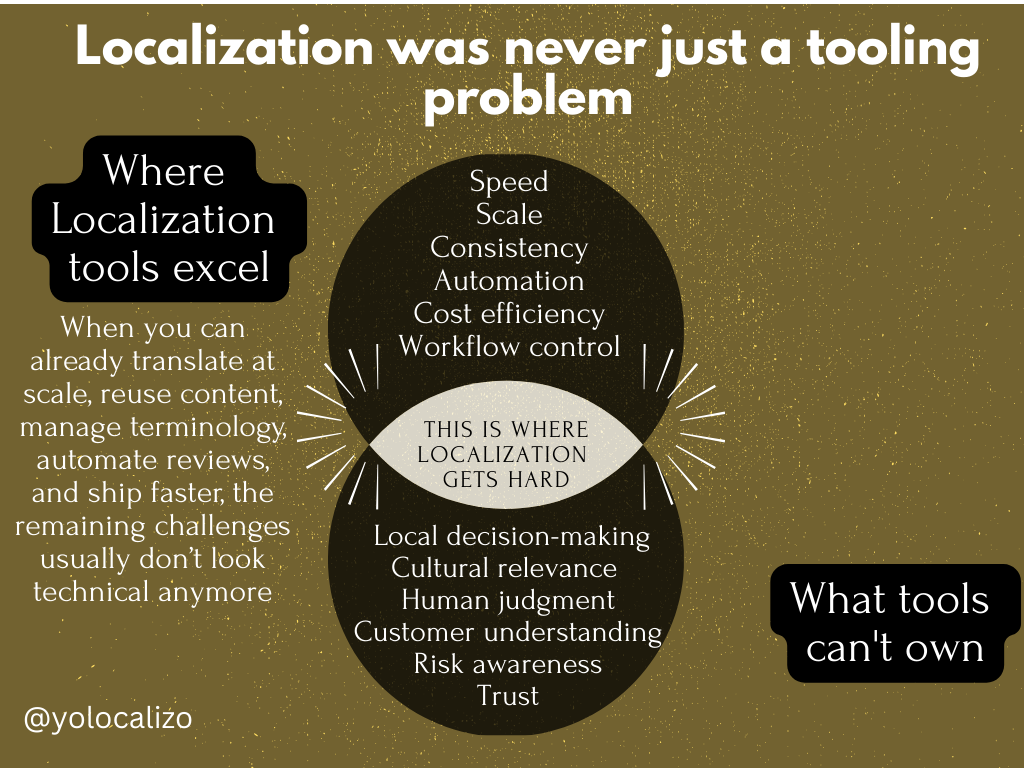
You need a solid localization tech stack before you can build a global digital product. Tools that help manage content, automate workflows, ensure consistency, handle volume, control quality, and scale across languages are essential. Without them, everything becomes slower, more expensive, and harder to manage. Today, we have great tools to support all of this. And yet, despite all these changes, something fundamental hasn’t changed in the ingredients that define good localization.

“Welcome to my blog. The space where I document my passion about Localization, Project Management and Leadership”
Habits are formed following a sequence of 4 steps. Read this article to learn more about this fascinating topic of habit formation
Localizability readiness is a series of processes and activities that optimize a product for a worldwide launch. In this post I explain how we can achieve localizability readiness by investing our efforts in improving the quality of the English content of the source text we create.
In this post I analyze the 7 areas that a Localization Service Buyer considers important when working with a Language Provider.
Software development using sprints are great for Localization teams! Please have a look at my post and let me know if you agree :)
Creating a localization budget is not an easy task as there are multiple variables to consider. In this article I explain the 3 that are the most important from my point of view
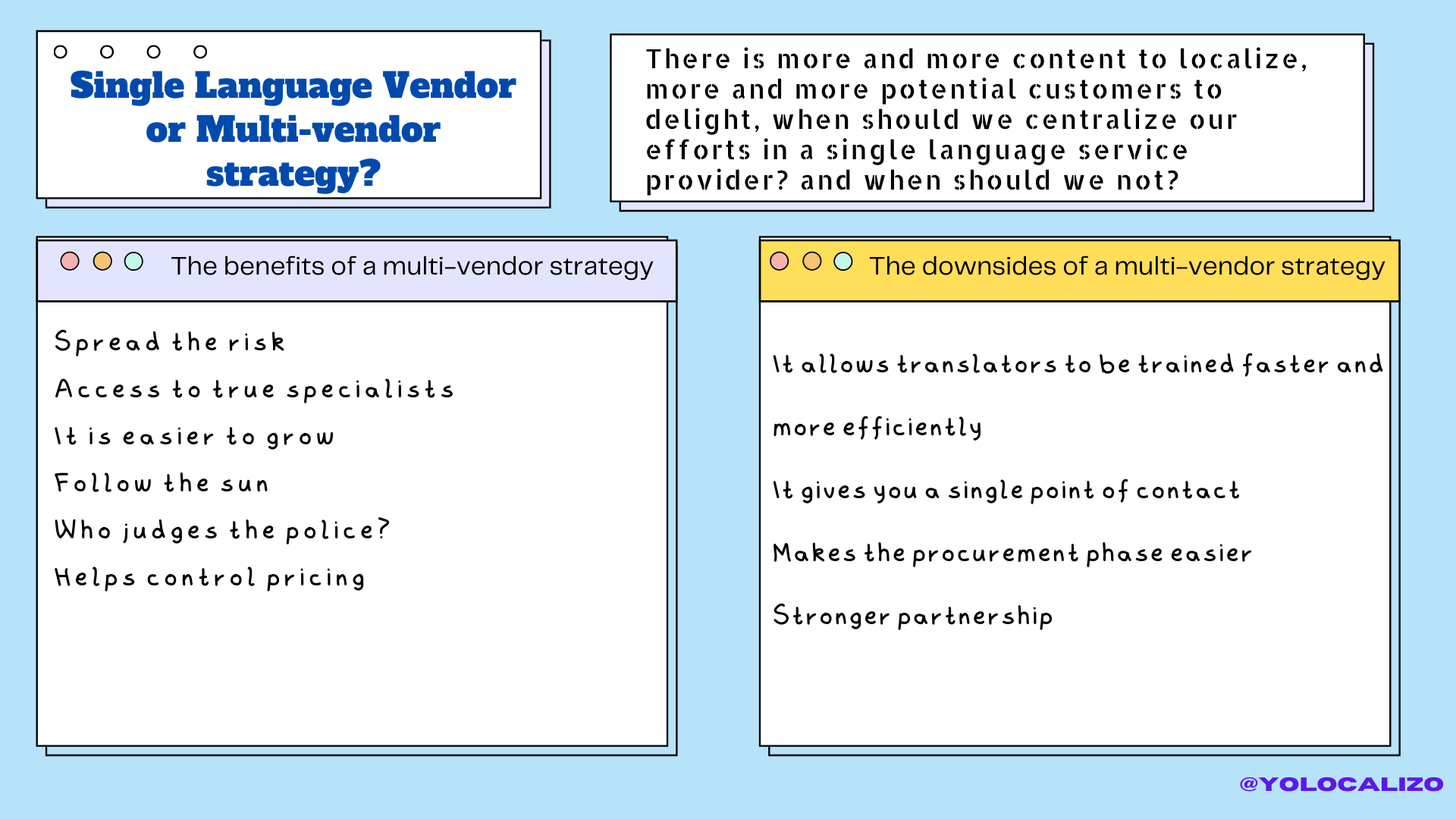
Some companies choose to have multiple vendors to execute their localization strategy while others prefer a more simplistic approach and concentrate their activities in a single partner. But what is it that can make us choose one option or the other?
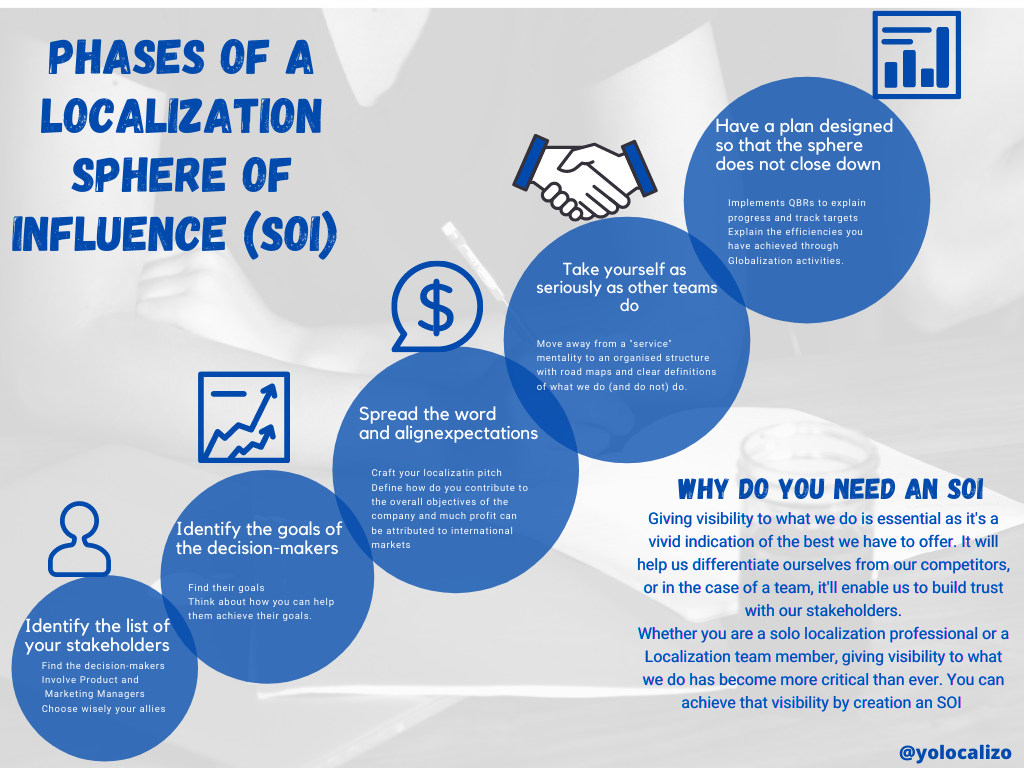
A Localization Sphere of Influence is something that can be extremely useful both to give visibility to the Localization activities we carry out and to provide us with professional development opportunities.
In this post, I explain the different phases you need to go through in order to create one and go into why it is important to have a Sphere of Influence (SOI) in your Localization strategy.
A multi-market expansion strategy for any product is most effective if the various Globalization (i.e.Localization, Internationalization) activities are understood as a cycle that runs parallel to the multiple phases of software development; This cycle repeats during the various product upgrades. It is not an activity that is executed as if it were a process once the home market version (usually in English) is finalized. It is not a transaction that simply sends files to a professional localizer shortly before the global release. No; Globalization is not a process. Globalization is a cycle that runs multiple times. It is a cycle that runs in parallel with the product research, design, and development phases.
Going global is tough. It is difficult to break into markets where you are not already present. How can we know which market has potential if we are not able to invest a lot of resources to assess which markets are the right ones for a product?
Copyedit is the process executed by a professional in the localization industry in which the editor looks for gross errors in the content they review. But how do you know you need copyedit?
On January 15, 2016, in a small but cozy hotel in London, this blog was born. In this post number 202, I make a summary of all the things I have learned by publishing a new post almost every Sunday in the last few years.
Sometimes hiring directly the services of several freelancers to carry out the Localization tasks of your project can be the best option. However, there are cases in which outsourcing all your work to an LSP/MLV may be the best localization strategy for your product.
Dealing with cultural diversity in Localization management in our industry is a dilemma in communication and stakeholders relationships. Such multicultural diversity puts in front of challenges that greatly hinder getting the best out of areas such as team dynamics or building alliances. The good thing is that today many resources can help us (a lot) raise our cultural competency and improve our cultural awareness.
Building Transparency in the Translation Supply Chain. How can we do it?
The localization industry is largely fragmented, and that fragmentation does not help achieve transparency and trust throughout the supply chain. Is this something that can change? It is not easy, but those who are in a position to buy services linguistic services can take the first step
Involving the Localization team in Playtest might be a great idea! Find out here why ☺️
Making your way as a localization professional in the video game industry might be tricky at the beginning. But it's obviously not impossible! In this post, I share 7 ideas so that all those who want to work localizing, testing, or managing video games will know where to start.
Is there anything more human than language?
Is there anything more user-centric than giving the user the product in their native language?
There is a better way to approach it, and that way is to understand that Localization is User Experience.
And in this post, I explain why (and how to do it!)
Can generic MT engines be used for business?
MT has come a long way in the last few years, but there is still a long way to go for stakeholders who are not very familiar with this technology to understand if the valid option for their global expansion is to use a generic MT engine or if a custom mt is what is needed.
In the second part of the LQA design post, I explain to you how to make LQA part of the design process
Building a digital product is an iterative process that includes several phases. Different localization activities to a greater or lesser extent are carried out throughout the different phases. One of these activities is Localization QA (LQA). LQA is traditionally done in the deployment phase; however, it is too late in most cases.




Several factors affect the duration of localization for a digital product, including translators' availability and the technology setup level. This blog post explores the various elements that impact the amount of time needed for product localization.