



Doom creator John Carmack said years ago “Story in a game is like story in a porn movie: it’s expected to be there, but it’s not that important.”
This week while having tapas with a friend I had a deja-vú about John’ words ….
Many companies claim to be customer-centric, but too often that promise stops at English. Surveys and focus groups are run in the US or UK and treated as if they represent the entire customer base, leaving most global customers unheard. In this post, I share a practical framework 5 audit questions to help leaders test if their strategy is truly customer-centric or just a slogan.
Choosing a TMS is not an IT vs Localization decision. Localization understands the business problem and the workflow; IT understands the technical ecosystem. The best result comes when both work together, with clear roles, shared criteria and a selection process that looks beyond the vendor demo.
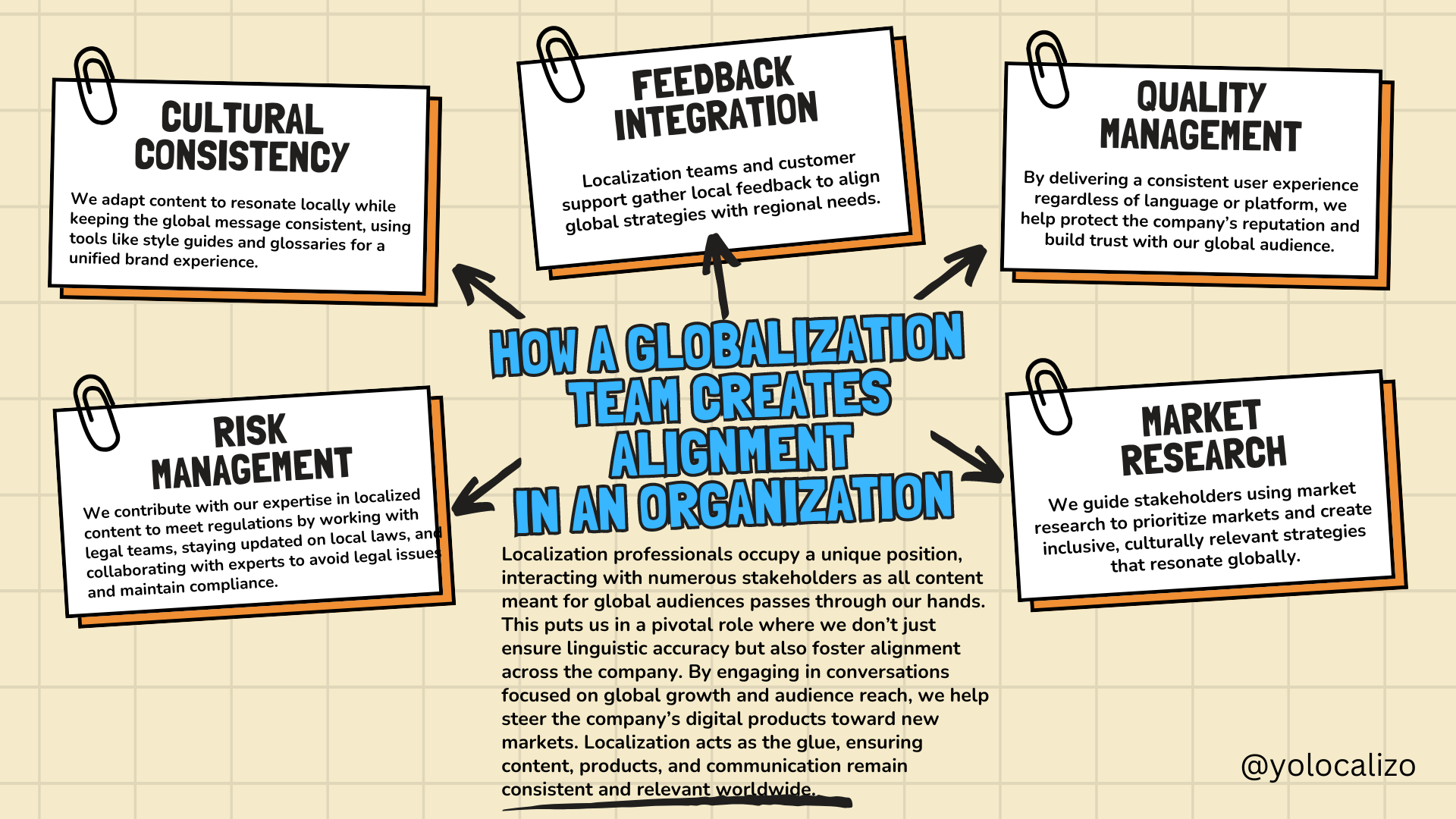
Words have the power to shape perceptions and influence actions, which is why reframing is such a powerful tool. In localization, we can reframe our role from simply translating to driving alignment across the company. By ensuring content is consistent, culturally relevant, and strategically aligned with business goals, localization professionals play a key role in helping businesses grow globally. This post explores how we create that alignment and why our work is much more than just translation.
AI is making it easier for teams to create multilingual content without going through Localization. That sounds very similar to a problem IT has been dealing with for years: shadow IT. In this post, I look at what Localization can learn from that experience and how we can keep visibility, quality and control without slowing the business down
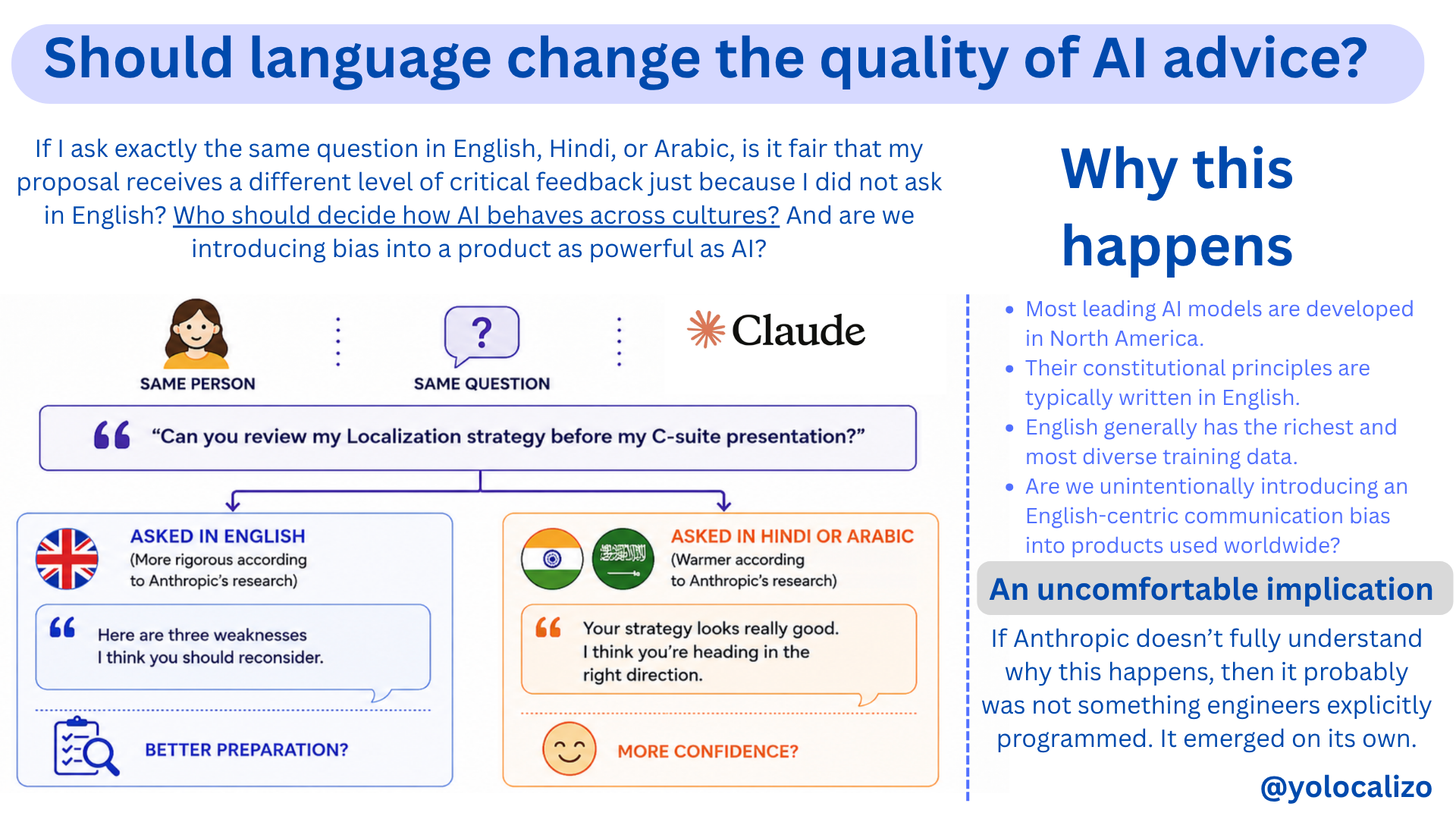
What if asking AI the same question in English, Hindi, or Arabic leads to different levels of critical feedback? Anthropic’s latest research raises fascinating questions about culture, AI behavior, and why Localization expertise may become increasingly relevant beyond translation.
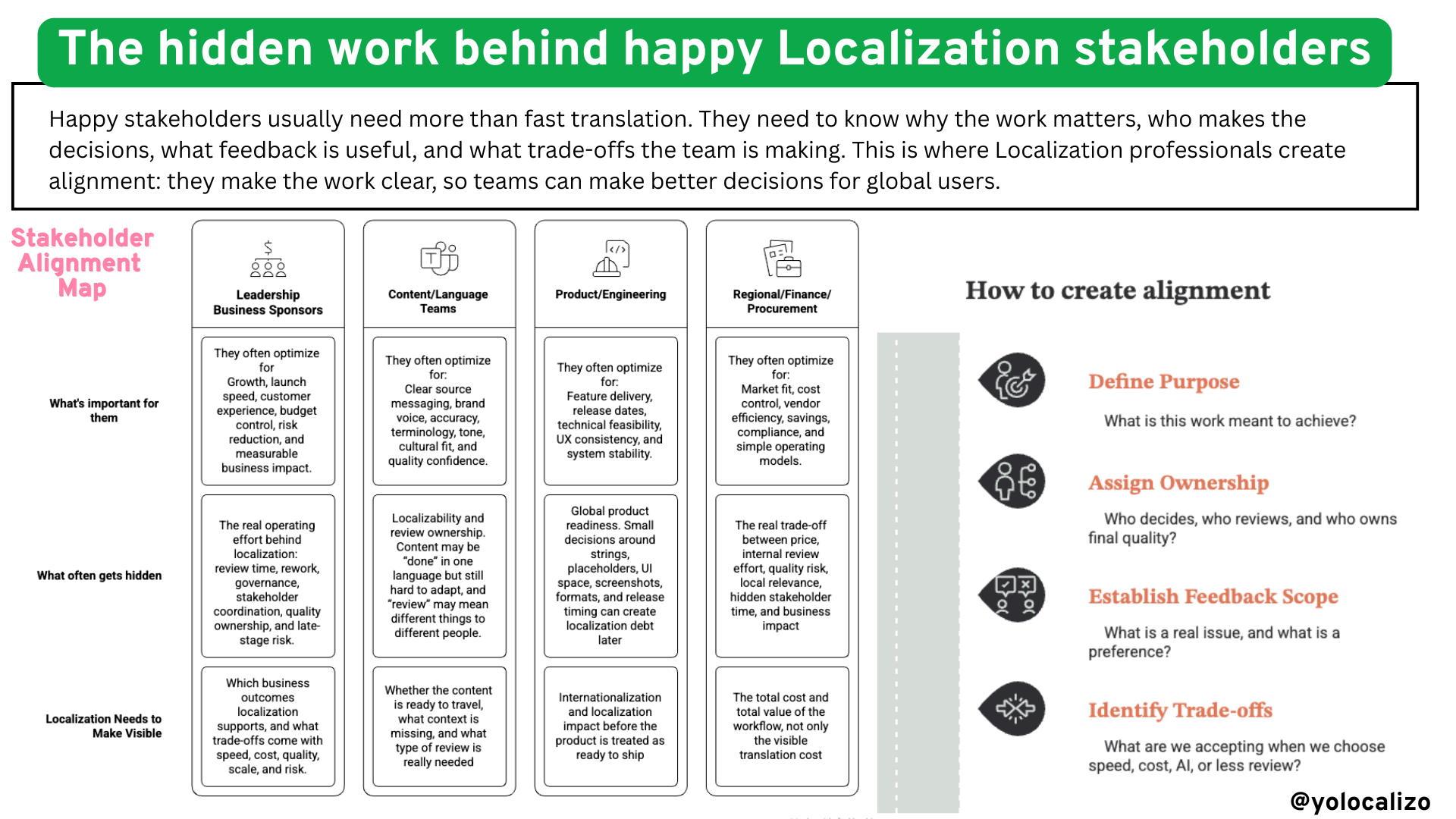
Localization Managers are often expected to keep many stakeholders happy: leadership, content teams, linguists, product teams, regional teams, finance, and procurement. But maybe happiness is not the real goal. In this post, I reflect on why stakeholder alignment matters more, and how Localization can make expectations, hidden work, ownership, and trade-offs more visible
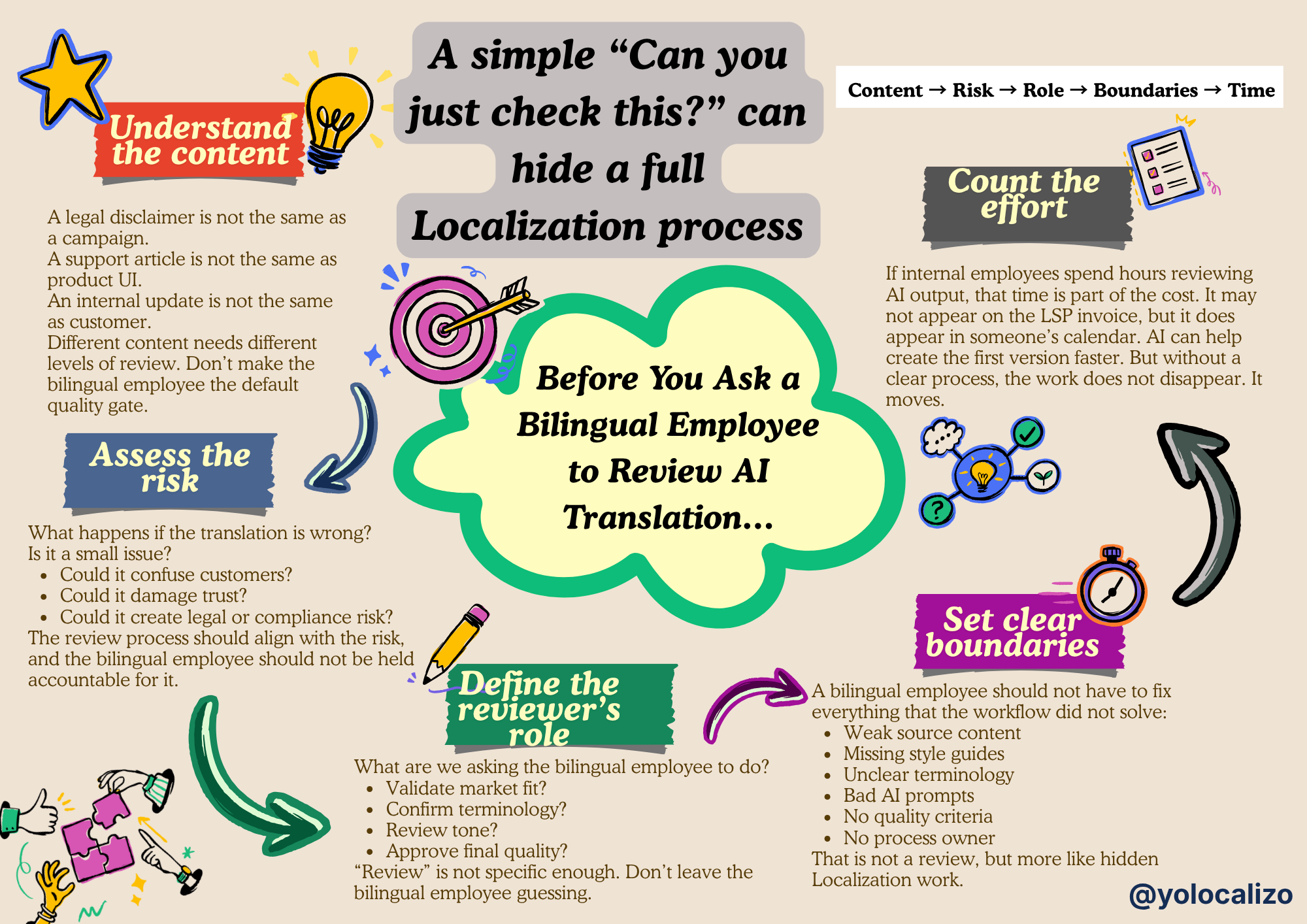
AI can help create the first translation faster, but the work does not always disappear. Sometimes it simply moves to someone else’s calendar. In this post, I reflect on the hidden cost of asking bilingual employees to review AI output without a clear process, role, or quality ownership
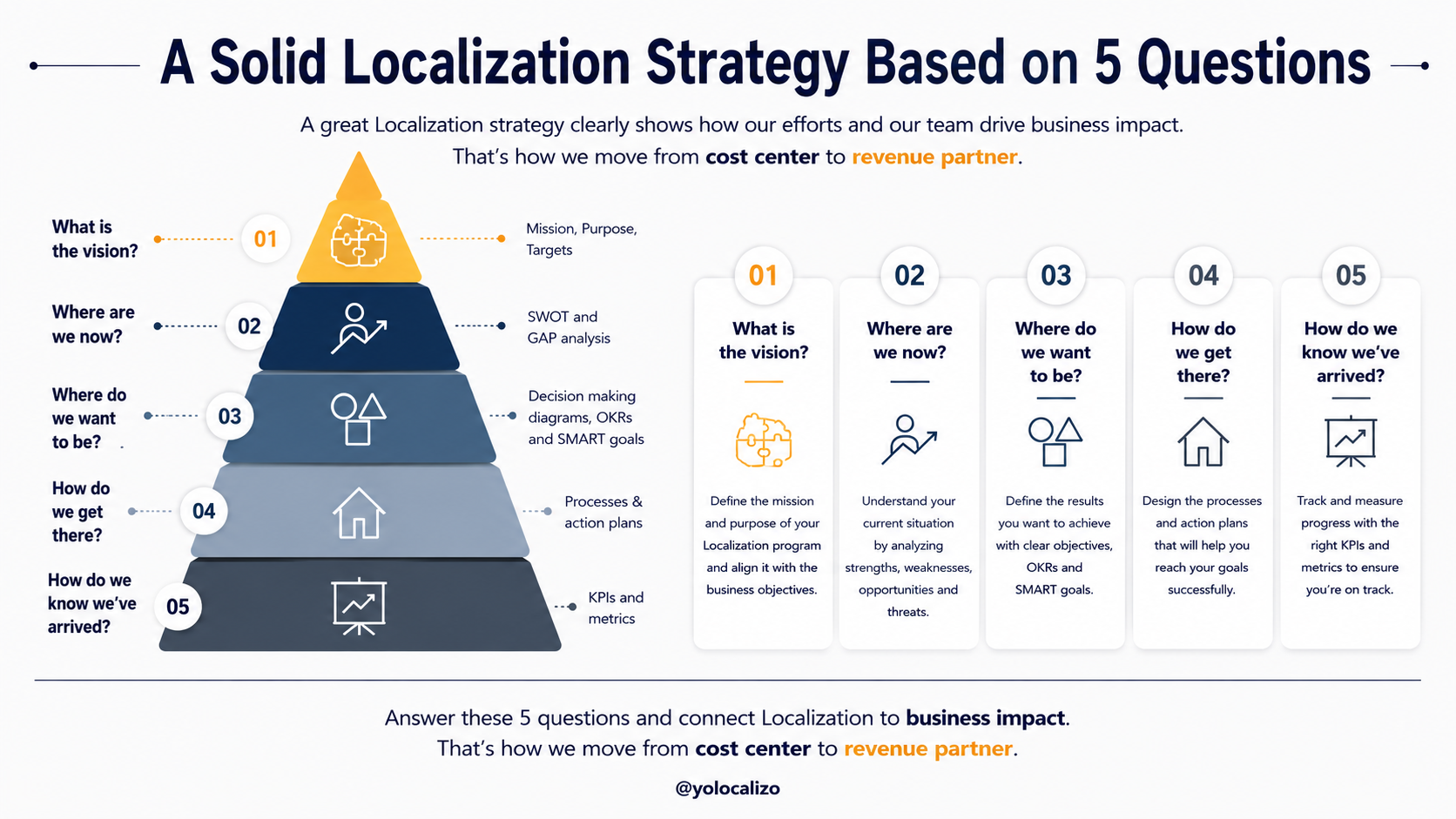
June is strategy season for many corporate teams. And for Localization, this usually means uncomfortable questions about budget, AI, workflows, markets, metrics, and business value. Before jumping into new tools or complex plans, maybe it is worth going back to the basics
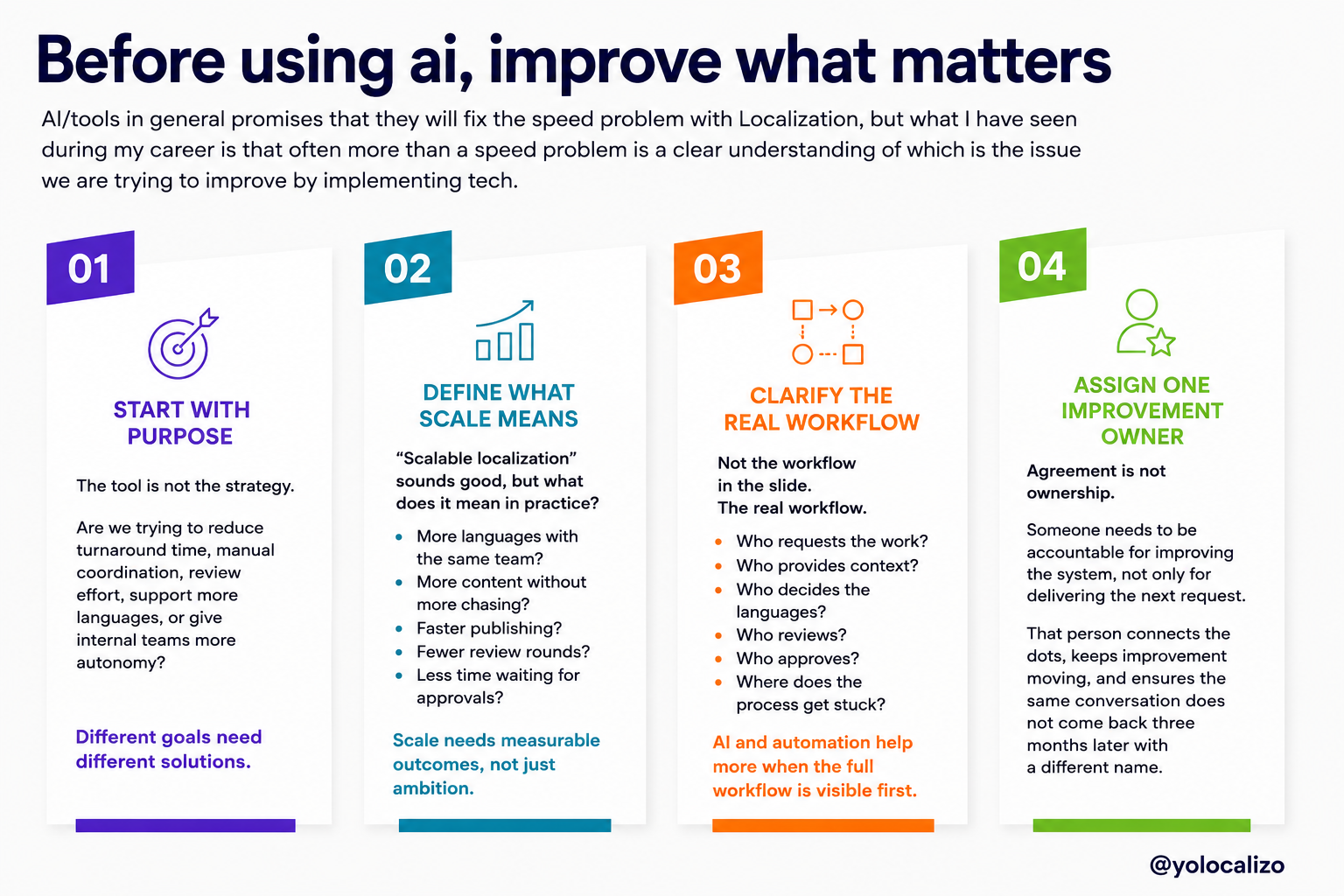
AI promises faster localization, and that message is attractive. But in many teams, the real issue is not speed. The work gets delivered. The harder question is how much hidden coordination, unclear ownership, and workflow complexity it takes to get there.

“Welcome to my blog. The space where I document my passion about Localization, Project Management and Leadership”
Doom creator John Carmack said years ago “Story in a game is like story in a porn movie: it’s expected to be there, but it’s not that important.”
This week while having tapas with a friend I had a deja-vú about John’ words ….
The world of Localization is a very multicultural industry. The professionals of this industry at some point in our lives have asked ourselves the following question: but why should I be the one who adapts to this environment? Why do not they adapt to me? :) That's what I cover this week in my post, I hope you like it!
Cultural Intelligence is like a super power that we can develop to lead teams in an effective way in this globalized world in which we live. And no, Emotional Intelligence and Cultural Intelligence is not the same. If you want to know why it is not the same, I invite you to read the post I created this week on my blog 🙂
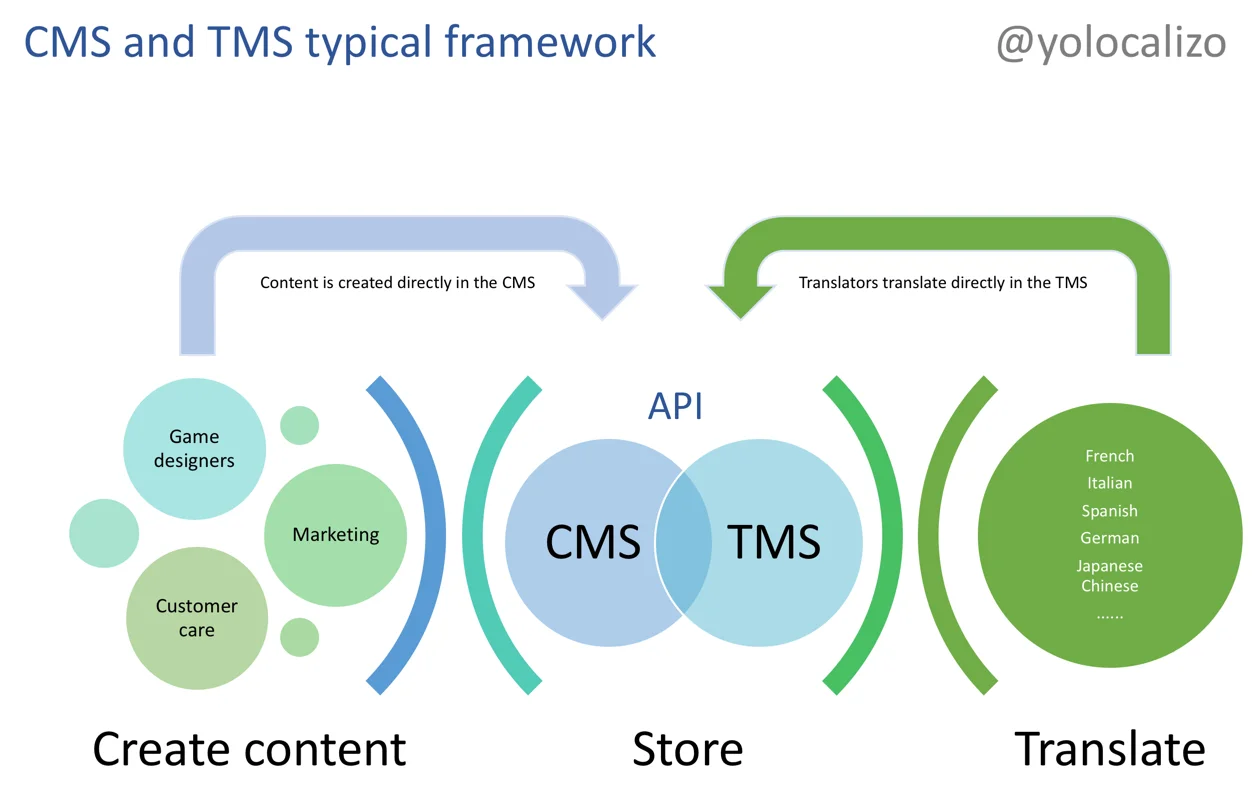
This week I finish my article on TMS and CMS, the Twins of our Translation industry. In this second part I explain the workflow and integration of a CMS and a TMS. Where the key to success lies in a bit of code that we call API ....
There are some things that look alike, but they are not much the same. Arnold and DeVito are an example of this in the movie industry in the Twins movie, and a CMS and TMS are an example in our Globalization / Localization industry. In this post I talk about cinema and what’s a CMS / TMS and why they are not twin tools :)
This week I bring a special post. It is a summary of the presentation that Maria and I gave on the fascinating topic about culture intelligence.
And why is it a special post? Well…. this post is an eBook! there are so many things that I'm passionate about the world of cultural intelligence that everything I wanted to write did not fit in a single post, so I wrote an eBook 🙂
Here you have an eBook of what I consider to be the future of management ... the cultural intelligence.
Hope you like it! Please send me your comments so we can continue the discussions around this amazing world of the CQ!
Enjoy the journey!
Miguel
The first Game Global Forum is a reality! this week in my post I talk about the first edition of this cool event and also take the opportunity to reflect on how to measure and quantify quality from a new perspective. Have a great week everyone!
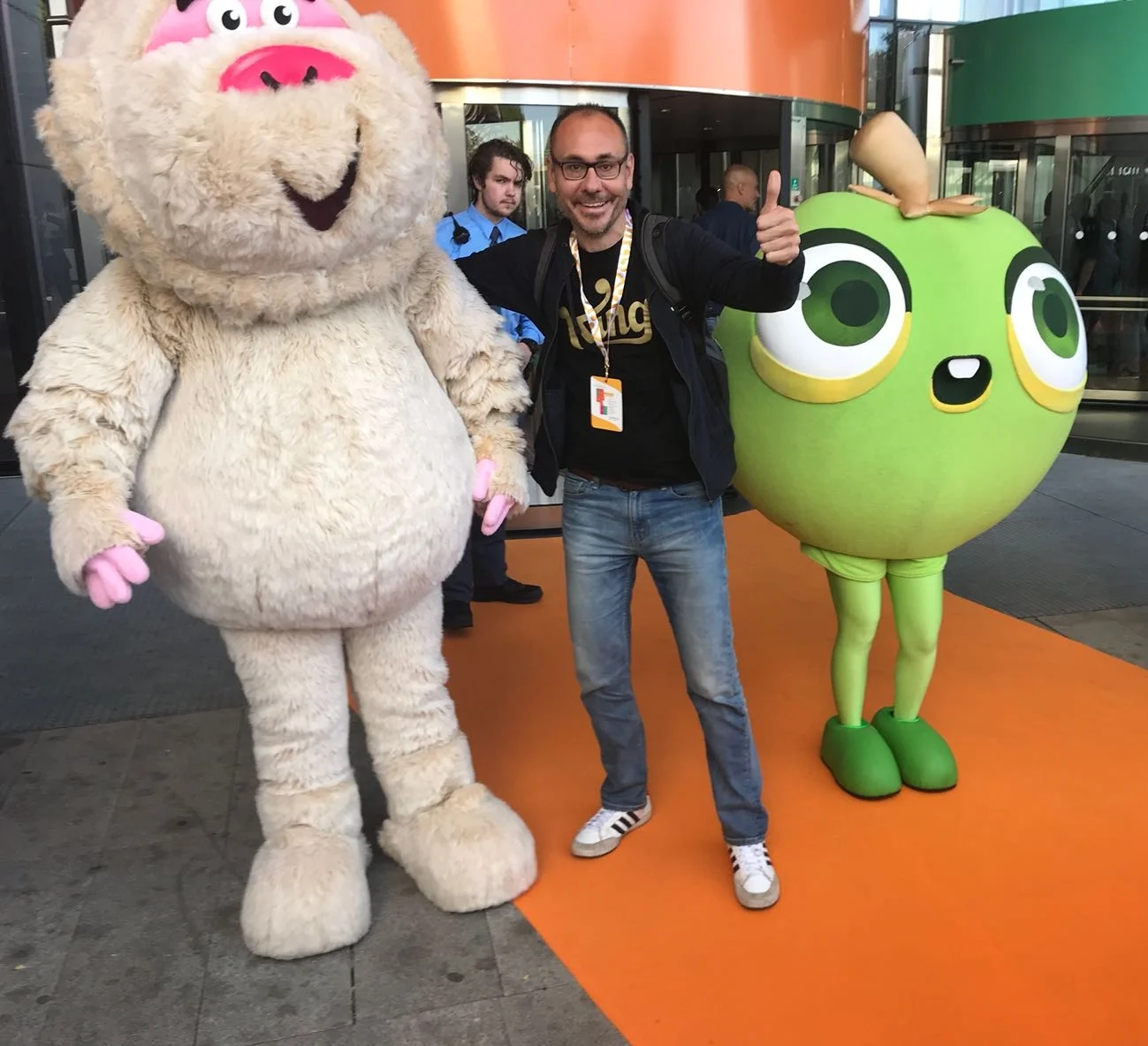
This week we had our annual event at King, a new opportunity to explain
that translating, localizing and globalizing is not the same,
that content is more than words and
that a good globalization strategy can not be an afterthought.
Globalizers of the world, localizers of the world … we are magicians! we have content in one language totally indecipherable. And with some tricks we decipher it … but there’s a saying in our industry Garbage IN, garbage OUT … so let’s see how we can keep the garbage under control …
This week I had the pleasure of being invited to give a master class on Localization in the Barcelona videogame incubator.
It was a nice afternoon ... and in my post this week I talk about it, especially on the subject of why continuous localization and agile localization are 2 different disciplines.
Do we always need an extraordinary quality of translation? Or sometimes the Good Enough approach is precisely what we need, which is Good, enough ... in this post I reflect on how to approach good enough in our localization industry ... hope you find this useful!
If we have 20 minutes to explain to a group of executives of our company the importance of Localization in the global results of the company… how do we approach this presentation?. A senior executive team probably does not care much about our glossary maintenance processes, XLIFF conversions or benefits of pseudolocalization. These executives breathe an air different from ours ... and finding a way to breathe “the same air” is vital to get Localization as an important step in the Global strategy of the company.
The Indian market with 1.3 billion inhabitants represents a unique opportunity for the video game market (and for the localization market in general!). It is a market with great potential ... but it is a complex market with 3 obstacles that deserves to be analyzed in order to better understand how a videogame can be profitable in this complex and fragmented market.
Can we still consider the quality of a translation as the only differentiating factor to have a good relationship with our LSP? I do not think so, today I want to talk about why the translation quality is not a differentiating factor anymore.
Is there any way to measure whether the good or poor quality of a translation has an impact on the perception we have about the quality of a company? Question with difficult answer, almost as difficult as finding the mythical Holy Grail 😃
When Localization teams and Dev Teams work together during the phase of game development good things happen ... join to my weekly post to know why!
Getting along with LSP is a long process but it has not to be necessary painful. Have a look to this post to get some ideas about how to on board vendors in any LOCALIZATION PROCESS.
Developing a game from scratch as an indie developer is a titanic effort, a lot of hours and quite often not enough money to outsource very necessary tasks. One of those very necessary tasks to conquer the world with our game is ... LOCALIZATION! In my weekly post this week I share some thoughts on this idea ... Can we localize our game for free? Have a look at the following post and feel free to share your comments below!
In the G-localization industry we have services that no one understands very well what they are ... but perhaps the most misunderstood service to all of them is ... Internationatilation! If you want to know more about this discipline, do not hesitate to read the post I prepared this week on my blog! Hopefully at the end of the article this service is a little more famous :)
Translation vs Transcreation which service do I really need? these 2 terms are used interchangeably but actually, these 2 services are quite different. Have a look to this post on my blog if you are unsure how these 2 translations disciplines differ frome each other .....












A multi-market expansion strategy for any product is most effective if the various Globalization (i.e.Localization, Internationalization) activities are understood as a cycle that runs parallel to the multiple phases of software development; This cycle repeats during the various product upgrades. It is not an activity that is executed as if it were a process once the home market version (usually in English) is finalized. It is not a transaction that simply sends files to a professional localizer shortly before the global release. No; Globalization is not a process. Globalization is a cycle that runs multiple times. It is a cycle that runs in parallel with the product research, design, and development phases.