


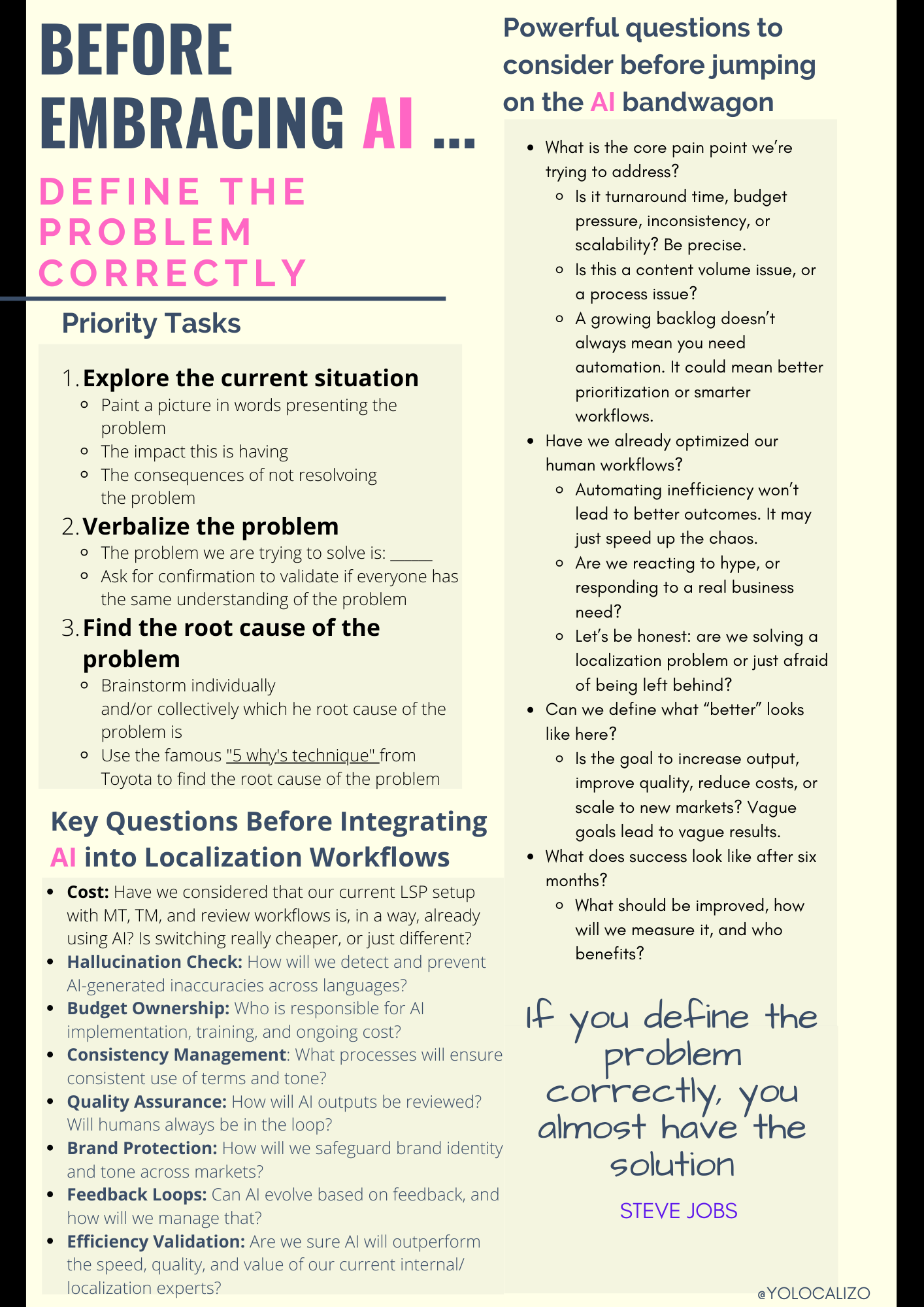
Before jumping on the AI bandwagon: What localization problem are you trying to solve? AI is everywhere right now, including in localization.
But before jumping on the bandwagon, we need to stop and ask:
Are we solving the right problem?
The world of localization is full of small, hidden details.
Some things are deeper than they seem, and I often see between in-context review and LQA in the world of Localization. They might seem the same, but if we scratch beneath the surface, we'll see they're not what they seem.
In this post, I want to focus on explaining the differences between in-context review and LQA, which is something I see being confused quite frequently, and although the tasks are similar ... they are not the same.
AI is not eliminating localization. But it is removing the illusion that execution alone is enough.
Layer 1 accuracy, delivery, quality was our playfield. Now AI scales it faster and cheaper. And when value is framed only around execution, the conversation shifts to cost and headcount.
Meanwhile, executives focus on retention and growth.
That’s Layer 2 cultural impact.
In the age of AI, localization must operate in both.
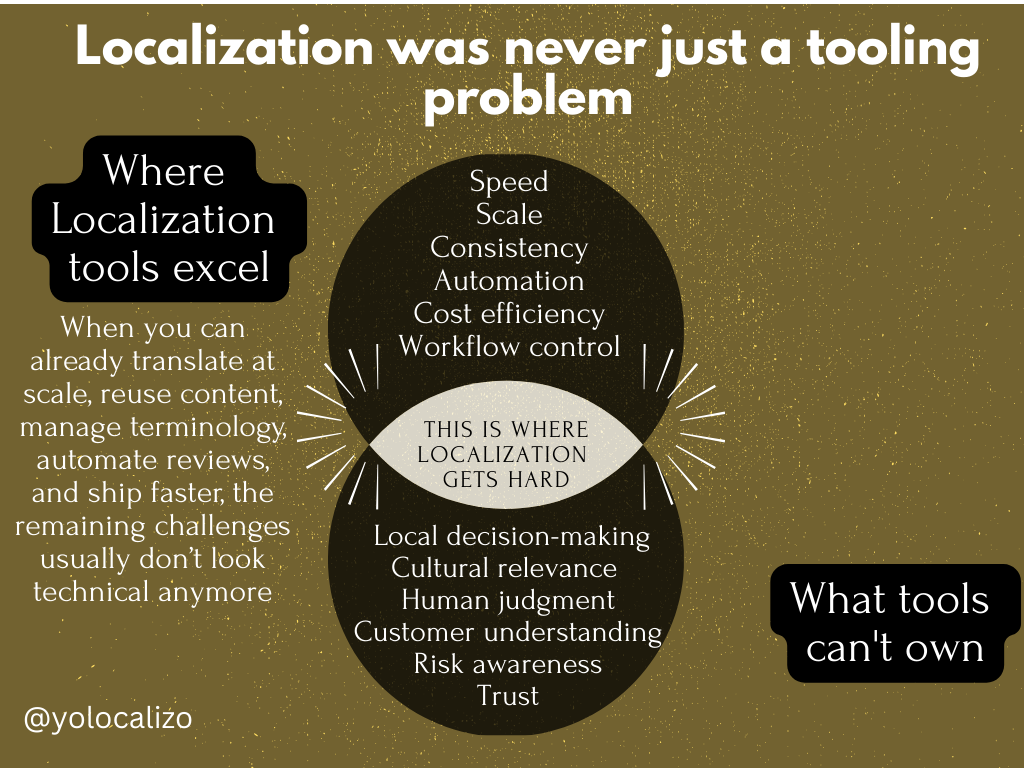
You need a solid localization tech stack before you can build a global digital product. Tools that help manage content, automate workflows, ensure consistency, handle volume, control quality, and scale across languages are essential. Without them, everything becomes slower, more expensive, and harder to manage. Today, we have great tools to support all of this. And yet, despite all these changes, something fundamental hasn’t changed in the ingredients that define good localization.
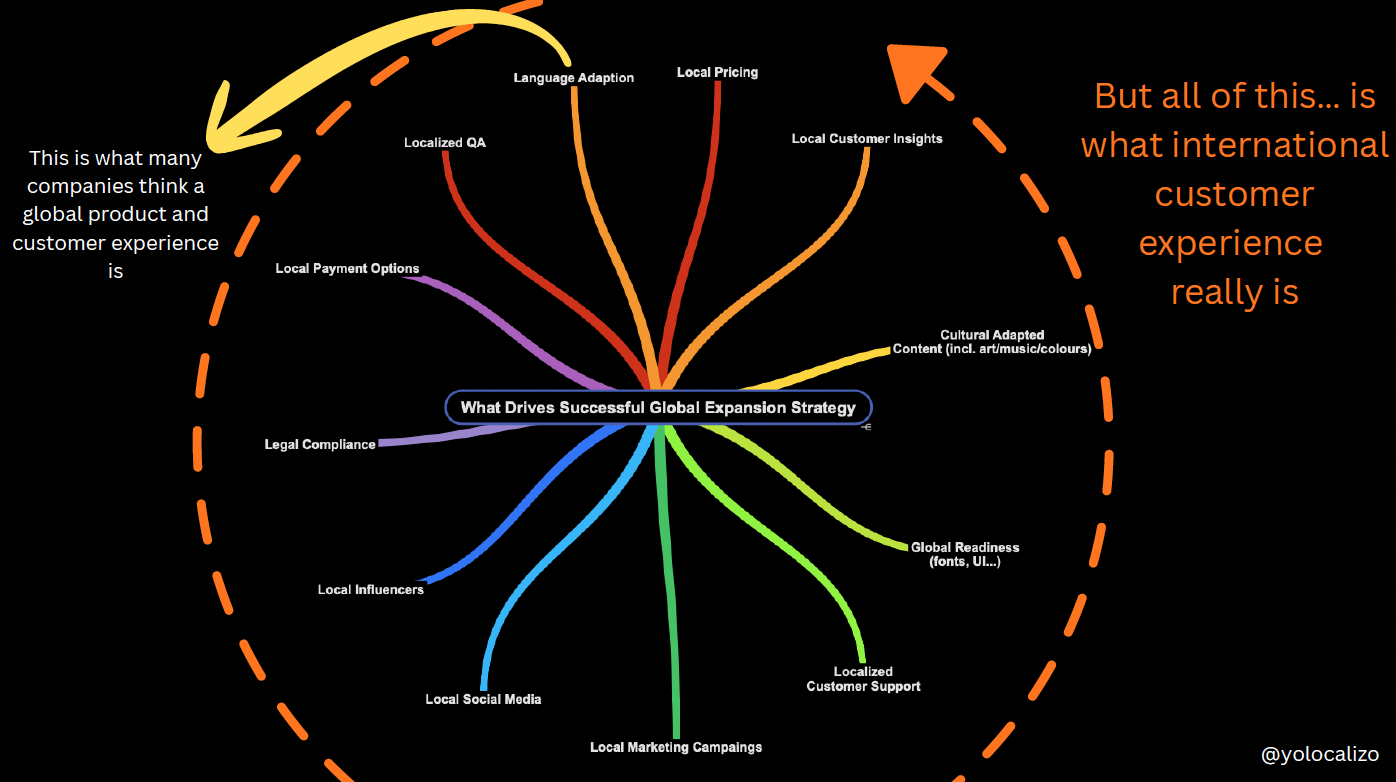
Outside the circles of localization and globalization, translation is still seen as the step to go global. As if adapting the language automatically creates a global product. As if users in new markets will suddenly feel at home just because the words are no longer in English. In reality, that’s rarely how it works. Users don’t experience products in pieces. They experience prices, payments, support, content, and expectations all at once. Adapting the language is an important start. Still, users experience the product as a whole. If only the words change, they will naturally notice the parts that didn’t.
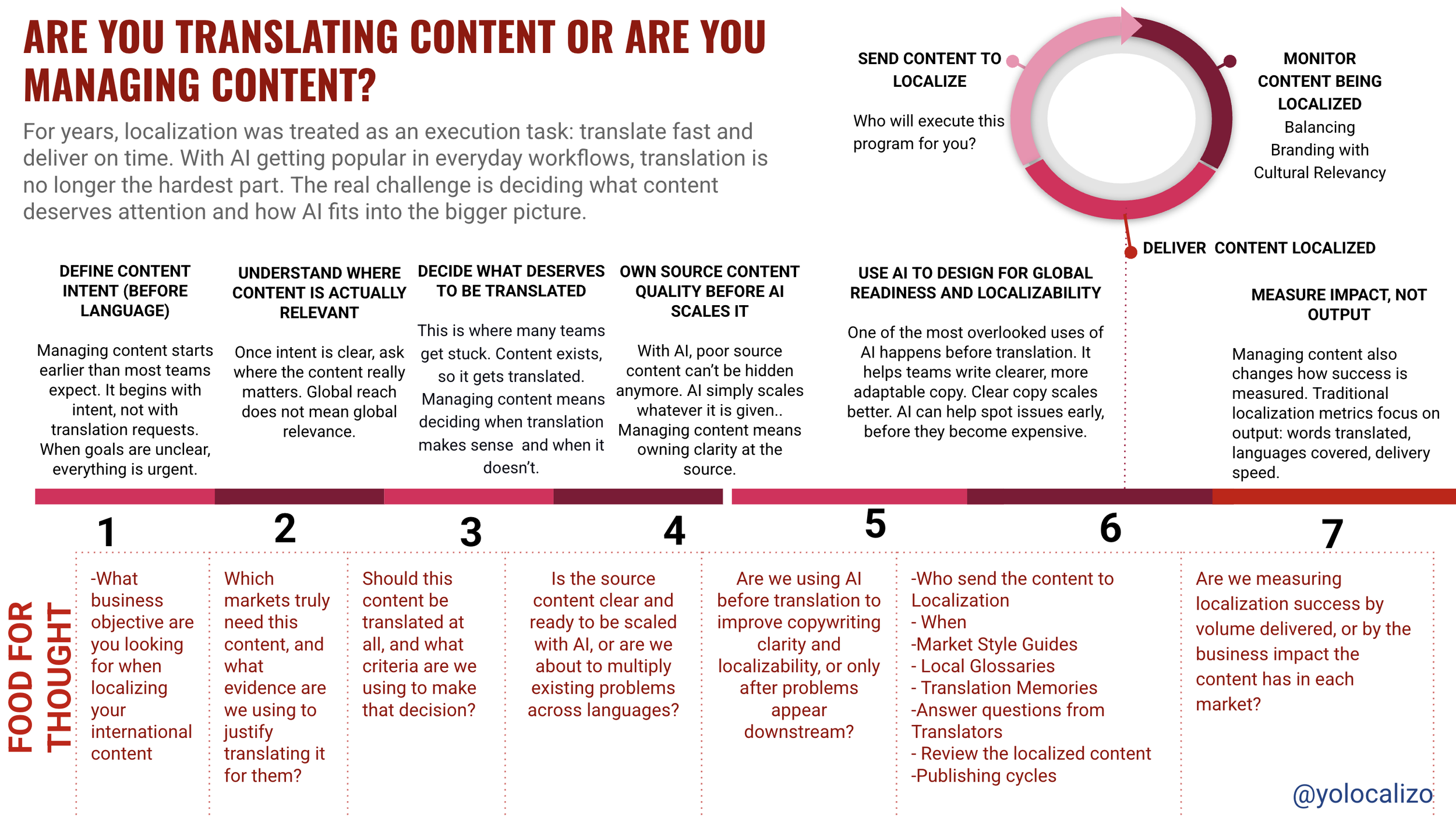
For a long time, localization was treated as a pure execution task: translate fast, deliver on time, and stay invisible. That model worked when content volumes were lower and speed was the main challenge. As AI becomes part of everyday workflows, this approach is no longer enough. Translation itself is not the hardest part anymore. The real challenge is deciding what content deserves attention and how AI fits into the broader content ecosystem. This shift highlights a deeper change: moving from simply translating content to actively managing it.
Localization professionals often focus on translation quality and best practices, but decision-makers care about customer impact and revenue. If we frame localization as a cost, it risks being deprioritized. Instead, we must highlight its value driving engagement, trust, and business growth.
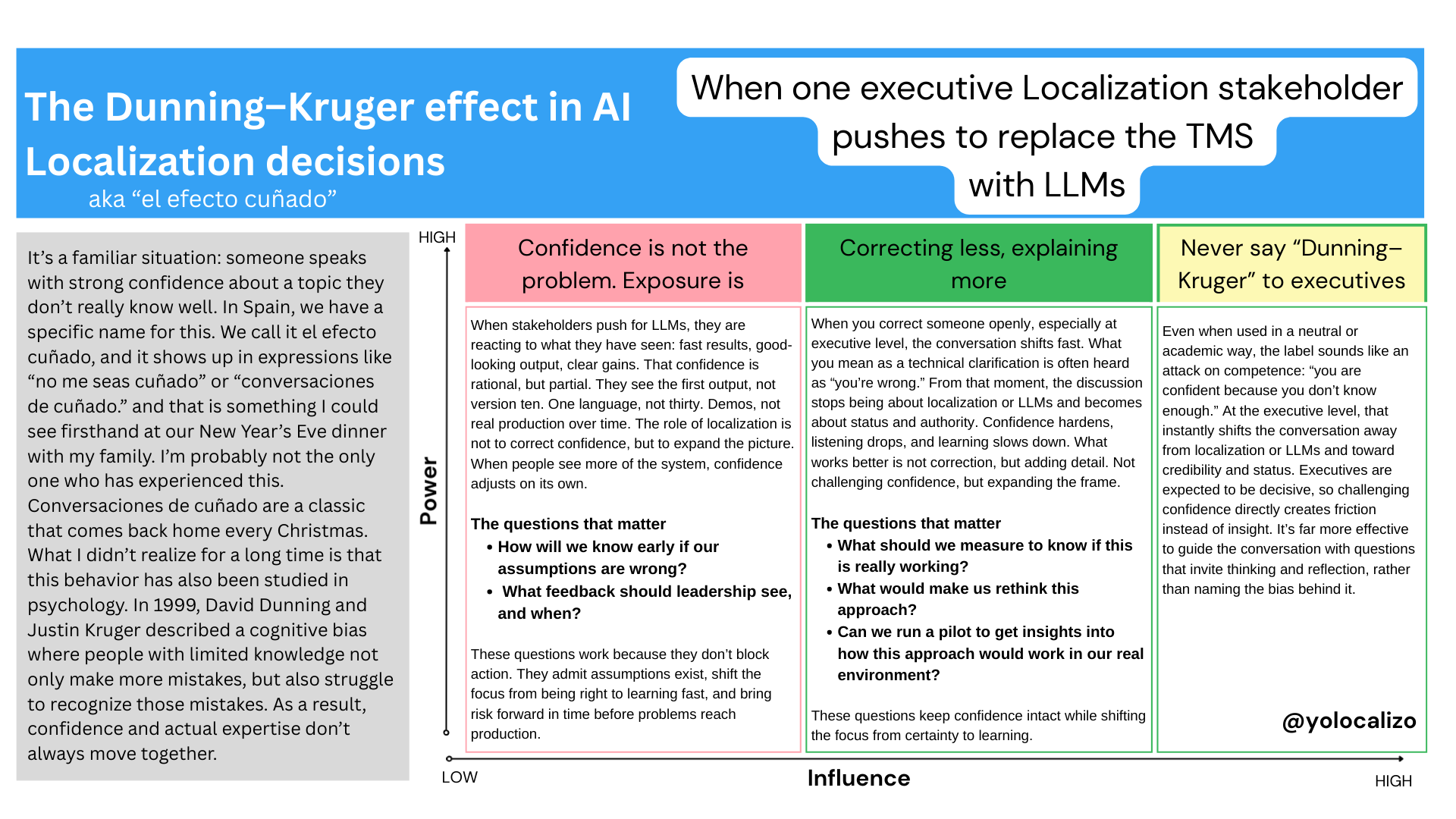
At a New Year’s Eve dinner with my family, I saw a familiar situation play out: someone speaking with strong confidence about something they only partly understood. In Spain, we call this el efecto cuñado. What I didn’t realize for a long time is that this behavior has a name in psychology too. It’s the Dunning–Kruger effect, and it shows up just as often in localization and AI conversations as it does at Christmas dinner tables.
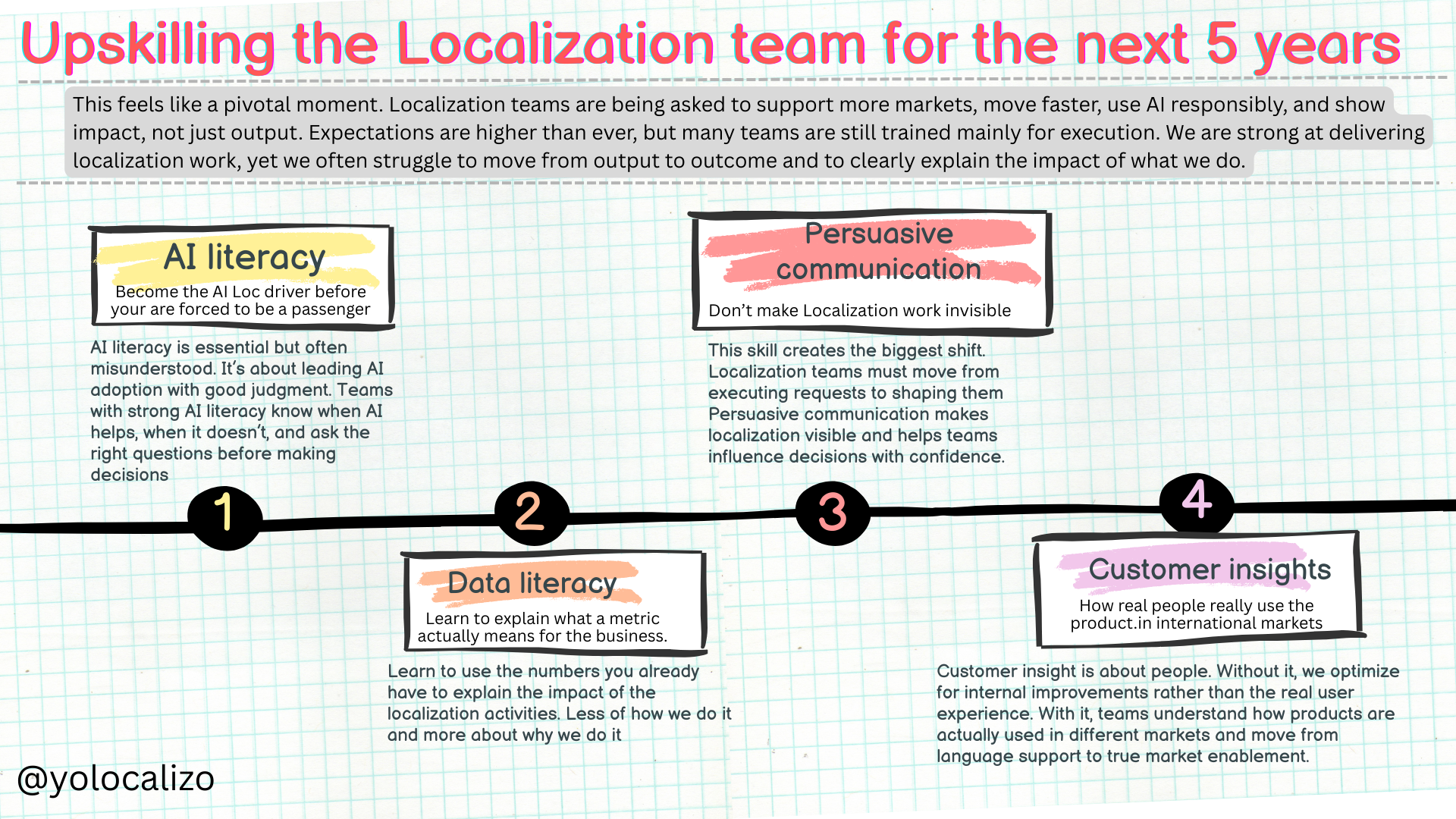
This feels like a pivotal moment. Localization teams are being asked to support more markets, move faster, use AI responsibly, and show impact, not just output. Expectations are higher than ever, but many teams are still trained mainly for execution. We are strong at delivering localization work, yet we often struggle to move from output to outcome and to clearly explain the impact of what we do.
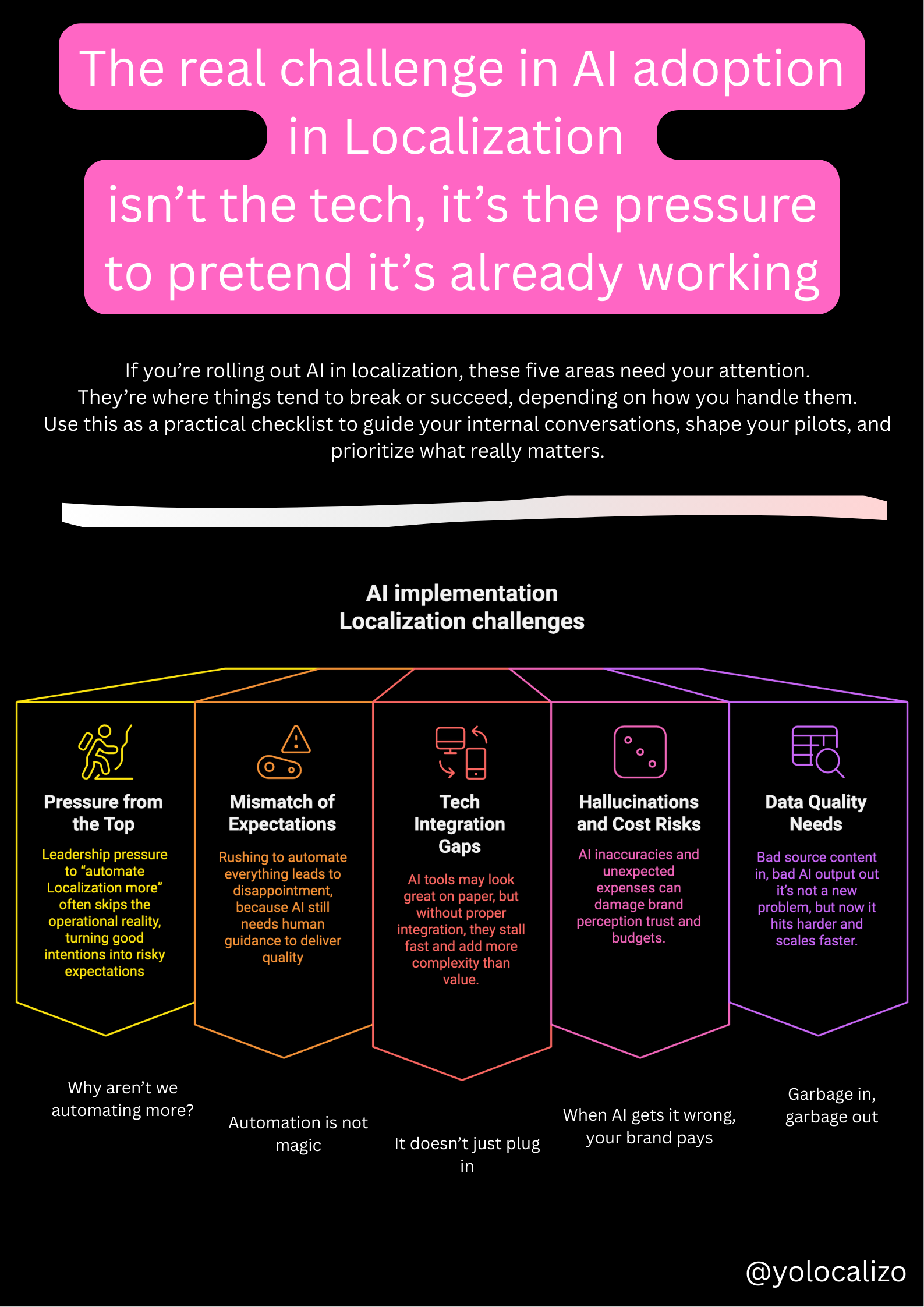
AI isn’t just changing tools, it’s changing expectations
Three years into working with AI in localization, I’ve seen the pressure build: automate faster, scale more, do it now.
But the real challenge isn’t the tech itself. It’s the gap between hype and reality , and what happens when teams are expected to act like everything’s already working.
In this post, I break down five common challenges that keep showing up, and what we can actually do about them.

“Welcome to my blog. The space where I document my passion about Localization, Project Management and Leadership”
Before jumping on the AI bandwagon: What localization problem are you trying to solve? AI is everywhere right now, including in localization.
But before jumping on the bandwagon, we need to stop and ask:
Are we solving the right problem?
Localizability has always been a challenge small issues in source content often lead to big problems later in translation. In this post, I explore how AI is giving localization teams a powerful new way to improve source quality, reduce friction, and create better content for every market right from the start.
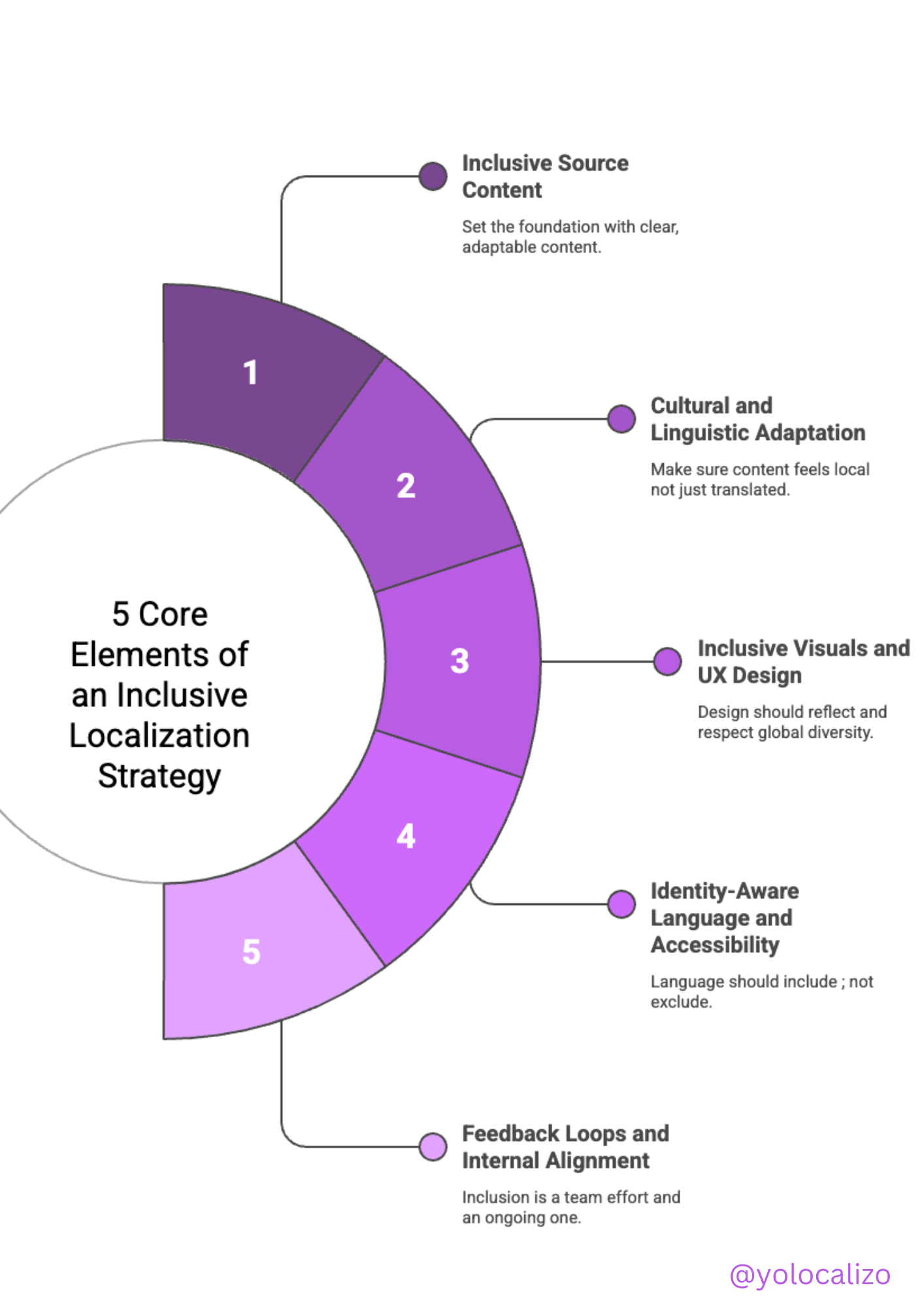
What if inclusive localization isn’t just the right thing to do but also the smartest way to break free from outdated pricing models? In this post, I explore the core elements of an inclusive localization strategy and why it might be the key to escaping the trap of price-per-word thinking.
We all talk about the importance of localization metrics, but where do you actually get them?
This question hit me hard during a recent panel, and it made me realize something I had been overlooking.
If you’ve ever struggled to find the right data to prove localization’s value, this post is for you.
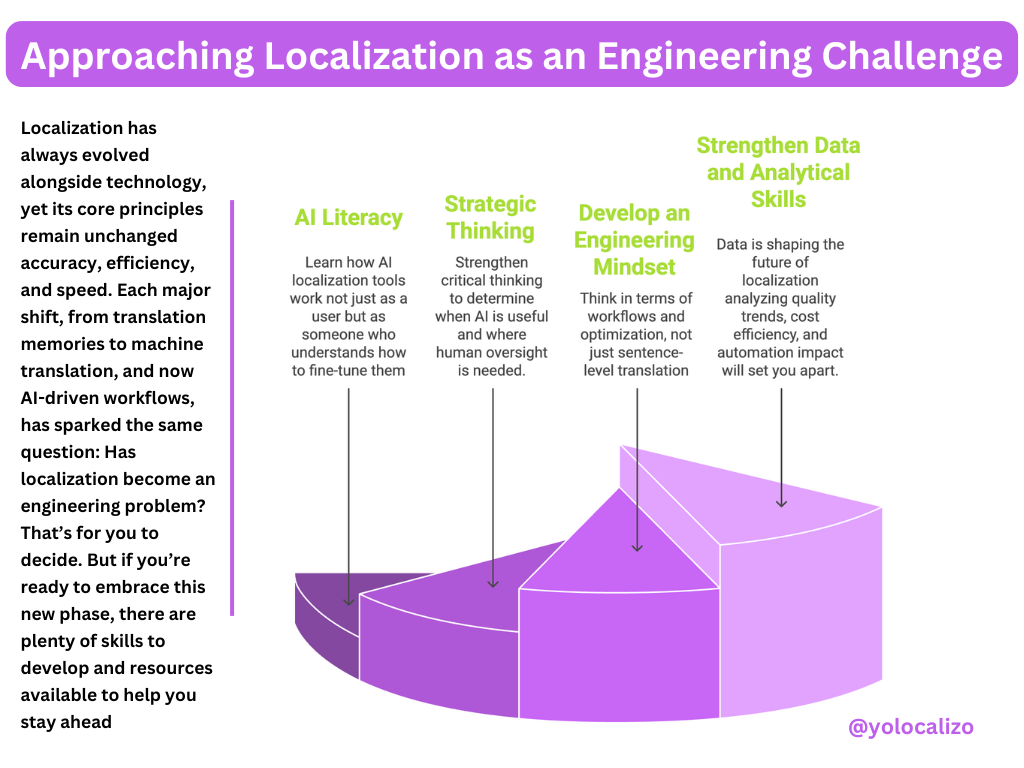
Localization has always evolved alongside technology, yet its core principles remain unchanged accuracy, efficiency, and speed. Each major shift, from translation memories to machine translation, and now AI-driven workflows, has sparked the same question: Has localization become an engineering problem? That’s for you to decide. But if you’re ready to embrace this new phase, there are plenty of skills to develop and resources available to help you stay ahead
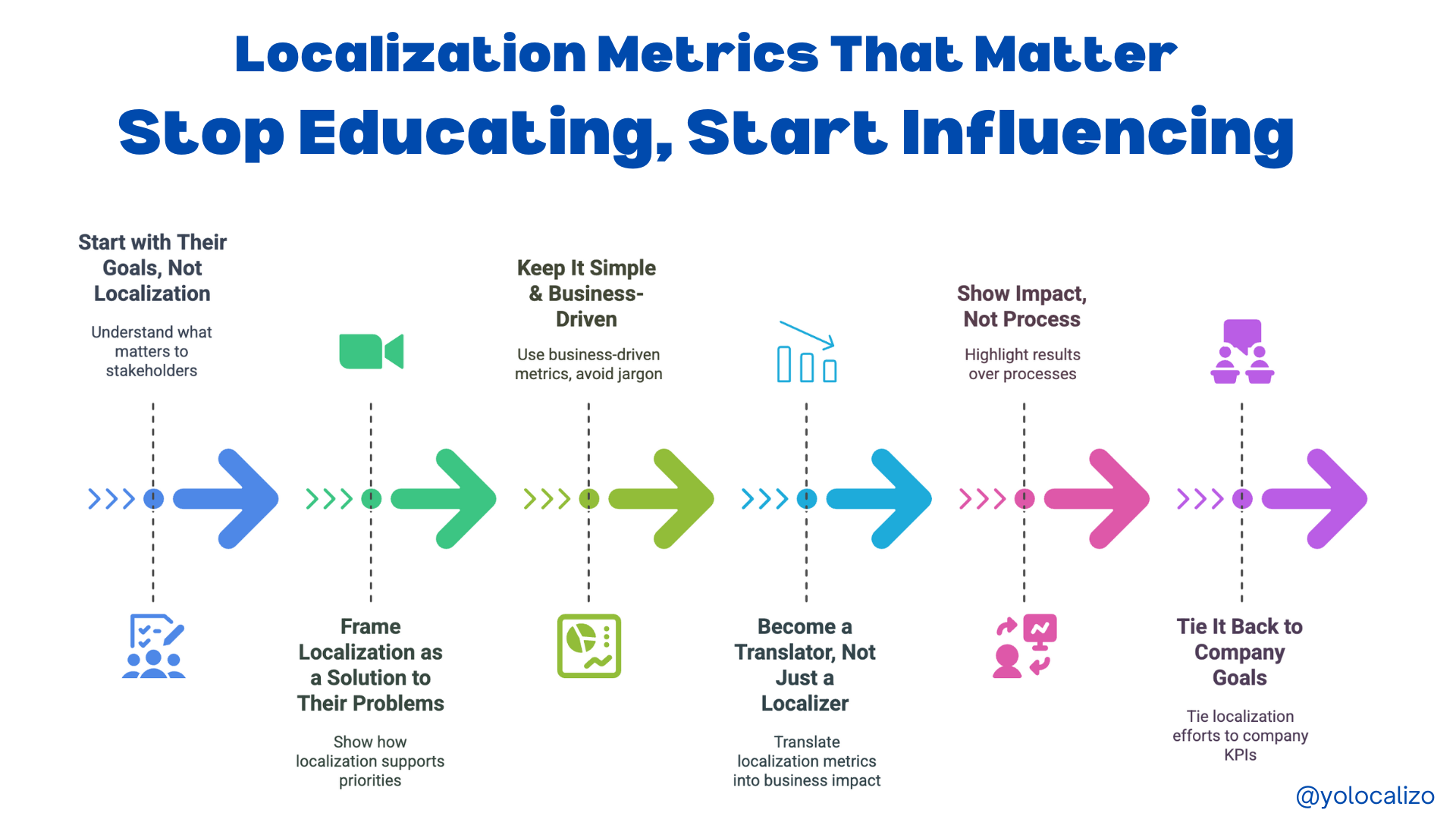
Certain words in business settings push all my buttons: 'synergies,' 'strategic meetings,' and 'thought leadership.'
The worst offender? Synergy. Lately, though, another term has been creeping up my list: 'educated.' In localization, we often say, 'We need to educate stakeholders.' But do they really want to be educated? No, they want to understand how localization impacts them.
Instead of teaching, we need to translate localization into business value.
Be Careful What You Wish For.
Getting buy-in for localization feels like a big win, until the requests start piling up and it’s impossible to keep up. More teams want your help, more content needs translation, and suddenly, you’re overwhelmed. In this post, I share my experience and the signs that show it’s time to grow your localization team
With tools like LLMs and GPT, we’re at a turning point, and staying curious, planning carefully, and aligning efforts are key. Missing any crucial element could hinder progress. A "slow and steady" approach is essential to navigate the AI wave.
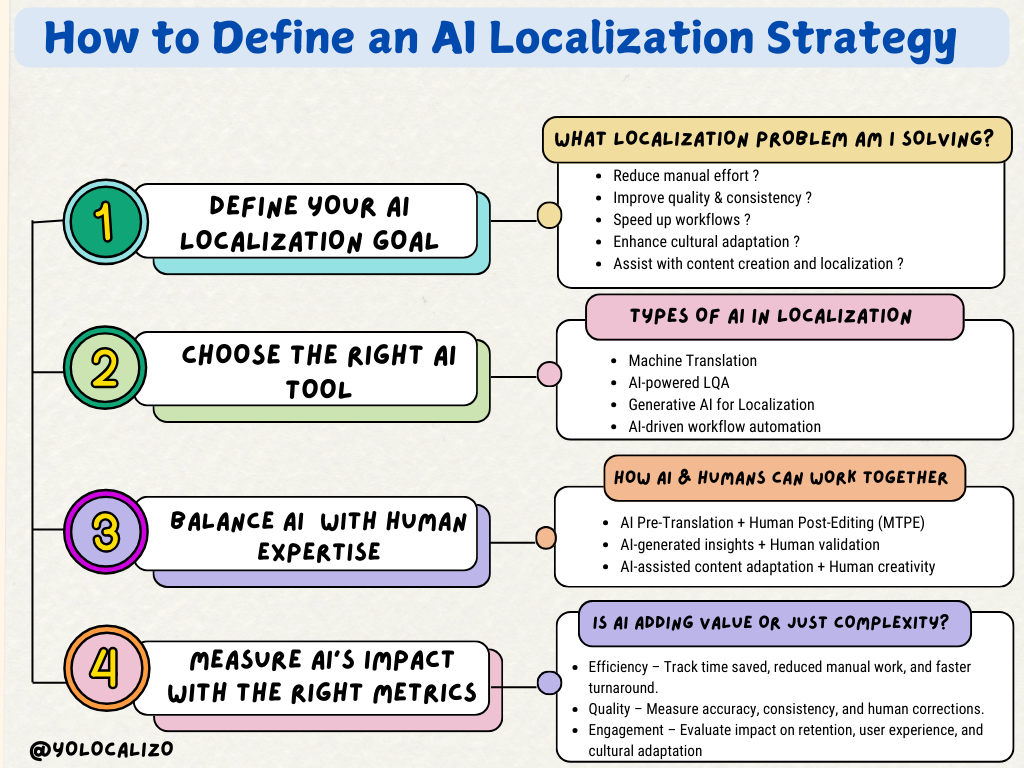
AI is everywhere, and localization teams feel the pressure to "do something with AI." However, without a clear strategy, AI adoption can become an expensive distraction rather than a real value driver. In this post, I explain how to define an AI localization strategy that enhances efficiency, improves quality, and delivers real business impact without just following the hype.
Localization professionals often focus on translation quality and best practices, but decision-makers care about customer impact and revenue. If we frame localization as a cost, it risks being deprioritized. Instead, we must highlight its value driving engagement, trust, and business growth.
Usually, when we want to improve something in our Localization strategy, we first set an ambitious goal. From there, we design a strategy to reach it as quickly as possible. If we don't see rapid changes, we feel like we're not improving. To break this cycle, we can try changing the way we set goals—smaller, but consistent objectives that, when we look back, show us that we are indeed making progress. This progress can be the driving force for us every week, every month, every year.
Here are some ideas on how we could apply this Kaizen methodology in the Localization world.
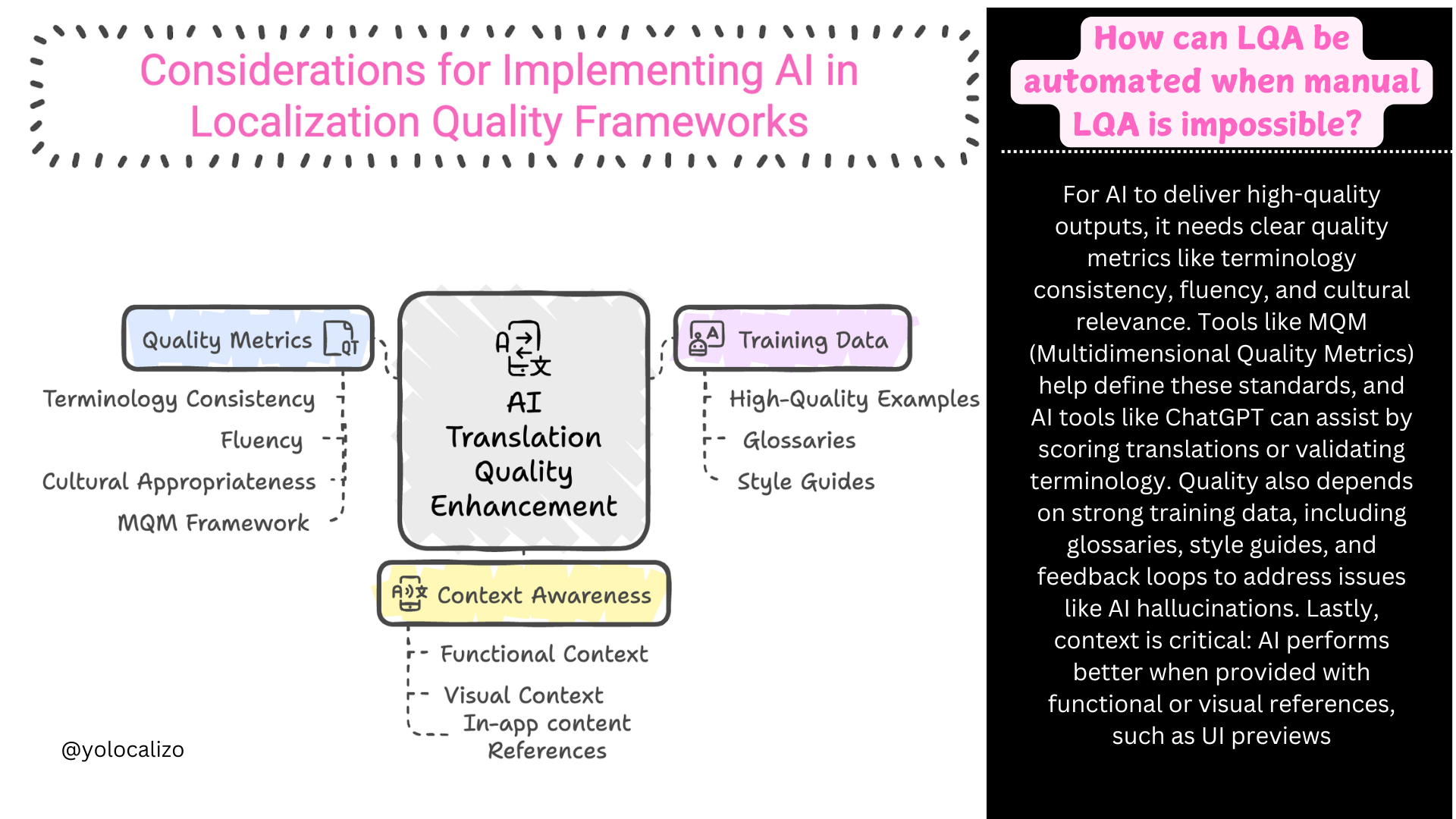
This blog explores how AI-driven post-editing frameworks, like ChatGPT, can redefine localization quality assurance by providing automated checks, real-time feedback, and prioritization of critical issues. If manual LQA feels impossible in your environment, this post will help you explore actionable AI solutions to bridge the gap.
"The Localization Accountability Ladder" explains how to go from avoiding responsibility to becoming a leader in localization. The blog covers seven simple steps, showing key behaviors, skills, and tasks to help teams improve.
Working with a coach has helped me see the bigger picture, stay focused, and find balance as a leader. I’ve discovered strengths I didn’t fully appreciate, faced blind spots I used to avoid, and learned how to manage stress while staying (kind of) on track with my goals. This post covers all that!
Transitioning from one job to another can be an enriching experience, or it can be a nightmare.
I have detected in my different movements, and after seeing many colleagues making transitions, that there are a series of usually effective tips.
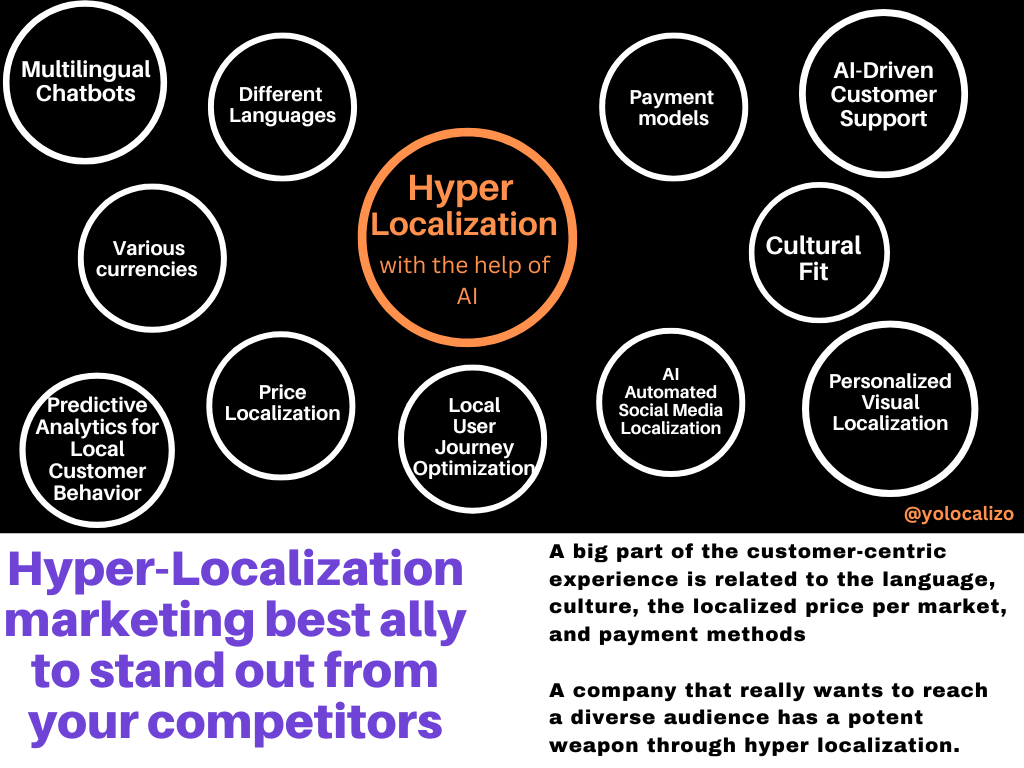
When it comes to offering a customer-centric experience, language, culture, localized pricing, and payment options play a crucial role. Companies aiming to reach a diverse audience can leverage hyper localization as a powerful tool.
Localization is often seen as an afterthought, focused on translating content late in the process. This post looks at how Globalization teams can step in earlier by identifying invisible tasks and using AI tools like to influence decissions from product teams to create products designed for global audiences. It’s about rethinking localization as a strategic partner instead of a support function
In this blog post, I imagine three roles that could become as popular as the Social Media Manager did: AI Workflow Localization Manager, Localization Data Curator and AI Localization Quality Specialist
These roles blend human expertise with AI, pointing to a future where localization jobs look very different from today.
In this post, I discuss the key indicators that suggest it's time to hire an International Localization Product Manager. Understanding when to bring this role into our team is essential for successfully navigating global markets and securing sustained international growth.
This post explores the key differences between working on the buyer versus the provider side of the localization industry. While there are some tasks common to both, others vary significantly in areas such as people management, operations, strategy, and metrics. The article breaks these tasks into four categories, providing examples for each to highlight these distinctions









AI will not eliminate (initially) localization roles, but it is reducing the time spent on certain tasks. What once took hours can now take minutes. That creates capacity.We can treat that time as a cost savings or reinvest it. If nothing meaningful replaces it, the value of the role will eventually be called into question.Jobs do not disappear because tasks are automated. They disappear when the value is not redefined.
So the real question is: what can you do now with the time AI gives you that wasn't possible before?