



The 'good enough' dilemma in Localization
Over the last two weeks, I’ve seen the “good enough” discusison come up again in the work we do as Localization professionals. I’ve heard it at events I’ve attended, and I’ve seen it in the comments on LinkedIn threads. “Good enough” basically means that, as Localization professionals, we don’t always have to deliver a perfect translation. Sometimes, a translation that does what the client and the user need is good enough. In other industries, this is often called “fit for purpose.”
“Good enough” is just that. It means understanding what the client wants, what the user needs, and what level of quality will meet those expectations. If we lose sight of that, it can create friction with our clients and with the stakeholders who work with our internal Localization teams. And I think it’s fairly easy to see where that friction comes from.
For many translators, translation is a calling. They love words, and they grew up in the good company of literary works and translations that we could easily call works of art. It’s translation as an art form. Many translators chose to study translation because they were drawn to the magic of words and to the way a translation can bridge a language gap. Without it, something would be lost in translation (pun intended). For a translator like that, every word matters, every metaphor has value, and every turn of phrase brings clarity to the text. Then you put that next to an LLM that basically looks at the words that came before and predicts which word is most likely to come next. And for them, in a way, it feels almost like an act of sacrilege against the craft of writing.Boring, predictable content. Empty, soulless, with none of the magic… But does every translation have to be a work of art? Not everyone values art. We may agree or disagree with that, but it’s the reality.
I can understand why someone might see that as an insult to the art of translation. When you’ve built your career around finding just the right words, I can understand why hearing “good enough” might feel like an insult to your craft. And that’s usually when someone says, “I’m tired of hearing about ‘good enough.’ As professionals in this industry, we should aim for excellence.”
Say that in the right room and people will nod and applaud. Say the same thing in the wrong room and you’ll see raised eyebrows and a few puzzled looks.
In this post, I want to focus on that second scenario. What happens when we don’t want good enough, but our stakeholders and our clients want exactly that? They want a translation that’s reasonably good, that people can understand, and that they can get quickly at a price they’re happy to pay.
Not everyone wants an €18 burger made with beef aged for 12 months. Some people are perfectly happy eating a €4 burger. Not everyone wants a €3 loaf of sourdough bread. For some people, a 60-cent loaf from the shop around the corner does the job just fine. And in our translation industry, the idea is much the same. The problem comes when we don’t want to accept that reality, or when we even make that refusal part of our personal brand, part of our identity
I’ve spoken to translators who take pride in saying they never, or almost never, use AI in their work. They see themselves as the resistance. They’re proud of their craft, translation is their passion, and good enough will never be good enough for them. I understand the appeal of that mindset. There’s something almost romantic about that love for the craft. But I think that today, this mindset does more harm than good.
When a client or stakeholder needs a translation quickly, “good enough” may be exactly what they want. If we tell them we’re tired of hearing that phrase and insist on doing everything exceptionally well, every single time, they may decide to go their own way. And these days, with a translation just a prompt away, that’s a pretty tempting option.
I talked about this in my previous post, What can Localization learn from about 20 years of shadow IT?
In that post, I shared three ideas for how to avoid a situation where a team quickly puts together its own translation solution, one that seems to work and runs alongside ours. Let’s remember how easy it is to believe an LLM’s answer when it sounds convincing, even if it’s wrong. Ask ChatGPT a complex question about maths, chemistry or philosophy, and it’ll give you an answer that looks impressive and sounds right. You look at it and think, “OK, this looks good,” and you move on.
With translation, it’s much the same. Ask it to translate something from English into Italian and you’ll get a translation that looks good and seems good enough. And that’s the danger. Stakeholders can bypass a Localization professional or an entire internal Localization team by using an LLM, and we don’t even know it’s happening.
So what do we do?
At this point, you might be thinking, “Well, Miguel, the picture you’re painting is pretty bleak. How do we stay relevant in this scenario of mediocrity you’re describing?”
Click HERE to download the graphic
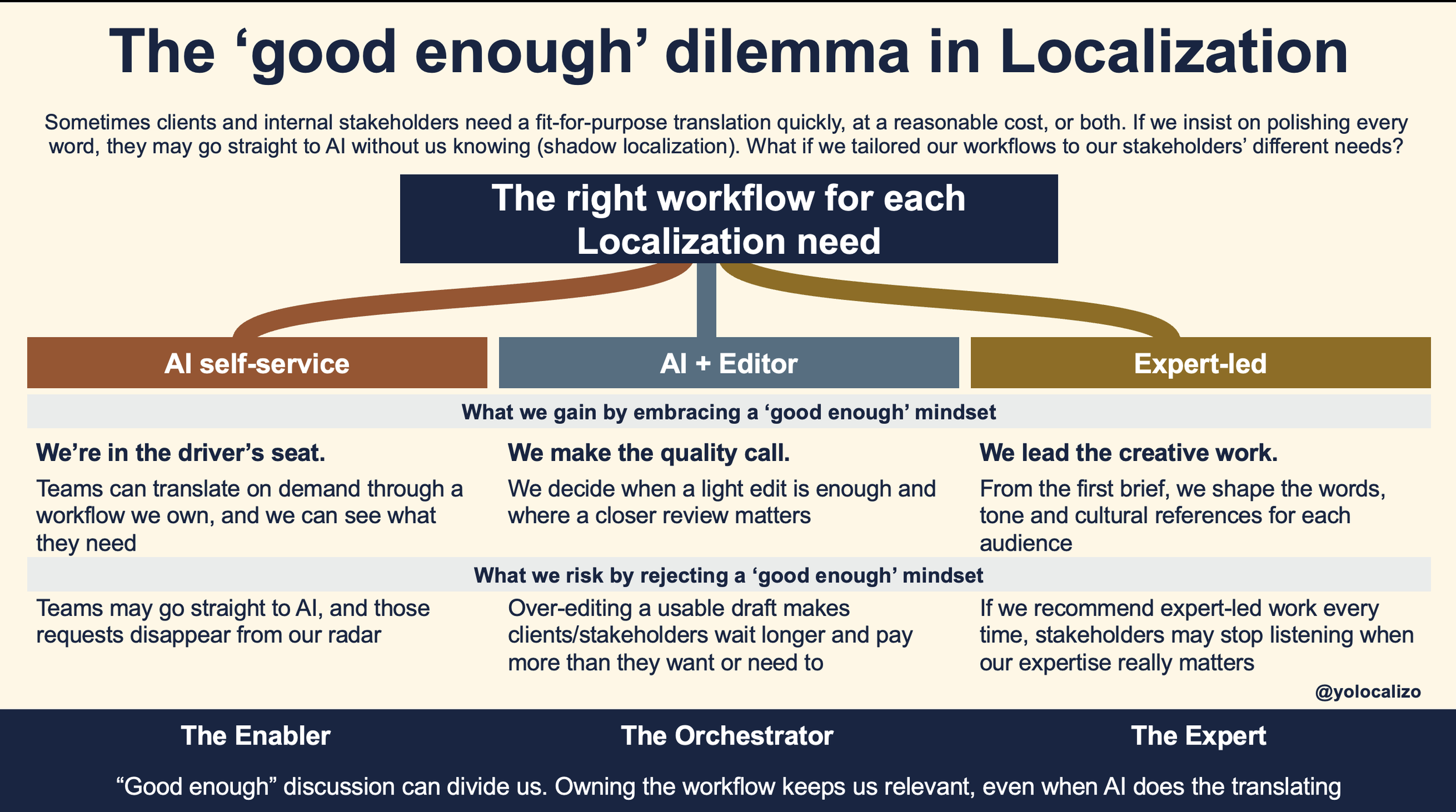
Well, my first piece of advice is to change our mindset and really take on board that, in many cases, good enough is indeed enough. And our job is to make sure that good enough actually is good enough. We can keep playing the resistance and putting obstacles in the way of AI in translation, or we can learn how to build a workflow where the LLM delivers the quality the client needs, and the client gets their translation faster and at a lower cost than with a traditional translation model.
We give stakeholders a way to run their own translations quickly with an LLM, under our supervision. We can see what they’re doing and what they need. We might have our reservations about this fast-food approach to translation, but at least our stakeholders aren’t going around us while we have no idea what they’re doing. Helping others use AI for translation gives us visibility and some degree of control over the company’s content strategy.
That would be the first step. The second goes hand in hand with it, which is why I don’t quite understand why conversations about good enough suddenly stop there and we end up in two camps. Good enough lovers. Good enough haters.
Some people will want to go a step beyond good enough. For them, we can define workflows that deliver a higher level of quality. That might mean AI with human expert post-editing, or it might mean a more traditional approach where a translator does the translation. It’s similar to what some software apps and services do with their service tiers. You have gold, silver, and bronze.
Gold would be the favorite of the good-enough haters. This is where we work with clients and stakeholders for whom quality matters most. Silver is a hybrid. And bronze is for those who see translation as more of a commodity. They want something translated reasonably quickly, to a decent standard, and at a price they can live with.
Final thoughts
For some people in Localization, offering a bronze service or helping stakeholders run their own AI translations can feel like a defeat. I see it differently. Whether you’re a translator or work in another Localization role, in-house or at a language service provider, helping people get the translation they need is part of the value we bring.
For me, the real defeat is when stakeholders stop coming to us because they’ve found an easier way to get what they need. And from their point of view, why go through a long process and pay more for a translation when they don’t need that level of quality in the first place?
The good enough debate can do more harm than it might seem at first glance. Accepting good enough, even embracing it, can feel like admitting defeat. The “machines” have won.
But there’s another way to look at it. Different clients and different types of content need different levels of quality. And in those cases where quality isn’t the top priority, we can still play an important role. We’re the ones who make it possible for others to get the translation they need. Even when someone else runs the translation, that still gives us a place in the driver’s seat when it comes to a company AI content Localization strategy.
And while that might not be enough for some people, I think it’s the right way for us to stay relevant as AI continues to change so many corners of our lives.
@yolocalizo
When you’ve built a career around finding just the right words, “good enough” can be hard to hear. But what happens when that’s exactly what a client or an internal stakeholder needs? With a translation just a prompt away, they may go straight to AI. What if we in Localization made it just as easy to come to us?